Seated Dumbbell Calf Raise
Isolation exercise, Free weightsOverview
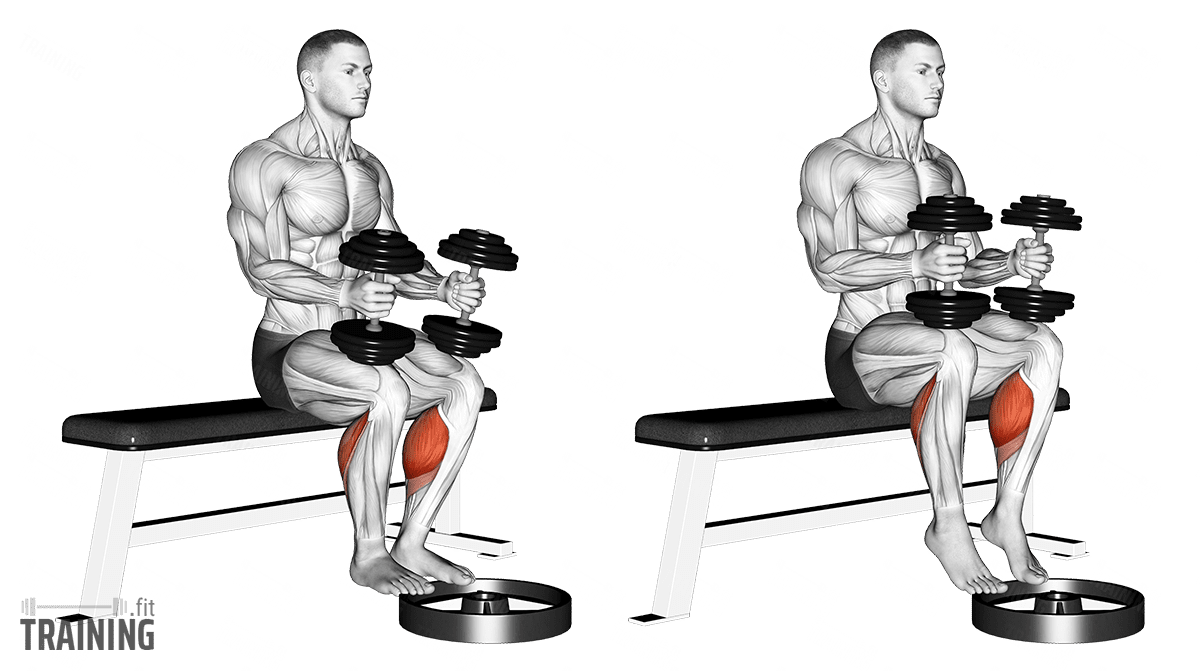
Main muscles
- Lower leg: Short fibula muscle
(Musculus peroneus brevis) - Lower leg: Long big toe flexor
(Musculus flexor hallucis longus) - Lower leg: Long fibular muscle
(Musculus fibularis longus) - Lower leg: Long toe extensor
(Musculus extensor digitorum longus) - Lower leg: Soleus muscle
(Musculus soleus) - Lower leg: Anterior tibial muscle
(Musculus tibialis anterior) - Lower leg: Twin calf muscle
(Musculus gastrocnemius)
Workout plan
Here you can find example plans for seated dumbbell calf raise training:
Seated Dumbbell Calf Raise: Basics and alternatives

Involved main muscle groups:
Seated Dumbbell Calf Raise
The seated dumbbell calf raise is a targeted exercise for strengthening the lower leg muscles. It follows the same movement pattern as the machine version: you place the weight on your thighs just above your knees, and by extending and flexing your ankles, you move the weight.
Other options include the standing and seated calf raise machine, or the seated barbell calf raise.
Correct Execution
You can perform the exercise with both legs one at a time or simultaneously. The one-at-a-time approach has the advantage of allowing you to stabilize the potentially heavy weight with your other hand.
Working both legs at once can save time.
By placing a barbell weight plate under your feet, you can increase the range of motion. Rest your toes on the weight plate, with your heels touching the floor. This expands the range of movement for your ankles.
Video Tutorial
Step-by-Step Instructions
Grab the two dumbbells and sit lengthwise on the weight bench.
Place the dumbbells in a neutral grip on your thighs, just above your knees. Position your feet so that your lower and upper legs form a right angle.
Straighten your back, forming a slight arch. Gently pull your shoulder blades back. You’re now in the starting position.
Lift the dumbbells by extending your ankles and moving your knees upward. The movement should come exclusively from the ankles. Keep your upper body still and upright. Move your ankles as far as possible without discomfort. Hold the end position for a moment and then lower the weight slowly and with control.
Common Mistakes
Moving too quickly not only reduces the training stimulus but also increases the risk of injury. Muscles, tendons, and joints are especially stressed at the end of the extension and flexion movements. So, make sure to perform the exercise slowly and with control.
It’s also crucial to securely stabilize the dumbbells with your hands. After all, you don’t want a dumbbell to fall on your foot.
Lastly, avoid placing the dumbbells directly on your knees. Instead, position them on your thighs just above your knees to prevent unnecessary stress on your joints.