Drop sets: a shorter workout, without a proven muscle-growth bonus

This article is verified by 2 studies/publications.
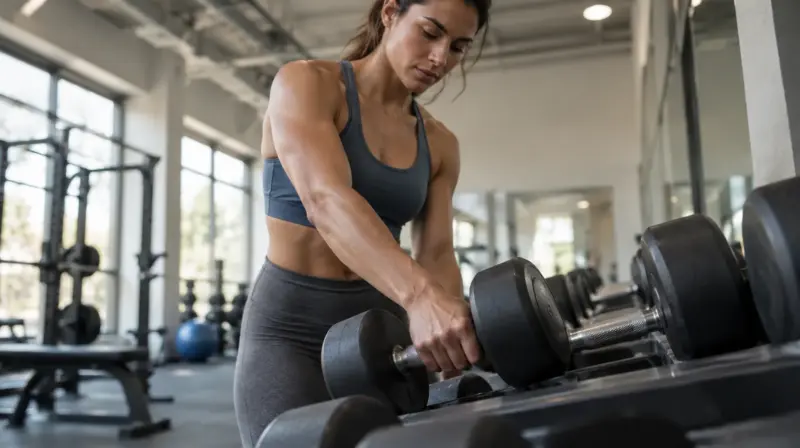
If you’re short on training time, reducing the weight and continuing a set can sound appealing. That’s the idea behind drop sets: instead of resting after a demanding set, you lower the load and keep going. Many studied versions continued until another repetition could no longer be completed.
The useful question is whether this buys you extra muscle growth, saves time, or mainly makes the exercise feel harder. Recent reviews help separate those possibilities.
Too long; didn’t read (Summary)
- Drop sets reduce the load and continue the exercise with little rest.
- Reviews found no clear muscle-growth advantage over traditional sets.
- Some tested protocols took less time, but a whole workout is not guaranteed to be cut in half.
- Most training studies lasted 6–12 weeks; harder-feeling sets do not establish better results.
What the reviews compared
A 2026 systematic review pooled 12 studies involving 274 participants, covering both immediate responses and training adaptations. Its analysis of longer-term outcomes included 9 studies. These generally involved healthy younger adults, often with resistance-training experience, and training periods of 6–12 weeks. The exercises, load reductions and ways of matching training volume varied.[1]
The pooled comparisons did not detect a clear advantage for drop sets in muscle size or strength. That supports treating them as an option, but it doesn’t prove that every drop-set routine and every traditional routine are equivalent. Small studies and short interventions can miss differences that matter over a longer period.
Drop sets versus traditional sets with rest periods. The pooled result concerns muscle-size changes after short training programmes, generally 6–12 weeks.
Muscle growth
Neither method clearly ahead
Dot: the estimated difference. Line: the uncertainty around it.
The uncertainty line reaches both sides of “no difference”. The review cannot reliably pick a muscle-growth winner; this does not prove equivalent results.
See the numbers and study details
| Outcome | Estimate | 95% confidence interval |
|---|---|---|
| Muscle growth | 0.04 | -0.29 … 0.36 |
0 = no difference between the compared conditions
Results: Meta-analytical Findings on Chronic Adaptations; muscle hypertrophy; Figure4A
Where the time saving comes from
A 2023 review provides useful detail about training time. Of the 5 studies included in its quantitative hypertrophy analysis, 2 reported duration. In those studies, the tested drop-set protocols took roughly half to a third of the time of the traditional protocols.[2]
Those were specific exercise protocols, rather than a guarantee that your entire gym visit will shrink by that amount. Warm-ups, equipment changes and the other exercises in your session still take time. The result also doesn’t tell you that one extended drop set always replaces a fixed number of ordinary sets.
More effort is a separate result
The 2026 review found higher perceived exertion with drop sets in its pooled acute comparisons. In everyday terms, packing repetitions together can feel more demanding. That is a different measurement from muscle growth after several weeks.
If you like this format and can reduce the load efficiently, it may be a practical way to fit some resistance work into a busy day. If you prefer regular rest periods, these findings give you no reason to assume you’re missing a special growth effect. Choose the format with its demands in mind: the evidence supports flexibility, while long-term sustainability remains less well studied.
Sources
- Acute and Chronic Effects of Drop-Set Training: A Meta-Analysis and Systematic Review. Havers T, Micke F, Geisler S et al. Sports Medicine – Open. 2026;12(1):38. doi: 10.1186/s40798-026-01012-1. Study.
- Effects of Drop Sets on Skeletal Muscle Hypertrophy: A Systematic Review and Meta-analysis. Sødal LK, Kristiansen E, Larsen S et al. Sports Medicine – Open. 2023;9(1):66. doi: 10.1186/s40798-023-00620-5. Study.