Fall prevention: why balance and everyday movements matter

This article is verified by 2 studies/publications.
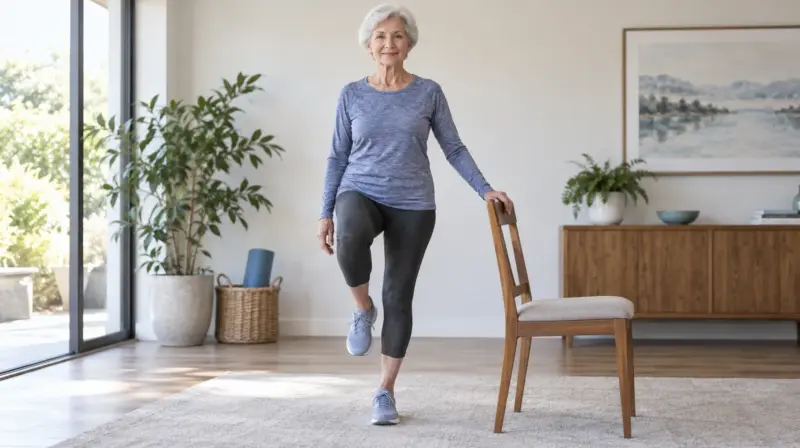
Walking more and getting stronger can be valuable goals. But when the specific aim is to prevent falls in later life, the type of exercise deserves attention too. Practising balance and movements used in daily life has a stronger evidence base for this outcome than simply assuming any workout will do.
This is about structured programmes with appropriate support, rather than testing how long you can balance unaided.
Too long; didn’t read (Summary)
- A 2020 review found fewer falls with balance and functional exercise in community-dwelling older adults.
- Its 24% reduction concerned fall rate, not a 24% lower chance of having at least 1 fall.
- Programmes focused mainly on walking or strength training had less certain evidence for this specific outcome.
- Choose a programme adapted by a trained professional, particularly if your fall risk is higher.
What the large review studied
A 2020 systematic review prepared to inform WHO guidance included 116 randomised trials and 25,160 participants. It examined older adults living in the community, rather than residential care. Eligibility generally started at age 60, although the review’s title refers to people aged 65 and over. Trials specifically recruiting people with certain conditions, such as stroke or Parkinson’s disease, were excluded.[1]
For the overall fall-rate analysis, 64 trials with 14,306 participants supplied usable data. Exercise reduced the rate of falls compared with control conditions. The review rated that evidence as high certainty.
A lower fall rate is a particular outcome
The balance and functional-exercise subgroup included 39 studies with 7,989 participants. It showed a 24% lower fall rate, with high-certainty evidence. These programmes targeted balance or functional tasks rather than only improving an isolated fitness measure.
Fall rate counts falls over a period of follow-up, including repeated falls by the same person. A 24% lower rate therefore does not mean every participant had a 24% lower chance of falling at least once. It also doesn’t promise a particular reduction for you personally.
Programmes combining exercise types, commonly balance and functional work with resistance exercise, probably reduced the fall rate too. Evidence for programmes focused mainly on walking or resistance training was uncertain for this specific outcome. That uncertainty doesn’t establish that those activities are useless; it limits what this review can tell us about preventing falls.
These results compare each programme category with control conditions, rather than directly with the other categories. Participants were older adults living in the community.
Balance and functional exercise
Lower fall rate; high-certainty evidence
Mainly resistance exercise
Unclear; very-low-certainty evidence
General activity, including walking
Unclear; very-low-certainty evidence
Dot: the reported ratio. Line: the uncertainty around it. The midpoint marks the same outcome in both groups.
Balance and functional programmes reduced fall rates with high-certainty evidence. The other two estimates remain uncertain. Fall rate includes repeated falls; it is not the chance of falling at least once.
See the numbers and study details
| Outcome | Estimate | 95% confidence interval |
|---|---|---|
| Balance and functional exercise | 0.76 | 0.70 … 0.82 |
| Mainly resistance exercise | 1.14 | 0.67 … 1.97 |
| General activity, including walking | 1.14 | 0.66 … 1.97 |
1 = the same fall rate with exercise and control
Table2(a): balance/functional exercise; resistance exercise; general physical activity including walking
Source: Sherrington et al., International Journal of Behavioral Nutrition and Physical Activity (2020)
Use a programme that fits the person
The 2022 global falls guidelines recommend balance-challenging and functional exercise, with individual progression. Examples include practising standing up from a chair and stepping. They also emphasise trained providers who can adapt exercises to functional ability and health conditions.[2]
If preventing falls is your goal, seek a programme with that focus and suitable support. Someone with a higher fall risk may need a clinician’s assessment and tailored intervention. The research supports repeated, well-designed practice, not an unsupervised balance challenge. Its strongest evidence here concerns community-dwelling older adults; the same results cannot simply be assumed for care-home residents or every neurological condition.
Sources
- Evidence on physical activity and falls prevention for people aged 65+ years: systematic review to inform the WHO guidelines on physical activity and sedentary behaviour. Sherrington C, Fairhall N, Kwok W et al. International Journal of Behavioral Nutrition and Physical Activity. 2020;17(1):144. doi: 10.1186/s12966-020-01041-3. Study.
- World guidelines for falls prevention and management for older adults: a global initiative. Montero-Odasso M, van der Velde N, Martin FC et al. Age and Ageing. 2022;51(9):afac205. doi: 10.1093/ageing/afac205. Study.