Hack Squat
Isolation exercise, MachineOverview
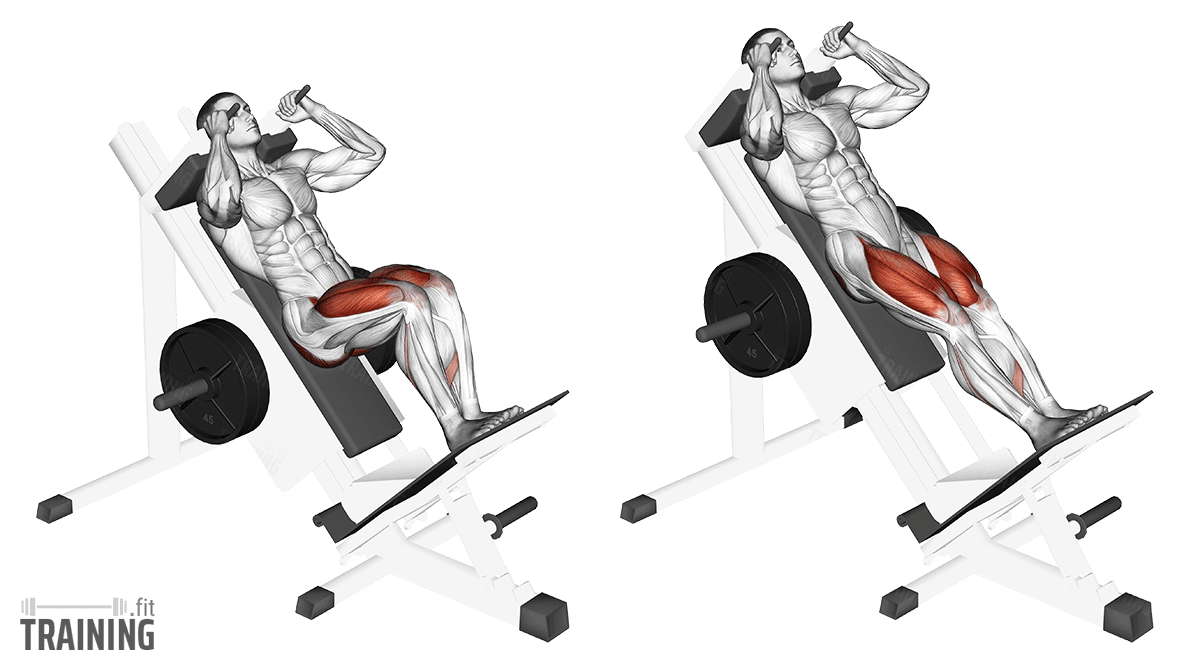
Main muscles
- Thigh: Quadriceps
(Musculus quadriceps femoris) - Thigh: Thigh flexor
(Musculus biceps femoris) - Buttocks: Large gluteus maximus
(Musculus gluteus maximus)
Training plans
Hack Squat is a suitable substitute for similar exercises in Thigh training or as a supplement to various training plans.
Hack Squat: Basics and alternatives
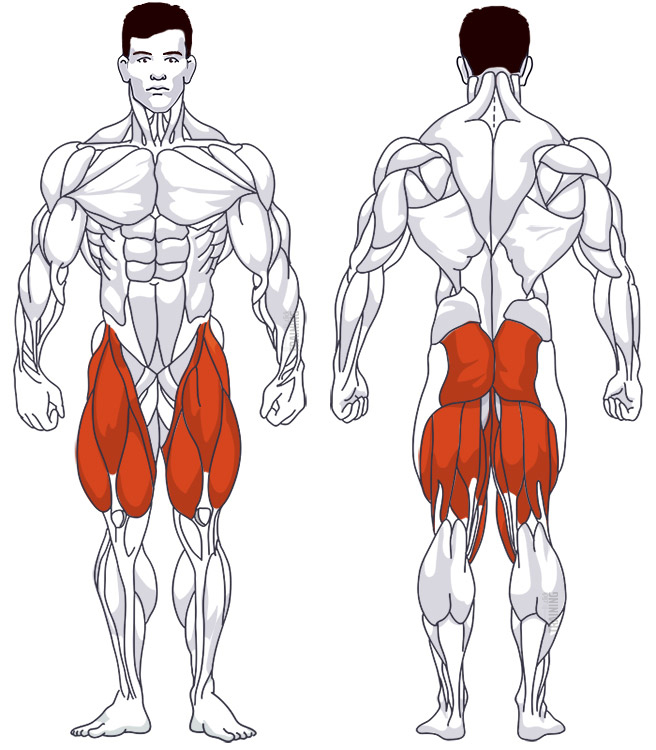
Involved main muscle groups:
Hack Squat
Hack squats on the machine are a guided exercise targeting the front thigh (quadriceps). The movement is pretty simple: You stand at a reclined angle in the machine and push the weight upwards with shoulder pads by straightening your legs.
This exercise can be viewed as an alternative to barbell front squats. Although the range of motion is similar, front squats require more stabilization effort (in the back) as a free compound exercise. Machine hack squats, on the other hand, are a guided leg exercise that needs little stabilization, similar to the leg press.
Correct execution
Hack press machines come in different versions, with variations in weight placement and movement angle. If the angles between two machines differ significantly, it can affect the amount of weight you can move. For example, you may find that you can move less weight when switching gyms due to a lower backrest angle.
So, it’s a good idea to start with a lower weight when changing machines.
Video tutorial
Step-by-step instructions
Load the appropriate weight for your workout.
Step into the hack press machine and place your shoulders under the pads.
Press your back against the backrest and position your feet about shoulder-width apart on the footrest.
Hold the handles, usually located next to your head, without pushing on them.
Tighten your body and get ready to lift the weight. Move the handles towards your head to release the lock and weight.
Extend your legs under control without forcing your knees backward. You’re now in the starting position.
Bend your knees and slowly lower the weight in a controlled manner. The end of the movement is reached when your lower and upper legs are just below a 90-degree angle.
Push the weight back up by extending your legs. Slow down near the top and avoid forcing your knees backward beyond a straight position. Keep your back against the backrest throughout the movement.
Common mistakes
Avoid snapping your knees backward as you finish a repetition. Slow down near the top and keep control of the weight instead of forcing your knees into hyperextension. Choose a load that lets you maintain this control throughout the set.
Due to the machine’s design, incorrect back posture is rarely a problem. Just make sure your back doesn’t round and stays upright against the back pad throughout the exercise.