Reverse Nordic Curl
Isolation exercise, Body weightThis article is verified by 3 studies/publications.
Overview
Main muscles
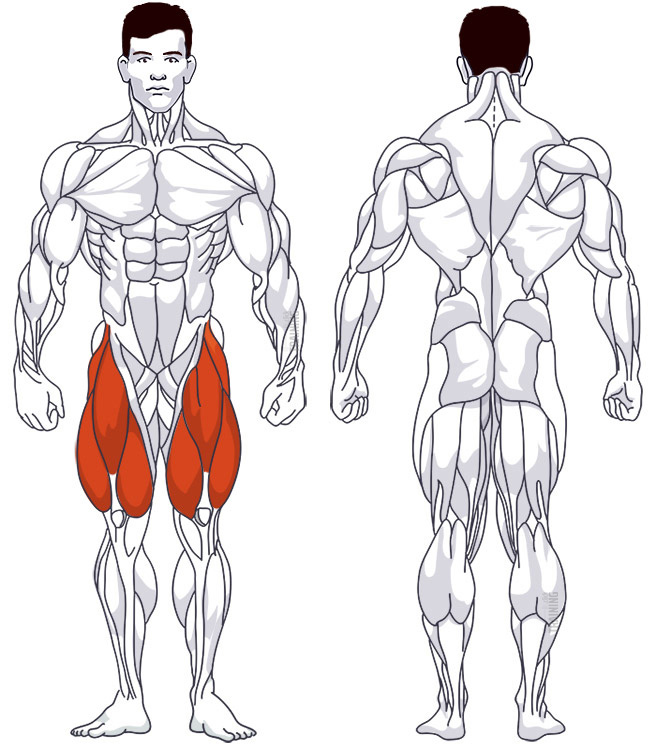
- Thigh: Quadriceps
(Musculus quadriceps femoris)
Training plans
Reverse Nordic Curl is a suitable substitute for similar exercises in anterior thigh training or as a supplement to various training plans.
Reverse Nordic Curl: Basics and alternatives
Involved main muscle groups:
Reverse Nordic Curl
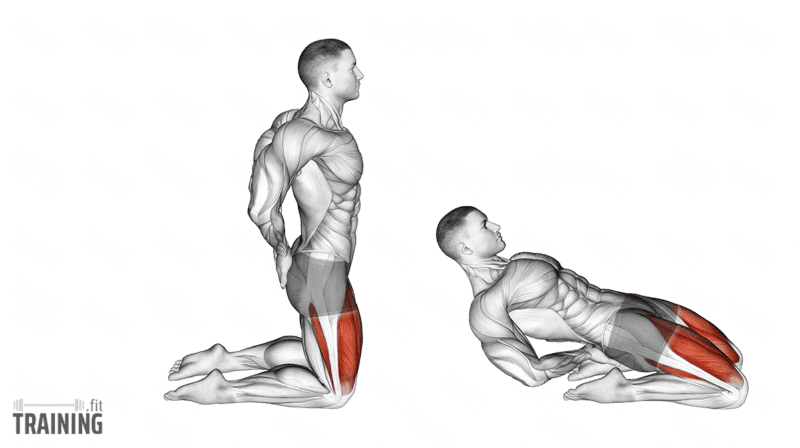
The reverse Nordic curl challenges your quadriceps with your own body weight. Kneeling on padding, keep your hips extended and lean back as your knees bend, then return upright. It’s also called a kneeling sissy squat or bodyweight leg extension.
Unlike in Leg Extensions, your lower legs stay supported while your thighs and upper body move. Seated band leg extensions offer another knee-extension exercise with adjustable elastic resistance. The reverse Nordic needs no weight, but bodyweight alone can make the movement demanding, especially as you lean farther back.
Correct execution
Here your knees are the moving joints while your thighs and torso stay in line. A short backward lean is a sensible place to learn that control before increasing the range.
Kneel on padding with your knees hip-width apart. You can rest the tops of your feet on the floor or choose another comfortable ankle position, as long as your knees stay supported. Set your hips above your knees and brace gently, with your thighs and upper body in one line.
Start with a small backward lean, keeping your thighs and upper body aligned. Pivot at your knees, with your butt off your heels and your back in its natural position. Return along the same path while you still have control. The deep lean shown in the illustration is an advanced range; you don’t need to start there. A securely anchored support in front of you can help you lean back and come up again. Choose an easier alternative if kneeling is uncomfortable.
A firm pad keeps your knees comfortable and level. Make sure there’s room behind you for your whole body as you lean back. If you like, place a stable, padded target behind your upper back to mark how far you lean, and touch it gently when you get there.
For the first attempts, choose a small lean that you can briefly hold. Return to tall kneeling with your shoulders and hips arriving together. Keep your arms in the same position from one repetition to the next, since reaching your hands forward shifts your balance.
Video tutorial
Step-by-step instructions
Kneel on a padded surface with your knees about hip-width apart and feet comfortably supported.
Extend your hips so your knees, hips and shoulders form a roughly straight line.
Brace gently and lean backward a short distance without folding at the hips.
Stop at a point where you can still reverse the movement smoothly.
Use the front of your thighs to return to upright kneeling, keeping your hips and upper body in line.
Reset the position before repeating; increase the range only when the return stays controlled.
Common mistakes
Sitting back onto your heels turns this into a different movement with much more hip bending. Keep your hips extended and shorten the backward lean instead.
Don’t chase the floor by arching your back or letting your head drop behind you: the lean should come from your knees. Your hands don’t have to be behind your back as in the illustration; keep them wherever they help you balance. If you drop backward and struggle to come back up, use a smaller range.
Progress gradually: lower the padded target or lean farther back only when you can still return smoothly. If you have to throw your head forward to come back up, you’ve gone too far, so raise the target or reduce the lean.
What the science says
The reverse Nordic curl has been tested in a few small studies, including 2 training programs lasting 8 weeks each and a single-session muscle-activity study.
In a 2024 study, 13 youth karate athletes around 15 years old did reverse Nordic curls as part of their karate practice 2 times a week for 8 weeks. Meanwhile, 14 athletes from another team continued their usual training. The reverse Nordic group improved their 10-m sprint, change-of-direction speed and jumps. The difference in jumping distance between their legs also fell by about 47%. The usual-training group showed no significant changes.[1]
A 2019 study had 26 people do 8 weeks of reverse Nordic training. Ultrasound showed that the rectus femoris, the front thigh muscle that crosses both the hip and the knee, got thicker and larger in cross-section, and its muscle fiber bundles got longer. These changes diminished again after 4 weeks without the exercise. There was no separate comparison group, since everyone took part in the training.[2]
Another 2024 study with 23 healthy adults (15 men) measured front thigh muscle activity during the lowering phase of the reverse Nordic curl, the single-leg squat, the Bulgarian split squat and the forward lunge. Activity in the rectus femoris and the inner quadriceps muscle (vastus medialis) was similar across the exercises, while the outer quadriceps muscle (vastus lateralis) worked less than in the single-leg squat. The knees also bent less in the reverse Nordic curl. In this comparison, the reverse Nordic curl didn’t produce greater front thigh activity than the squat-based exercises.[3]
Sources
- The Effects of Reverse Nordic Exercise Training on Measures of Physical Fitness in Youth Karate Athletes. Bouguezzi R, Sammoud S, Negra Y, Hachana Y, Chaabene H. Journal of Functional Morphology and Kinesiology. 2024;9(4):265. doi: 10.3390/jfmk9040265.
- Changes in rectus femoris architecture induced by the reverse nordic hamstring exercises. Alonso-Fernandez D, Fernandez-Rodriguez R, Abalo-Núñez R. The Journal of Sports Medicine and Physical Fitness. 2019;59(4):640–647. doi: 10.23736/s0022-4707.18.08873-4.
- Reverse Nordic Curl Does Not Generate Superior Eccentric Activation of the Quadriceps Muscle Than Bodyweight Squat-Based Exercises. Pereira NDS, Chaffe LP, Marques MI, Guimarães RF, Geremia JM, Vaz MA, et al. Journal of Sport Rehabilitation. 2024;33(8):646–653. doi: 10.1123/jsr.2023-0431.