Band Seated Leg Extension
Isolation exercise, Free weightsThis article is verified by 2 studies/publications.
Overview
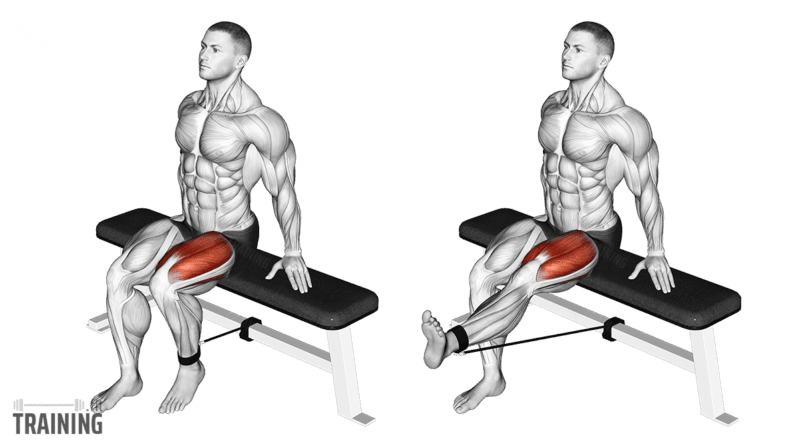
Main muscles
- Thigh: Quadriceps
(Musculus quadriceps femoris)
Training plans
Here you can find example plans for band seated leg extension training:
Band Seated Leg Extension: Basics and alternatives
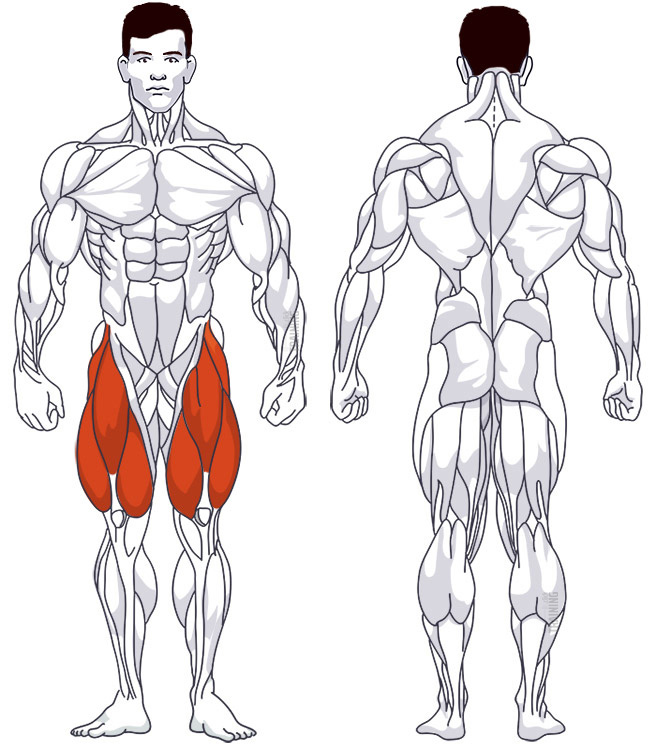
Involved main muscle groups:
Band Seated Leg Extension
Seated band leg extensions are a good stand-in when there’s no leg extension machine. Sit on a stable bench with your thigh supported and a band attached near your ankle. Straighten your knee to raise your lower leg, working your quadriceps against the pull from behind.
Leg Extensions use a machine pad and weight stack, while reverse Nordic curls train knee extension from a kneeling position with your bodyweight. For the band version, all you need is a stable bench and a secure low anchor.
Correct execution
The seat supports your thigh while your lower leg moves against the band. That makes the anchor position important: it needs to leave a clear path for the knee to straighten.
Fasten the band to a sturdy low anchor behind the seat and connect it to a suitable ankle cuff. If you use the bench as the anchor, make sure it’s solid and stable enough to take the pull. Sit far enough forward that your lower leg can move freely, while your thigh remains supported.
Begin with your knee bent at roughly a right angle and light band tension. Straighten your knee smoothly, keep your butt on the seat and stop at a comfortable extension. Don’t kick or force your knee past its normal straight position. Return slowly against the band’s pull and change sides after your repetitions. Adjust band strength or anchor distance if the final part becomes too difficult to control.
Plant your other foot for balance. Position the cuff attachment behind your ankle, facing the anchor, and keep the band clear of the bench legs beneath the seat. Check that the seat edge doesn’t press behind your knee as you straighten your leg.
Let your toes point the same way as your kneecap; there’s no need to turn your whole leg out or point your foot hard to finish the extension. As your lower leg rises, your knee should stay at about the same height.
Video tutorial
Step-by-step instructions
Check that the seat is stable.
Secure the band to a low anchor behind the seat and connect it to a suitable cuff around your working ankle. Check that the band and both connections are secure.
Sit upright with your working thigh supported and your knee bent at roughly a right angle.
Hold the seat lightly and keep your hips still.
Straighten your working knee to raise your lower leg against the band.
Pause at a comfortable extension without snapping your knee straight or lifting your thigh.
Bend your knee slowly back to the start and repeat, then change legs.
Common mistakes
Lifting your thigh off the seat adds hip movement to the knee extension. Keep your thigh on the seat and your upper body upright throughout each repetition, and use less resistance if your butt starts to lift.
Don’t let the band drag your leg quickly back under the bench. Control the return and check that the cuff stays in place. If the anchor slides or tips, stop and secure it before continuing.
Use the same seat position and band length when comparing sides. If one leg needs less resistance, make a note of the band and distance you use for each side. Kicking faster isn’t a substitute for control, so use a lighter band or adjust the anchor distance if needed.
What the science says
A few small studies have compared knee extensions against an elastic band or tube with the same exercise on a leg extension machine. These single-session tests measured activity in the front thigh muscles (quadriceps). They don’t establish which version produces more muscle or strength gains over time.
In 16 women and men aged 28–67, quadriceps activity while lifting was similarly high with elastic tubing and on a machine. During lowering, the machine produced more activity in 2 of the quadriceps muscles. With the tubing, activity peaked as the knee neared full extension. On the machine, it peaked closer to a right angle. Participants rated both versions as similarly demanding.[1]
A second study tested 7 women and 9 men who hadn’t done resistance training in the previous year. They did seated knee extensions in a machine chair, either against the machine or against elastic tubing attached to an ankle cuff. Quadriceps activity was higher on the machine at the beginning of lifting and the end of lowering. When the tubing was shortened by 30% so it was already under tension at the start, activity through the middle and end of the lift didn’t differ significantly from activity on the machine.[2]
Sources
- Muscle activity during knee-extension strengthening exercise performed with elastic tubing and isotonic resistance. Jakobsen MD, Sundstrup E, Andersen CH, Bandholm T, Thorborg K, Zebis MK, et al. International Journal of Sports Physical Therapy. 2012;7(6):606–616. PMID: 23316424.
- Electromyographic Activity and Applied Load During High Intensity Elastic Resistance and Nautilus Machine Exercises. Aboodarda SJ, Shariff MA, Muhamed AM, Ibrahim F, Yusof A. Journal of Human Kinetics. 2011;30:5–12. doi: 10.2478/v10078-011-0067-0.