Can you progress by adding reps instead of weight?

This article is verified by 1 study/publication.
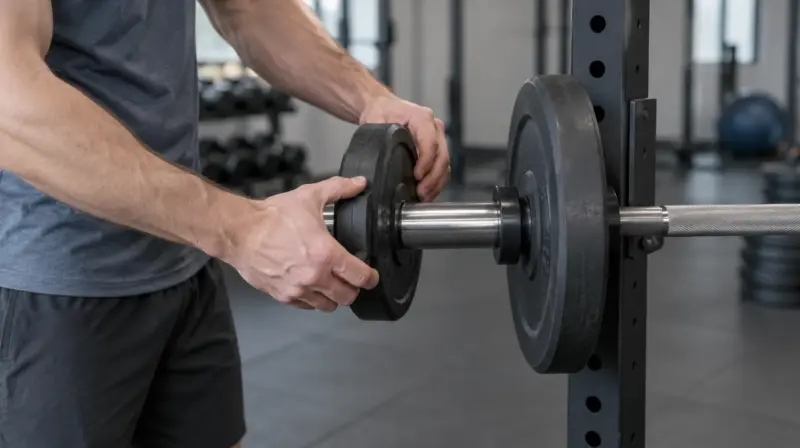
You finish a set and know you could do more, but the next dumbbell is a big jump. Does progress have to mean lifting a heavier weight? A 2022 trial suggests that adding repetitions can also be a useful route, at least during a short block of lower-body training.[1]
Too long; didn’t read (Summary)
- A small 2022 trial compared adding weight with adding repetitions over 8 weeks.
- Both groups improved most measured thigh and calf muscle sizes; differences were generally small.
- Adding reps can be a useful option, but this does not prove the methods are identical or equally effective over years.
2 ways to make training harder
The researchers recruited 43 men and women aged 18–35 who already had at least 1 year of consistent lower-body strength training. They randomly assigned participants to increase the load or increase the repetitions. In total, 38 completed the study.
Both groups trained twice a week for 8 weeks. Each session included 4 sets each of back squats, leg extensions, standing calf raises and seated calf raises. Initially, the weights allowed roughly 8–12 repetitions per set. One group added weight while trying to stay in that range. The other kept its initial weight and tried to perform more repetitions as training progressed.
The sessions were supervised, with controlled repetitions and 2 minutes of rest between sets. Participants were encouraged to reach the point where they could no longer complete another repetition with proper form, although some stopped earlier. This was a comparison of demanding training programmes, rather than easy sets that simply became longer.
Muscle growth, with room for uncertainty
Ultrasound measurements showed increases in thigh and calf muscle thickness in both groups. Most differences between the methods were small. One thigh measurement favoured repetition progression, but the uncertainty around that result also allowed little or no advantage. It needs replication before becoming a reason to prefer more reps.
After eight weeks, the reported differences in thigh thickness favored neither method clearly. Each measure adds thickness at three ultrasound sites; these are not percentages of muscle growth. Estimates account for starting values and sex.
Front thigh thickness: three-site sum
Leans toward reps, with substantial uncertainty
Outer thigh thickness: three-site sum
No clear advantage for either method
Dot: the estimated average difference. Line: the uncertainty around that estimate.
Both lines reach both sides of no difference. The front-thigh estimate leaned toward adding reps, but allowed little or no benefit. This small, short trial does not establish equivalence or settle long-term progression.
See the numbers and study details
| Outcome | Estimate | 90% confidence interval |
|---|---|---|
| Front thigh thickness: three-site sum | 2.8 | -0.5 … 5.8 |
| Outer thigh thickness: three-site sum | -0.3 | -3.6 … 3.6 |
0 = no difference between the groups
Table 1, RF sum and VL sum, Adjusted effect (CI90%); table notes; Methods, Muscle thickness and Statistical analyses; Figure 2
Source: Plotkin et al., PeerJ (2022)
Maximum squat strength improved in both groups. The estimate slightly favoured adding weight, but the uncertainty allowed an advantage in either direction. Also, participants trained with free-weight squats and were tested on a Smith machine, which complicates the interpretation. The trial did not establish that the methods were equivalent.
What you can take into your training
If heavier weights aren’t available, this study gives you a reason to track repetitions rather than regard the same weight as an automatic dead end. Record the load, completed reps and movement quality so you can see what changes.
Keep the scope in mind: this was 8 weeks, mainly young recreational lifters, and only selected thigh and calf muscles. It did not test years of progression, upper-body growth or elite strength performance. Adding reps is another option to consider, not proof that loading never needs to change.
Sources
- Progressive overload without progressing load? The effects of load or repetition progression on muscular adaptations. Plotkin D, Coleman M, Van Every D, et al. PeerJ. 2022;10:e14142. doi: 10.7717/peerj.14142. Study.