One limb or two? Strength gains depend on the test

This article is verified by 1 study/publication.
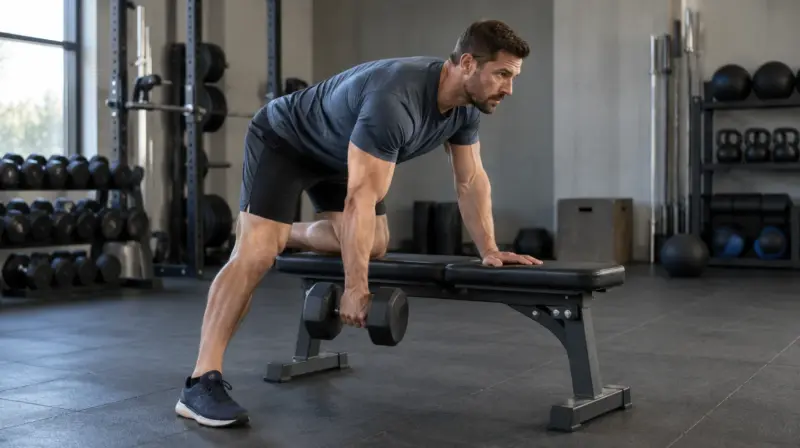
Should you train one arm or leg at a time, or use both together? The useful answer starts with what you want to improve. A strength test using one limb asks a different question from a test using two, and a 2026 review found that this distinction affected which training approach came out ahead.
Unilateral training means working mainly with one limb at a time. Bilateral training means producing force with both together. Think of a single-leg knee extension versus the same movement with both legs. The review compared these approaches, rather than assuming that one is best for every goal.
Too long; didn’t read (Summary)
- A review compared unilateral and bilateral training across 24 randomized trials.
- Unilateral training had an advantage in one-limb strength and jump tests.
- The smaller advantage for bilateral strength was less certain and sensitive to analysis choices.
- No clear overall difference in muscle growth was found; that does not prove identical results.
What the review compared
The researchers combined 24 randomized trials involving 588 participants. Most studies involved athletes, although trained and untrained participants were also included. The programs lasted at least 4 weeks and covered resistance training, jump training and combinations of the two. This was a varied evidence base, not 24 trials of the same gym exercise. People undergoing rehabilitation or with acute injuries were excluded.[1]
The paper was released as a peer-reviewed accepted manuscript in July 2026, before final editing. Its findings deserve the same attention to study limitations as other research.
The test changed the result
Unilateral training showed an advantage for strength measured one limb at a time and for single-limb jump performance. The review rated confidence in these findings as moderate. Bilateral training showed a smaller advantage in strength tests using both limbs, with low confidence in that estimate.
That bilateral-strength result also became less clear under some alternative analysis assumptions and when certain individual comparisons were removed. So it is better read as a possible, task-specific advantage than a firm rule that both-limb training always builds more strength.
One-limb training versus training both limbs together. The review kept strength tests using one limb separate from tests using both.
Strength tested with one limb
One-limb training ahead; moderate certainty
Strength tested with both limbs
Two-limb training ahead; low certainty, less robust
Dot: the estimated average difference. Line: the uncertainty around that estimate.
One-limb tests favored one-limb training. Two-limb tests favored training both together in the main analysis, but that finding was less certain and became less clear under some alternative analyses.
See the numbers and study details
| Outcome | Estimate | 95% confidence interval |
|---|---|---|
| Strength tested with one limb | 0.42 | 0.23 … 0.60 |
| Strength tested with both limbs | -0.28 | -0.54 … -0.02 |
0 = no difference between the groups
Accepted manuscript pp.12–13, Results 3.3 and Figure 2; robustness pp.17–18, 3.6.1–3.6.2; Supplement Table S14
Source: Xin et al., BMC Sports Science, Medicine and Rehabilitation (2026, accepted manuscript)
There was no clear overall difference in muscle growth, two-limb jumping or sprint performance. Change-of-direction findings were uncertain and sensitive to the analysis. None of these unclear comparisons proves that the approaches produce identical results for every person or program.
Base your choice on the movement you want to improve
If your goal involves producing force with one limb, including practice with that limb is a reasonable application of these results. If improving a two-limb lift matters to you, continuing to practice that lift also makes sense. The practical point is to match some of your training to the task you care about, while recognizing that the evidence is stronger for some outcomes than others.
You can include both approaches in a routine. This review did not establish an ideal ratio or prove that a mixed program is superior. It also does not show that unilateral work fixes every strength imbalance or prevents injury. Those are separate questions. For muscle growth alone, the findings give you no clear reason to choose solely on whether one or two limbs move at once.
Sources
- Comparative effects of unilateral versus bilateral training on performance adaptations: a systematic review and multilevel meta-analysis. Xin X, Liu Q, Guo Y, Wang P, Li X, Hu Z, Wu B, Liu Q, Qi Z, Chen J, Kong Z, Che L, Xie J. BMC Sports Science, Medicine and Rehabilitation. 2026. Peer-reviewed accepted manuscript. doi: 10.1186/s13102-026-01834-2. Study.