Band Chest Fly
Isolation exercise, Free weightsThis article is verified by 3 studies/publications.
Overview
Main muscles
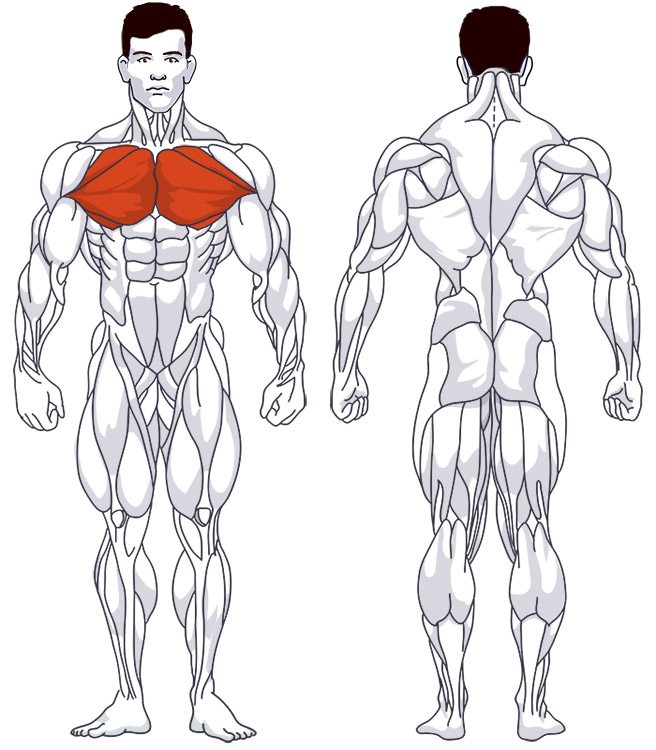
- Chest: Large pectoral muscle
(Musculus pectoralis major) - Chest: Small pectoral muscle
(Musculus pectoralis minor)
Training plans
Band Chest Fly is a suitable substitute for similar exercises in middle chest training or as a supplement to various training plans.
Band Chest Fly: Basics and alternatives
Involved main muscle groups:
Band Chest Fly
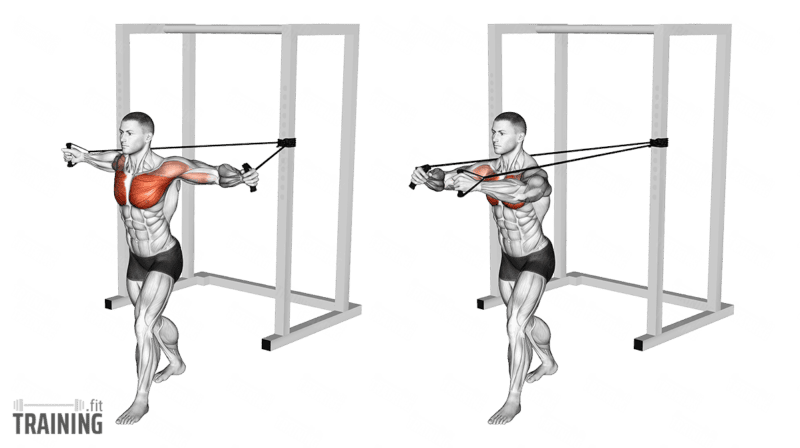
Band chest flys let you do the popular fly movement with nothing more than a fitness band and a secure anchor. You stand facing away from the attachment point and bring your arms together in front of your chest in a broad arc, keeping your elbows slightly bent. The movement works your chest, with some help from your front shoulders.
For a version with weights, try dumbbell flys on a bench. With resistance band chest presses, you bend and straighten your elbows as you push your hands forward. During the fly, you’ll keep roughly the same elbow bend throughout.
Correct execution
The band pulls you backward as your arms open. A steady stance lets you focus on bringing your arms together without turning the fly into a forward lean.
Attach the band securely around chest height and check it for damage. Keep both sides about the same length and stand centered in front of the attachment point. Step forward until there’s light tension with your arms open. A staggered stance can help you stay steady against the backward pull.
Bring your hands together at chest height with a small, steady bend in your elbows. Your hands only need to meet, not cross far past each other, and your wrists stay in line with your forearms the whole time.
Open your arms slowly, stopping before the band pulls your upper arms far behind your body. Check both the opening and closing movement when choosing your distance from the anchor. You should be able to finish the fly without stepping forward or straightening your elbows to push through the last part.
If one hand consistently arrives first or moves higher than the other, stop and check your position and the band lengths. A lighter band may help you keep both arms moving evenly. With a low anchor, your arms sweep upward instead; this version uses a chest-height anchor.
Video tutorial
Step-by-step instructions
Attach the band to a secure support around chest height and test the attachment.
Take one end in each hand, turn away from the anchor and place one foot in front of the other.
Open your arms to a comfortable starting width with a slight bend in both elbows. Adjust your distance from the anchor until there’s light tension in this position.
Breathe out and bring your hands together in front of your chest along a rounded path.
Breathe in as you open your arms slowly, maintaining roughly the same elbow angle. At the end of the set, step back toward the anchor with control until the band is no longer stretched, then release your grip.
Common mistakes
A common mistake is bending and straightening your elbows a lot, which turns the fly into a press. If you can’t keep the same slight bend, switch to a lighter band. When you open your arms, move slowly so the band doesn’t snap them backward.
Don’t lean a little farther forward with every rep to get past the band’s resistance. Instead, keep the same stance and upper-body position throughout. If the band rubs on an edge or the anchor starts to move, stop and fix the setup before you continue.
Additional tips
You can adjust the resistance by switching bands or changing your distance from the anchor, then check the whole path again. Pick a setting where you can control both the opening and closing, with the band taut but not overstretched.
What the science says
Most chest fly research measures muscle activity in a single session. These studies show how hard a muscle works, not how much it grows over time.
A study with 29 healthy men and women, 10 of them strength-trained, used a setup very close to the one described here. They did flys with dumbbells on a bench and with a band while standing, facing away from a shoulder-height anchor. With loads they could lift 10 times, the band produced slightly less chest activity than the dumbbells, but clearly more front shoulder activity. The authors consider bands a practical alternative to dumbbells.[1]
In 17 resistance-trained men, dumbbell flys were compared with the barbell bench press at a weight they could lift 6 times. Across the whole movement and most of its phases, the chest, front shoulders and triceps were 8–81% more active during the bench press, while the biceps worked 57–86% harder during the flys.[2]
An older study with 12 college-age men and women with varying lifting experience found no significant difference in chest or front shoulder activity between dumbbell flys and the dumbbell or barbell bench press. However, muscle activity lasted for a smaller proportion of the lift during flys.[3]
The 2 dumbbell studies disagree on whether flys work the chest less than pressing. Both research groups nevertheless regard flys as an addition to pressing exercises, rather than a replacement.
Sources
- Muscle Activity in Upper-Body Single-Joint Resistance Exercises with Elastic Resistance Bands vs. Free Weights. Bergquist R, Iversen VM, Mork PJ, Fimland MS. Journal of Human Kinetics. 2018;61(1):5–13. doi: 10.1515/hukin-2017-0137.
- A Comparison of Muscle Activation between Barbell Bench Press and Dumbbell Flyes in Resistance-Trained Males. Solstad TE, Andersen V, Shaw M, Hoel EM, Vonheim A, Saeterbakken AH. Journal of Sports Science & Medicine. 2020;19(4):645–651. PMID: 33239937.
- Electromyographic Activity of the Pectoralis Major and Anterior Deltoid Muscles During Three Upper-Body Lifts. Welsch EA, Bird M, Mayhew JL. Journal of Strength and Conditioning Research. 2005;19(2):449–452. doi: 10.1519/14513.1.