Dips
Compound exercise, Body weightThis article is verified by 1 study/publication.
Overview
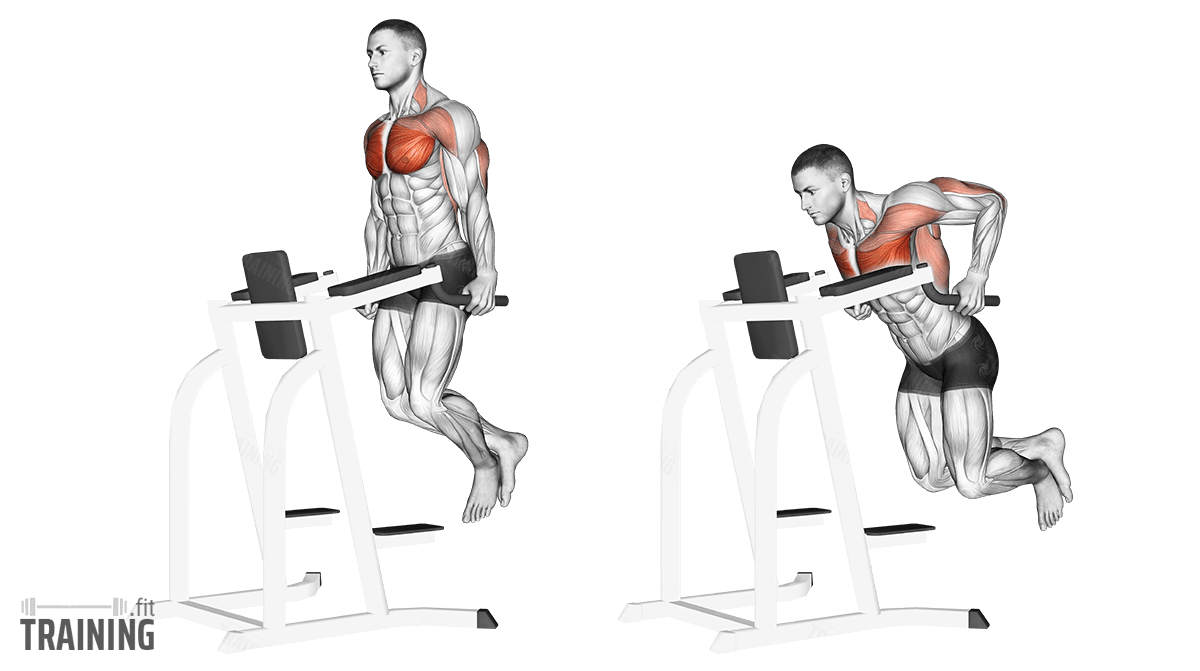
Main muscles
- Chest: Large pectoral muscle
(Musculus pectoralis major) - Chest: Small pectoral muscle
(Musculus pectoralis minor) - Shoulder: Anterior deltoid muscle
(Musculus deltoideus, Pars clavicularis) - Triceps: Three-headed arm muscle
(Musculus triceps brachii)
Training plans
Here you can find example plans for dips training:
Dips: Basics and alternatives
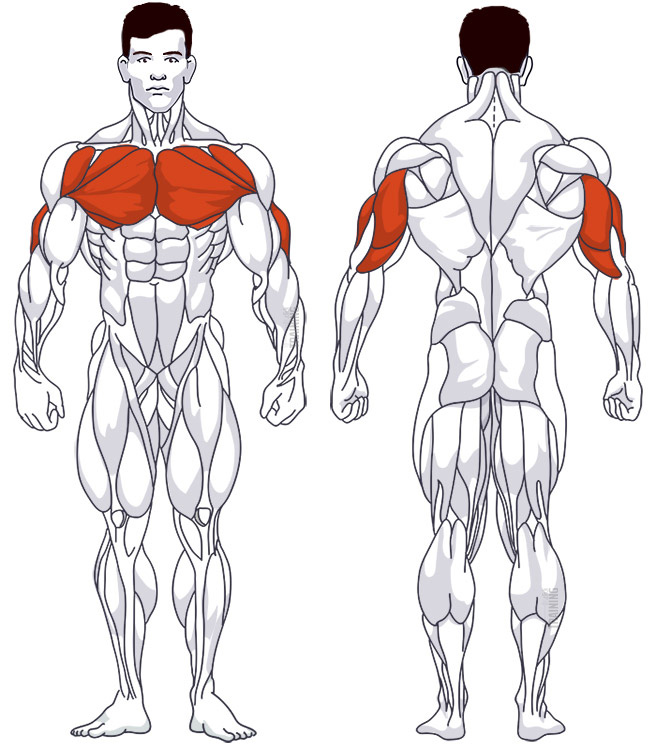
Involved main muscle groups:
Dips
Dips are a key exercise in bodybuilding and rank among the most popular chest exercises. That’s why you’ll find dip bars or dip machines in almost every gym. In this exercise, you support your body with your arms, lower it, and then raise it again. The main muscles worked are the pectoral muscles, triceps, and anterior shoulder.
In this exercise, sometimes called bar dips, you lean on two bars and dip your body down. Dips are often confused with bench dips, which target similar muscles but are executed differently.
Since dips involve safely moving your body weight using your chest and triceps, they’re not ideal for beginners.
However, gyms have dip machines to help you get started. You can choose a weight that’ll lighten the load during training. In theory, it sounds great, but in practice, it often doesn’t work as well. If you set the assistance level too high, the exercise becomes too easy and the training effect is almost non-existent. If you don’t choose enough support weight, proper execution suffers. So, only approach dips with more experience and strength.
Dips are commonly described as a lower chest exercise. While true, the rest of the chest is also activated effectively. One study that measured the upper chest (clavicular head of the pectoralis major) during parallel bar dips confirmed that the exercise also activates this area, along with the triceps[1]. Dips are a good complement to incline bench press and flat bench press.
Additionally, since your arms extend during dips, the arm extensor (triceps) also receives a high training stimulus.
Correct execution
Despite efficiently activating the chest, dips have a poor reputation due to the high stress on the shoulders.
Proper form is crucial to avoid unnecessary stress on the shoulder joints. Performing dips with the upper body completely upright puts more stress on the shoulders. Leaning your upper body forward at an appropriate angle (see video below) reduces joint stress. Dips are similar to a steep negative bench press in this regard, as the movement sequence is quite similar despite different postures.
Some people recommend keeping your body upright to activate the triceps more. However, don’t follow this advice, as triceps will extend regardless of upper body inclination. This means the training stimulus remains high even with the upper body leaning forward.
Just like with the bench press, ensure your elbows aren’t spread too far from your body. Your shoulder blades should be tucked in. Also, the dip bars shouldn’t be too wide. As a rule of thumb, each side should be about 4 to 5 inches wider than your hips.
Video tutorial
Step-by-step instructions
Stand between the dip bars. Many bars aren’t parallel but angled. Position yourself between the bars so the distance from the bars to your hips matches the spacing described above. You can adjust freestanding dip bars accordingly.
Grab the bars with your hands, pull your shoulder blades back and push your chest out.
Lift your body off the ground by straightening your arms with your triceps.
Bend your legs at the knees.
Tilt your upper body forward slightly.
Lower your torso evenly downward by bending your arms. Stop the downward movement when your elbows are bent to 90 degrees. Don’t lower your body any further, as this strains muscles and joints alike without providing greater training stimulus. Also, ensure your elbows aren’t spread too far apart.
Push your body back up using your chest muscles and extending your arms. Keep your arms slightly bent at the end of the movement to avoid stressing your elbow joints.
Common mistakes and injuries
Shoulder injuries are a potential long-lasting complication, giving dips a somewhat bad reputation. Thus, it’s vital to pay close attention to proper form and listen to your body while performing the exercise.
Be mindful of the following points:
- Only perform dips on bars that aren’t too far apart (no more than about 4 to 5 inches wider than your hips on each side).
- Tilt your torso forward slightly as you lower it.
- Don’t spread your elbows too far.
- Don’t lower your body too much. Your elbows should be bent about 90 degrees (between your upper and lower arm) at the end of the movement. Going down too low can release the tension on your shoulder blades, pushing your shoulders forward and increasing joint stress.
- Don’t add weight until you can confidently perform dips without additional weight. Start low and increase the weight gradually. If in doubt, increase the number of repetitions without adding extra weight to the belt.
- Stop doing dips if they cause shoulder pain. In such cases, switch to exercises where the training weight can optionally be below your body weight. This is the best way to ensure the weight isn’t too heavy. If you’ve had a shoulder injury in the past, adapt the load and range of motion to your recovery, ideally with guidance from a doctor or physiotherapist.
As mentioned earlier, dips are more of an advanced exercise. So, only move on to regular bar dips once you can do easier variations, such as machine-assisted dips, with control and without pain. If you can do that, then you can focus on performing dips as accurately as possible while learning them without any issues.