Downward Facing Dog
Compound exercise, Body weightThis article is verified by 4 studies/publications.
Overview
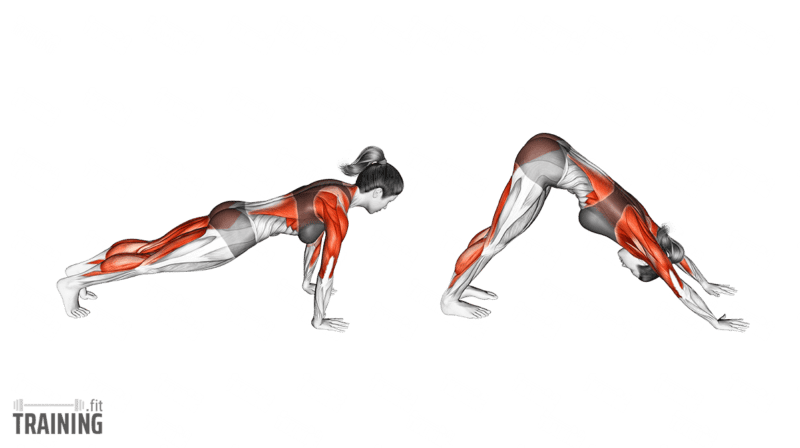
Main muscles
- Shoulder: Anterior deltoid muscle
(Musculus deltoideus, Pars clavicularis) - Triceps: Three-headed arm muscle
(Musculus triceps brachii) - Abdomen: Transverse abdominal muscle
(Musculus transversus abdominis)
Training plans
Downward Facing Dog is a suitable substitute for similar exercises in Mobility and balance or as a supplement to various training plans.
Downward Facing Dog: Basics and alternatives
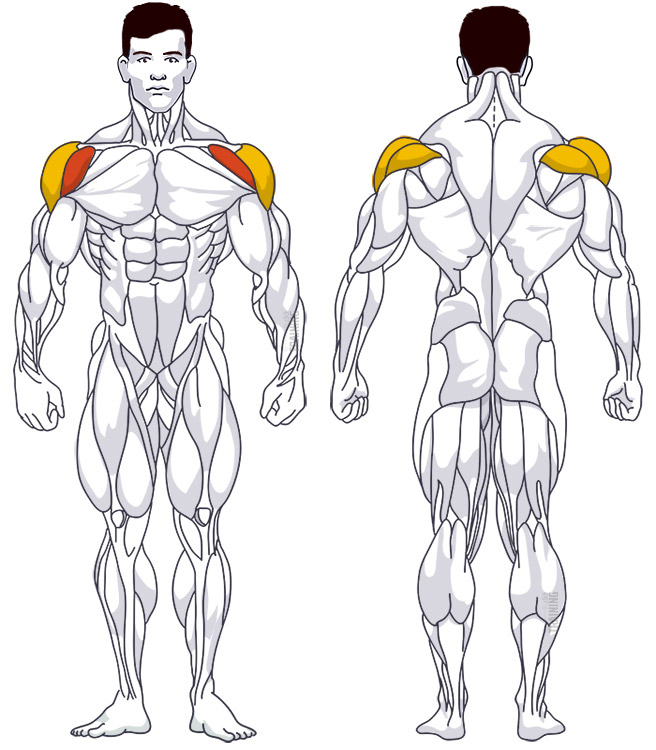
Involved main muscle groups:
Downward Facing Dog
Downward-facing dog forms an upside-down V, a classic yoga shape. Support yourself on your hands and feet and lift your hips up and back. Your arms and shoulders support your upper body, and you may feel a stretch along the backs of your legs. One way to get into the pose is from a high plank.
You can also start on your hands and knees, as you would for cat and cow. Another floor exercise is the cobra pose: you lift your chest while your pelvis stays on the mat. For downward dog, you don’t have to straighten your knees fully or bring your heels to the floor.
Correct execution
The pose is about lifting your hips and lengthening through your back, not forcing your heels down. Bent knees can give you room to find that shape while your hands stay firmly supported.
Place your hands about shoulder-width apart and spread your fingers. From a high plank, press through your palms and move your hips up and back. If you’re starting on all fours, tuck your toes under before lifting your knees. Your feet should be roughly hip-width apart.
Keep pressing through your hands and lengthen your back. Bend your knees if straightening your legs makes your back round or shifts you forward onto your hands. Let your heels sink toward the floor without forcing them down. Keep your head between your upper arms and relax your neck.
Spread the pressure evenly across your palms and the bases of your fingers so you don’t roll onto the outer edges of your hands. Don’t push your elbows into an exaggerated backward bend, and let your shoulder blades move freely with your arms.
Breathe steadily while holding the pose. To finish, bend your knees and lower them gently to the floor. You can also return to a high plank as illustrated: move your shoulders forward while lowering your hips until they’re in line with your trunk. If you need to adjust the distance between your hands and feet, lower your knees first.
Video tutorial
Step-by-step instructions
Set your hands shoulder-width apart with your fingers spread, starting on all fours or in a high plank.
If you’re starting on all fours, tuck your toes under first. Press through your palms and lift your knees as you send your hips up and back.
Keep your feet about hip-width apart and bend your knees enough to keep your back long.
Let your head relax between your upper arms and lower your heels only as far as comfortable.
Continue breathing, then bend your knees to return to the floor or move smoothly back to high plank.
Common mistakes
Trying to force your heels onto the floor can make your back round and shift your weight forward. Keep your heels raised and bend your knees a little more if this helps you keep your back long.
It’s tempting to push your chest as far down as possible, but that lets it sink between your shoulders. Keep pressing actively through your hands instead. When you move back to the plank, go slowly enough to bring your shoulders over your hands while you keep your hips from sagging.
What the science says
Several laboratory studies of yoga poses have included downward-facing dog. They measured eye pressure or muscle activity during single sessions, so they show what happens in the pose, not what regular practice changes over time.
In a 2015 study, 10 people with glaucoma and 10 people with healthy eyes held 4 head-down yoga poses for 2 minutes each. Downward-facing dog raised the pressure inside the eye the most, from about 17 to 28–29 mmHg in both groups. The pressure returned to its starting level within 2 minutes of sitting up, but the study didn’t test whether these brief increases cause harm in people with glaucoma.[1]
A 2023 study with 22 healthy young adults with yoga experience measured the abdominal, lower back and side glute muscles in 16 poses often recommended for chronic low back pain. Downward dog kept all of them below 20% of their maximum, a low level similar to cat and cow. In boat pose, by comparison, abdominal muscle activity exceeded 50%.[2]
In a study of the sun salutation with 8 experienced practitioners, the broad back muscle (latissimus dorsi) worked at 34.6% of its maximum in the sequence’s inverted-V pose. This pose also produced the sequence’s highest activity in the six-pack muscle (rectus abdominis), although it reached only 22.8%.[3]
A 2018 study with 13 experienced yoga practitioners, 12 of them women, measured 5 leg muscles in 5 poses. In downward-facing dog, the muscle at the front of the shin (tibialis anterior) was the most active of them. Compared with one-legged balance poses such as tree pose, activity in the calves, hamstrings and side glutes was low.[4]
Sources
- Intraocular Pressure Rise in Subjects with and without Glaucoma during Four Common Yoga Positions. Jasien JV, Jonas JB, de Moraes CG, Ritch R. PLOS ONE. 2015;10(12):e0144505. doi: 10.1371/journal.pone.0144505.
- Electromyographic analysis of trunk and hip muscles during Yoga poses prescribed for treating chronic low back pain. Dewan M, Nijhawan M, Chhabra HS, Shandilya S, Kumar P, Phadke V. Journal of Bodywork and Movement Therapies. 2023;36:117–124. doi: 10.1016/j.jbmt.2023.06.007.
- Exploration of muscle activity using surface electromyography while performing surya namaskar. Mullerpatan RP, Agarwal BM, Shetty TV. International Journal of Yoga. 2020;13(2):137–143. doi: 10.4103/ijoy.ijoy_72_19.
- An electromyographic analysis of selected asana in experienced yogic practitioners. Kelley K, Slattery K, Apollo K. Journal of Bodywork and Movement Therapies. 2018;22(1):152–158. doi: 10.1016/j.jbmt.2017.05.018.