Crescent Moon Pose
Compound exercise, Body weightThis article is verified by 4 studies/publications.
Overview
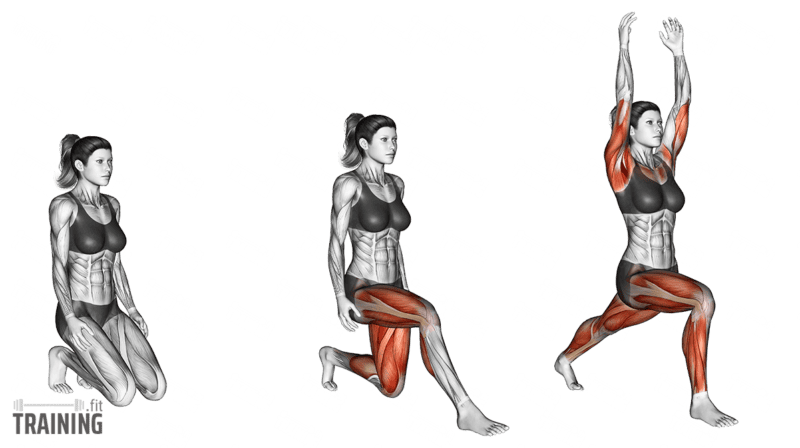
Main muscles
- Thigh: Quadriceps
(Musculus quadriceps femoris) - Buttocks: Large gluteus maximus
(Musculus gluteus maximus)
Training plans
Crescent Moon Pose is a suitable substitute for similar exercises in Mobility and balance or as a supplement to various training plans.
Crescent Moon Pose: Basics and alternatives
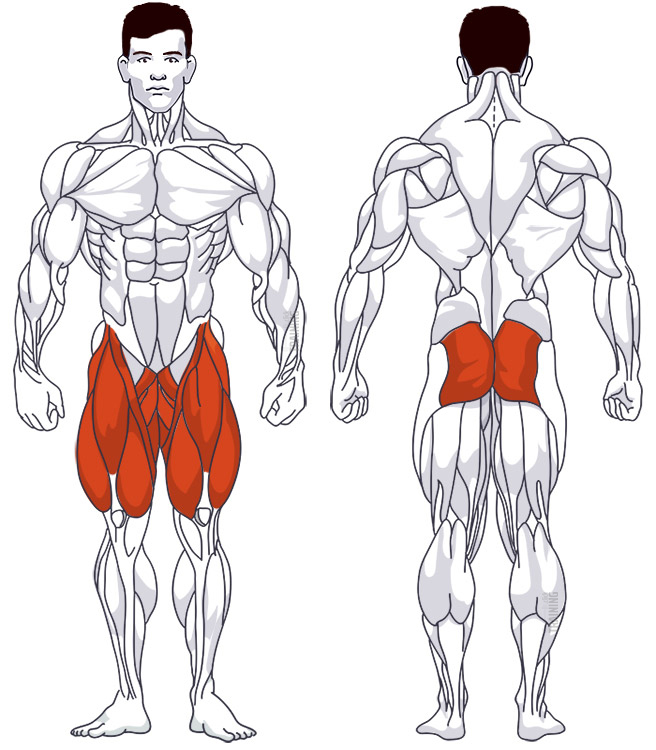
Involved main muscle groups:
Crescent Moon Pose
Crescent moon pose, or crescent lunge, is a split-stance pose with raised arms and an upright upper body. Your rear knee rests on the floor in the low version; in the high version, it’s lifted and your rear toes and forefoot support you. The illustration shows this transition. Your thighs and butt steady you, and you may feel a stretch at the front of your rear hip.
Lunges use a similar split stance with repeated lowering and rising. In yoga sequences, downward-facing dog is another common position from which to step into the lunge.
Correct execution
The kneeling lunge gives you a base for lifting your torso and arms. A shorter stance or lower arm position can help you explore the pose without forcing a deeper backbend.
Begin kneeling and bring one foot forward. Leave a little width between your feet so you’re not balancing on a single line. Place your front foot flat with your knee roughly above your ankle, and rest your hands on your front thigh or on the floor beside your foot. Adjust the stride before lifting your upper body.
You can remain here with your rear knee padded and the top of your rear foot down. For the high version, tuck your rear toes, press through your feet and lift your rear knee. Reach your arms up, but don’t push your ribs forward into a big backbend. If it helps you balance with your upper body upright, keep a small bend in your rear knee. Breathe steadily, then lower your hands and rear knee before changing sides.
In high lunge, keep your rear heel raised over the ball of your foot and avoid rolling that foot onto its outer edge. Keep your whole front foot grounded. Turn your hips forward as far as feels comfortable, without twisting your front knee. Raise your arms about shoulder-width apart, palms facing each other. Look ahead; you don’t need to follow your hands with your eyes. Lower your rear knee before making a larger stance adjustment.
Video tutorial
Step-by-step instructions
From kneeling, step one foot forward and place it flat on the floor.
Adjust the width and length of the stance until your pelvis feels steady.
Raise your upper body with your hands on your front thigh. You can stay in this low version if you like.
For high lunge, tuck your rear toes and lift your rear knee while keeping your rear heel raised.
Reach your arms upward, keeping your chest lifted without forcing an arch in your lower back. Lower your hands and rear knee under control, then repeat with the other foot forward.
Common mistakes
Avoid lining up both feet on one narrow line; it makes balancing harder. If you catch yourself gripping the floor with your front toes, widen your stance a little.
Forcing a long stride or a straight rear knee can pull your pelvis forward and increase the arch in your back. If that happens, shorten your stance or bend your rear knee slightly. And if raising your arms makes it hard to keep your upper body steady, rest your hands on your hips until your legs feel settled.
What the science says
There doesn’t seem to be a training study on crescent moon pose, but a few lab studies have measured how your hips and legs work in it and in similar yoga lunges. These single-session measurements describe what happens in the poses, rather than the effects of regular practice over time.
In a 2021 study, 13 experienced, certified female yoga practitioners performed the crescent lunge, warrior II and triangle pose while cameras and force plates recorded their legs. In each pose, the hip accounted for most of the leg joints’ angular impulse (52–71%), a measure that adds up the turning force at each joint over the whole movement. The peak turning forces (joint moments) at the hip and ankle didn’t differ significantly between the poses, while the triangle pose needed the most range of motion and put the most sideways load on the knee.[1]
A 2020 study with 8 experienced yoga practitioners measured muscle activity during the sun salutation, which includes a low lunge with the back knee and both hands on the floor. Among the poses held during the sequence, this lunge produced the most activity in the glutes (38.5% of their maximum) and in the outer front thigh (34.9%).[2]
In a 2018 study, motion analysis tracked the hips of 20 healthy, regular yoga practitioners in 11 poses. Many of the poses brought the hip close to the limits of its range. The crescent lunge, like warrior I and warrior II, stressed the hip in extension, the direction in which the leg moves behind your body.[3]
Core and glute activity was measured across 11 poses in a 2014 study of 30 yoga practitioners with more than 3 months of experience. The authors recommended chair pose and warrior I, a raised-arm lunge in which the back heel stays on the floor, for targeting the gluteus maximus, your largest glute muscle.[4]
Sources
- Biomechanical Characteristics on the Lower Extremity of Three Typical Yoga Manoeuvres. Whissell E, Wang L, Li P, Li JX, Wei Z. Applied Bionics and Biomechanics. 2021;2021:7464719. doi: 10.1155/2021/7464719.
- Exploration of muscle activity using surface electromyography while performing surya namaskar. Mullerpatan RP, Agarwal BM, Shetty TV. International Journal of Yoga. 2020;13(2):137–143. doi: 10.4103/ijoy.ijoy_72_19.
- Position of the Hip in Yoga. Mears SC, Wilson MR, Mannen EM, Tackett SA, Barnes CL. The Journal of Arthroplasty. 2018;33(7):2306–2311. doi: 10.1016/j.arth.2018.02.070.
- Core muscle function during specific yoga poses. Ni M, Mooney K, Harriell K, Balachandran A, Signorile J. Complementary Therapies in Medicine. 2014;22(2):235–243. doi: 10.1016/j.ctim.2014.01.007.