Cat and Cow Pose
Compound exercise, Body weightThis article is verified by 2 studies/publications.
Overview
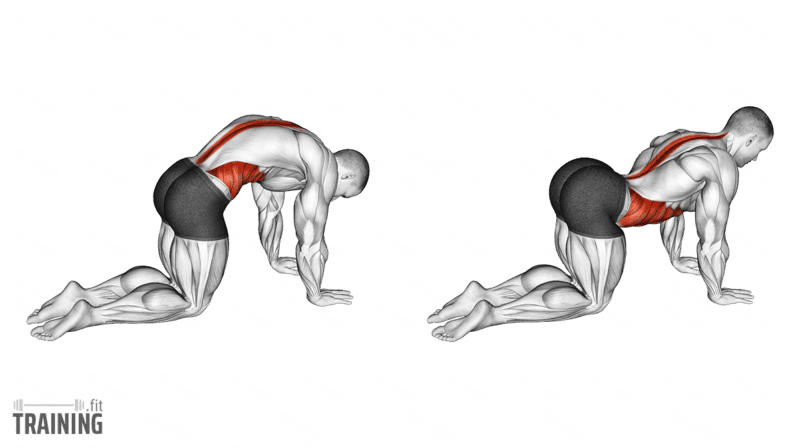
Main muscles
- Back: Back extensor
(Musculus erector spinae) - Abdomen: Straight abdominal muscle
(Musculus rectus abdominis)
Training plans
Cat and Cow Pose is a suitable substitute for similar exercises in Mobility and balance or as a supplement to various training plans.
Cat and Cow Pose: Basics and alternatives
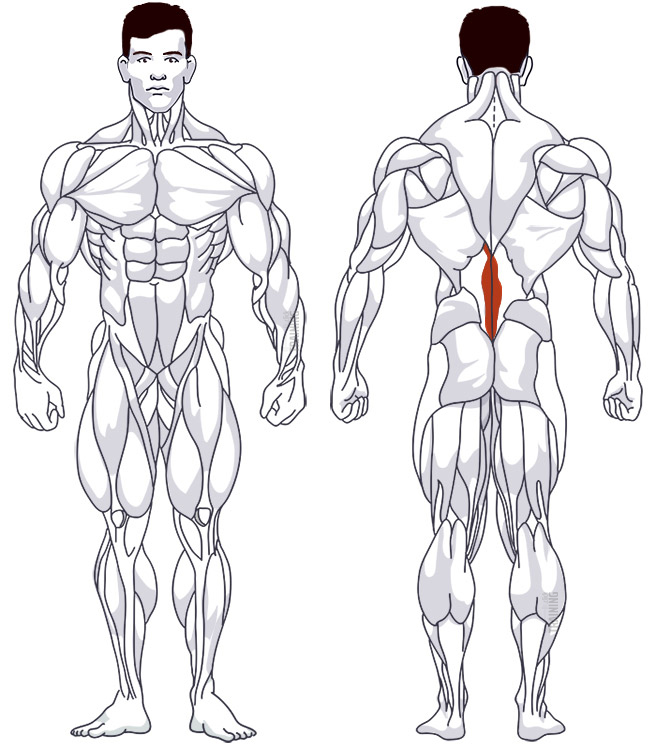
Involved main muscle groups:
Cat and Cow Pose
Cat and cow are a simple yoga pairing: on your hands and knees, you’ll alternate between rounding your back and lightly arching it. Let your pelvis and head follow while your hands and knees stay down.
The bird dog uses the same starting position, but you keep your trunk steady as you reach with an arm and the opposite leg. Downward-facing dog raises your hips into an inverted V. For cat and cow, stay on your knees and move slowly with your breathing.
Correct execution
Cat and cow are gentle changes in your back position, not a contest to reach the largest curve. You can start with a small movement and let your breathing set a steady rhythm.
Get onto a comfortable surface with your hands under your shoulders and your knees under your hips. Spread your fingers and keep pressing through your palms. Start with your back relaxed in a middle position, looking at the floor.
As you breathe in, tip your pelvis so your tailbone rises slightly, let your belly sink toward the floor and bring your chest forward. Only lift your gaze as far as it’s comfortable for your neck. As you breathe out, tip your pelvis the other way and round your back up, letting your head follow. Move smoothly; there’s no need to reach the deepest possible shape. Return through the middle each time. Keep your knees on the floor throughout.
Let your shoulder blades spread as you push the floor away in cat. Keep your arms straight but not locked, since the rounding comes from your upper back, not from bending your elbows like in a push-up. Your hips stay above your knees throughout, even as you breathe out.
If you find the movement unfamiliar, start with a small pelvic tilt and let your back follow. Keep the pace slow enough to breathe comfortably.
Video tutorial
Step-by-step instructions
Get onto your hands and knees, with your hands beneath your shoulders and knees beneath your hips.
Settle into a comfortable middle position and distribute pressure through both palms.
Breathe in, tip your pelvis so your tailbone rises and gently arch your back as your chest comes forward.
Breathe out, tip your pelvis the other way and round your back, allowing your head to lower.
Alternate slowly within a comfortable range, then return to the middle and rest.
Common mistakes
Throwing your head back adds neck movement rather than a deeper back movement. Let your neck follow your upper body and keep your gaze lower if needed.
Moving mostly through your lower back while forcing your chest down can leave you holding an uncomfortable extreme position. Use a smaller movement, let your pelvis and upper back join in, and keep breathing.
What the science says
Cat and cow have been the subject of relatively little exercise research. The 2 studies below show how hard your trunk muscles work in the pose and how far your spine can move on all fours, but neither tested what happens when you practice it regularly.
In a 2023 study, 22 healthy young adults with yoga experience (16 women, 6 men) moved into and held 16 yoga poses that are often recommended for chronic low back pain. The researchers measured the activity of the abdominal muscles, the lower back muscles and the side glute muscle (gluteus medius). Cat-camel, the study’s name for cat and cow, kept all measured muscles below 20% of their maximum, as did downward dog and the warrior poses. Abdominal activity in boat pose, by comparison, exceeded 50% of the muscles’ maximum.[1]
A 2009 study filmed 24 healthy young and 22 healthy older adults as they bent forward and arched backward through each section of the spine. Arching the back on all fours, a movement the study called the cat stretch, allowed more backward bending in the upper back than the standard test did. Range of motion was lower in the older adults throughout the spine.[2]
In the muscle-activity study, cat and cow placed relatively low demands on the measured trunk muscles. This fits their use as a gentle movement exercise rather than an exercise for strength.
Sources
- Electromyographic analysis of trunk and hip muscles during Yoga poses prescribed for treating chronic low back pain. Dewan M, Nijhawan M, Chhabra HS, Shandilya S, Kumar P, Phadke V. Journal of Bodywork and Movement Therapies. 2023;36:117–124. doi: 10.1016/j.jbmt.2023.06.007.
- Video based measurement of sagittal range of spinal motion in young and older adults. Kuo YL, Tully EA, Galea MP. Manual Therapy. 2009;14(6):618–622. doi: 10.1016/j.math.2008.12.006.