Jumping Rope
Compound exercise, Free weightsThis article is verified by 3 studies/publications.
Overview
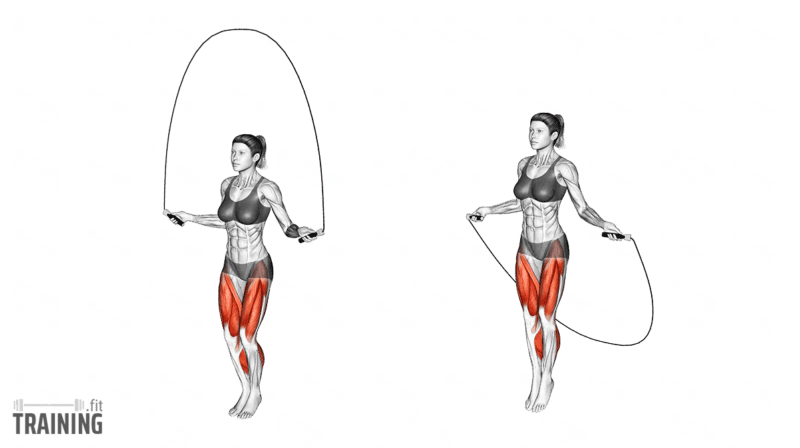
Difficulty
Easy
Required equipment
- Jump rope
Main muscles
- Lower leg: Twin calf muscle
(Musculus gastrocnemius) - Lower leg: Soleus muscle
(Musculus soleus) - Thigh: Quadriceps
(Musculus quadriceps femoris) - Buttocks: Large gluteus maximus
(Musculus gluteus maximus) - Abdomen: Transverse abdominal muscle
(Musculus transversus abdominis)
Training plans
Jumping Rope is a suitable substitute for similar exercises in Conditioning and full-body or as a supplement to various training plans.
Jumping Rope: Basics and alternatives

Involved main muscle groups:
Jumping Rope
Jumping rope is a classic exercise that doesn’t need much equipment: a jump rope and enough room to swing it are all it takes. In the basic version, you jump with both feet together and let the rope pass underneath once per jump. Your calves do much of the work as you push off and land, while your thighs and hips help control the movement.
Once you’ve found a steady rhythm, you can try High Knee Jump Rope, lifting your knees alternately. High Knee Sprints use a similar running motion without the rope. If you’d prefer an alternative that keeps one foot on the ground, try Brisk Walking.
Correct execution
A steady rope rhythm starts with small jumps and room for the rope to pass. You can work on timing before trying to turn it faster.
Choose a rope you can turn with your hands beside your hips. Follow the manufacturer’s sizing guidance, then check the length with a few slow turns. You’ll need clear space above, in front of and behind you, plus an even surface where the rope won’t catch.
Keep your elbows slightly bent and close to your body. Most of the turning comes from small movements of your wrists; you don’t need to swing your whole arms. Jump just high enough for the rope to pass under your feet. Land softly on the balls of your feet, letting your ankles and knees bend a little, and keep your upper body upright.
If you can’t string several jumps together yet, practice one turn and one jump at a time. Stop, put the rope behind your heels and start again. As the timing becomes easier, join the jumps together without an extra bounce between turns. The rope should brush the floor briefly. If it drags along the ground, check its length and your hand position before trying to jump higher.
Video tutorial
Step-by-step instructions
Check the rope length and make sure you have enough clear space around and above you.
Stand with your feet close together and the rope behind your heels. Hold your hands beside your hips with your elbows slightly bent.
Turn the rope forward with small, even movements of your wrists.
As the rope approaches your feet, jump with both feet just high enough to let it pass underneath.
Land softly on the balls of your feet, allowing your knees and ankles to bend a little. Continue with one jump for each turn of the rope. Finish by letting the rope come to rest. Place it behind your heels before starting again.
Common mistakes
Jumping too high or kicking your heels backward makes it harder to keep a steady rhythm. Keep your feet beneath you and use small jumps with just enough clearance for the rope.
Large arm circles and uneven hand positions can make the rope catch on your feet. Bring both hands back beside your hips and slow down until the rope turns evenly. If it still catches, check the length as well as your timing. Untangle it before you start again.
What the science says
Training studies on jumping rope have included schoolchildren, runners and young adults. They measured fitness and performance over weeks, not how much each muscle works.
A 2023 meta-analysis combined 15 randomized trials with 1,048 children aged 10–12. Compared with regular PE lessons, jumping rope brought small to large extra gains: boys improved more in speed, strength, muscular endurance and agility; girls improved more in coordination, balance and resting heart rate. There was no advantage in body measurements, and little change in flexibility.[1]
In a 2020 study, 96 amateur endurance runners were randomly split into 2 groups. For 10 weeks, one group replaced 5 minutes of its usual warm-up with jumping rope, 2–4 times a week. This group ran a faster 3-km time trial, jumped higher, rebounded better from a drop jump and developed a stiffer foot arch, while no statistically significant changes were found in the other group. Faster runs were associated with better rebound performance and a stiffer foot arch.[2]
A 2025 trial with 59 healthy young adults (29 women) compared 8 weeks of interval rope skipping, steady rope skipping and no exercise. Both skipping groups increased their maximum oxygen uptake, a key marker of endurance fitness, from about 44 to 48 and from 42 to 47 mL/kg/min, and ended well above the non-exercise group. No statistically significant change in body composition was found in any group, and enjoyment scores didn’t differ significantly between the 2 skipping styles.[3]
Sources
- Jumping Rope Improves the Physical Fitness of Preadolescents Aged 10-12 Years: A Meta-Analysis. Zhao Q, Wang Y, Niu Y, Liu S. Journal of Sports Science & Medicine. 2023;22(2):367–380. doi: 10.52082/jssm.2023.367.
- Jump-Rope Training: Improved 3-km Time-Trial Performance in Endurance Runners via Enhanced Lower-Limb Reactivity and Foot-Arch Stiffness. García-Pinillos F, Lago-Fuentes C, Latorre-Román PA, Pantoja-Vallejo A, Ramirez-Campillo R. International Journal of Sports Physiology and Performance. 2020;15(7):927–933. doi: 10.1123/ijspp.2019-0529.
- Effects of high-intensity interval rope-skipping on cardiorespiratory fitness, body composition, and enjoyment in young adults. Phongchin W, Tingsabhat S, Trongjitpituk R, Reun-arom T, Poon ET, Wongpipit W. European Journal of Clinical Nutrition. 2025;79(12):1227–1232. doi: 10.1038/s41430-025-01575-4.