Kettlebell Farmers Carry
Compound exercise, Free weightsThis article is verified by 4 studies/publications.
Overview
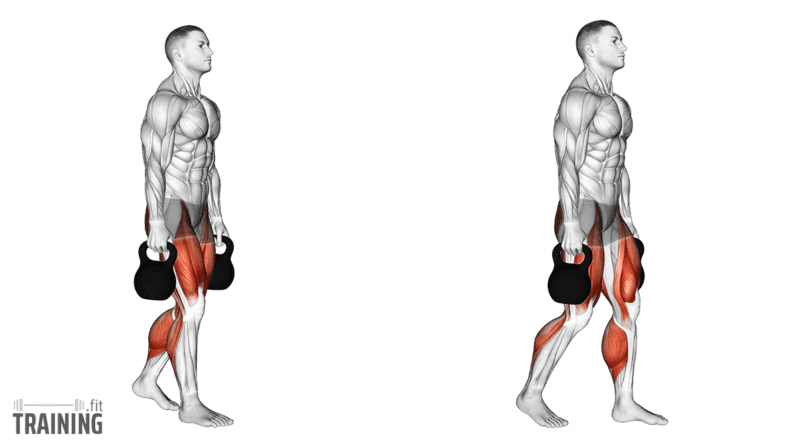
Main muscles
- Thigh: Quadriceps
(Musculus quadriceps femoris) - Buttocks: Large gluteus maximus
(Musculus gluteus maximus) - Back: Back extensor
(Musculus erector spinae) - Neck: Trapezius muscle
(Musculus trapezius) - Abdomen: External oblique abdominal muscle
(Musculus obliquus externus abdominis)
Training plans
Kettlebell Farmers Carry is a suitable substitute for similar exercises in Conditioning and full-body or as a supplement to various training plans.
Kettlebell Farmers Carry: Basics and alternatives
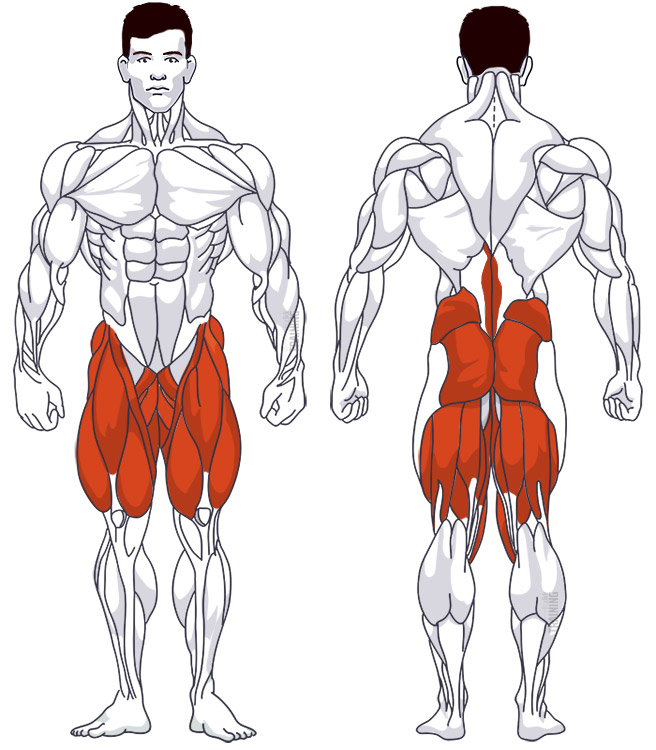
Involved main muscle groups:
Kettlebell Farmers Carry
The farmer’s carry keeps the setup simple: two kettlebells and a clear route. Hold one bell by its handle at each side and walk. Your forearms keep your grip firm, your core and upper back steady the load, and your legs carry you forward.
If you’d rather use dumbbells, the dumbbell farmer’s carry works in a similar position. In the kettlebell overhead carry, you hold a weight above your head instead, so it’s a good idea to practice carrying the bells steadily at your sides first.
Correct execution
Place two kettlebells of equal weight on either side of your feet and clear a level walking route. Bend your hips and knees to reach the handles without collapsing your trunk. Grip the middle of each handle, stand up and let the bell bodies hang below your hands. Keep enough room for them to clear your thighs.
Walk smoothly with manageable steps, stand tall and keep your arms straight. Keep breathing and look ahead. If a bell keeps bumping your leg, slow down, adjust your grip or choose a lighter load. End the walk before your grip gives out: stop, bend your hips and knees, and place both bells on the floor without swinging them forward.
Turn the handles so you can grip both comfortably with your palms facing your legs. Kettlebells differ in shape, so take a few test steps with a manageable pair to see how much room they leave beside your thighs before you choose your working weight.
The bells hang from your closed hands the whole time and don’t rest against your forearms like they would in a rack carry. Keep a natural distance between your feet and step straight ahead so your legs don’t swing out into the bells. If the bells start moving in opposite directions, stop and let them settle before you carry on.
Video tutorial
Step-by-step instructions
Set two kettlebells of equal weight beside your feet and clear the route.
Bend your hips and knees and take a secure grip in the middle of each handle.
Stand upright with your arms straight and the bells hanging at your sides.
Walk forward with controlled steps while keeping the bell bodies clear of your legs.
Stop before your grip or upright position becomes difficult to maintain. Bend your hips and knees to return both bells to the floor under control.
Common mistakes
Don’t curl the kettlebells to keep them away from your thighs. Keep your arms straight and adjust your hand position or steps instead.
A hurried turn can swing a bell into your knee. Slow down and turn in small steps, or set the weights down before changing direction if space is tight. Leaning back to carry more weight also changes your trunk position; reduce the load and keep a natural upright stance.
Stop where there’s enough flat floor for both bells, away from plates or mat edges. Bend until both bases reach the floor outside your feet, keeping both grips secure; letting go of one early can make you twist toward the other.
What the science says
Loaded carries have received limited research attention, mostly using dumbbells or strongman handles instead of kettlebells. The studies looked at single sessions or test results, so they don’t show how much muscle or strength the carry builds over time.
A 2019 review of 11 biomechanics studies on strongman exercises found that the farmer’s walk was the most studied carrying event. Athletes who performed better in it took longer and quicker strides and spent less time with each foot on the ground. The authors emphasize that the evidence is preliminary.[1]
In a kettlebell carry test with 67 Australian Army soldiers (46 men and 21 women), the median distance was 265 m. Across this and 2 other carry tests, soldiers with more lean mass, especially in the legs, performed better. After accounting for lean mass in the legs, there was no significant association between performance and either age or sex.[2]
A 2024 study with 18 college-aged adults (12 women and 6 men) compared a farmer’s carry using 2 dumbbells (about 51 kg in total on average) with standing still while holding the same weights. Abdominal and lower back activity increased on both sides when participants walked. A plank held for the same duration worked the abs harder, while the carry worked the lower back muscles harder.[3]
In another study, 16 resistance-trained men carried dumbbells over 8 m at 75% of their 6-rep max. The side glute muscle (gluteus medius) worked harder in those whose hip abductors, the muscles that move your leg out to the side, were weak compared with their thigh muscles: about 42–47% of a maximal contraction versus 26%. The authors propose the farmer’s walk as a way to strengthen this muscle, although the study didn’t test strength gains.[4]
Sources
- The Biomechanics and Applications of Strongman Exercises: a Systematic Review. Hindle BR, Lorimer A, Winwood P, Keogh JWL. Sports Medicine – Open. 2019;5(1):49. doi: 10.1186/s40798-019-0222-z.
- Modifiable Anthropometric Characteristics Are Associated With Unilateral and Bilateral Carry Performance. Beck B, Carstairs GL, Billing DC, Caldwell JN, Middleton KJ. Journal of Strength and Conditioning Research. 2017;31(2):489–494. doi: 10.1519/jsc.0000000000001504.
- The Quantification of Muscle Activation During the Loaded Carry Movement Pattern. Ellestad SH, Holcomb TP, Swiergol AM, Holmstrup ME, Dicus JR. International Journal of Exercise Science. 2024;17(1):480–490. doi: 10.70252/nwue9985.
- The Gluteus Medius Vs. Thigh Muscles Strength Ratio and Their Relation to Electromyography Amplitude During a Farmer’s Walk Exercise. Stastny P, Lehnert M, Zaatar A, Svoboda Z, Xaverova Z, Pietraszewski P. Journal of Human Kinetics. 2015;45(1):157–165. doi: 10.1515/hukin-2015-0016.