Dumbbell Farmers Carry
Compound exercise, Free weightsThis article is verified by 4 studies/publications.
Overview
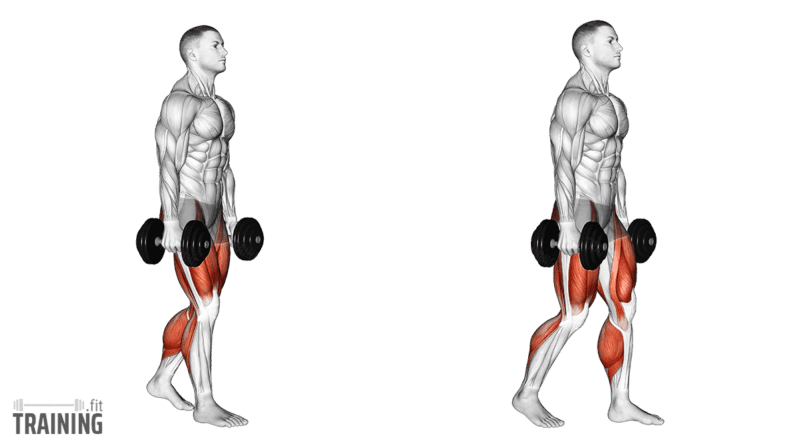
Main muscles
- Thigh: Quadriceps
(Musculus quadriceps femoris) - Buttocks: Large gluteus maximus
(Musculus gluteus maximus) - Back: Back extensor
(Musculus erector spinae) - Neck: Trapezius muscle
(Musculus trapezius) - Abdomen: External oblique abdominal muscle
(Musculus obliquus externus abdominis)
Training plans
Dumbbell Farmers Carry is a suitable substitute for similar exercises in Conditioning and full-body or as a supplement to various training plans.
Dumbbell Farmers Carry: Basics and alternatives
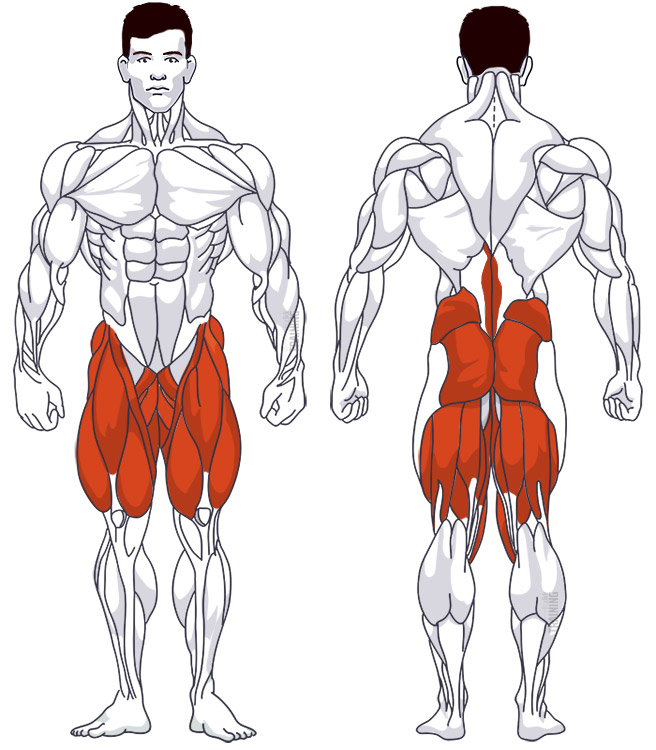
Involved main muscle groups:
Dumbbell Farmers Carry
The dumbbell farmer’s carry is simple: you’ll hold a dumbbell at each side and walk with controlled steps. Your grip secures the handles, your upper back and core steady the weights, and your legs carry you forward.
The kettlebell farmer’s carry uses two kettlebells in a similar position. With dumbbell deadlifts, you practice lifting and lowering the weights while standing in place. It’s a good idea to get comfortable with that before you carry heavier dumbbells across the room.
Correct execution
Choose two matching dumbbells and a clear, level route with room to set them down. Bend your hips and knees, grip the handles firmly and stand up with the weights beside you. Center each hand on its handle to keep the dumbbells level. Pause briefly before taking your first step.
Keep your arms straight and your wrists roughly in line with your forearms. Your shoulders simply carry the load in a natural position, neither shrugged up toward your ears nor pulled down on purpose. Stand tall without leaning back and keep breathing as you walk.
For a controlled training carry, take short, natural steps with a little space between your feet, and look ahead. Unlike in everyday walking, your arms don’t swing: the weights stay beside your thighs, just clear of your legs.
Slow down before a turn and take several small steps to change direction. At the end of the route, come to a steady stop before bending your hips and knees to lower both dumbbells outside your feet. End the carry while you can still hold the handles securely.
Video tutorial
Step-by-step instructions
Place two dumbbells of equal weight beside you and check that the walking route is clear.
Brace your core and keep your back in its natural, neutral position as you bend your hips and knees, grip both handles and stand up under control.
Keep your arms straight and stand upright before taking the first step.
Walk forward with short steps, keeping the dumbbells beside your body.
Slow down before you turn and take small steps so the weights stay steady. Stop and keep your core braced and your back neutral as you bend your hips and knees to set both dumbbells down with control.
Common mistakes
If the dumbbells swing, you’ll need to keep correcting your balance. Slow down or reduce the weight so you can carry them steadily beside your body.
Walking until your grip fails is a common mistake. You still need to set both weights down safely, so stop while you can hold them securely and lower them outside your feet under control.
Looking at your feet the whole time can encourage you to lean forward. Check that the route is clear before starting, then look ahead while you walk.
What the science says
The farmer’s carry remains relatively little studied. Most studies measure muscle activity during a single carry or compare stronger and weaker carriers, rather than testing what weeks of carrying do.
A 2019 review of 11 biomechanics studies on strongman exercises found only preliminary data. In the strongman farmer’s walk, the better athletes took longer strides at a higher rate and spent less time with each foot on the ground. These findings describe competitors racing with heavy loads over a set distance, rather than a controlled training carry.[1]
In a 2024 study, 12 women and 6 men carried 2 dumbbells weighing about 51 kg in total on a short walk. Walking increased the activity of the abs, obliques and lower back muscles on both sides compared with just holding the same dumbbells for the same time. Lower back activity was greater during the carry than during a plank. The plank, however, produced more ab and oblique activity.[2]
In another study, 16 resistance-trained men did a dumbbell farmer’s walk over 8 m at a moderate load. The side glute muscle (gluteus medius) worked harder in men whose hip abductors were weak compared with their thigh muscles (about 42–47% vs. 26% of its maximum). The authors recommend the exercise to strengthen this muscle, but they didn’t measure the effects of a training program.[3]
In 46 male and 21 female soldiers, more lean mass, especially in the legs, was associated with longer carrying distances in kettlebell carries, jerry can carries and a stretcher carry. After accounting for lean mass in the legs, age and sex no longer showed a significant effect.[4]
Sources
- The Biomechanics and Applications of Strongman Exercises: a Systematic Review. Hindle BR, Lorimer A, Winwood P, Keogh JWL. Sports Medicine – Open. 2019;5(1):49. doi: 10.1186/s40798-019-0222-z.
- The Quantification of Muscle Activation During the Loaded Carry Movement Pattern. Ellestad SH, Holcomb TP, Swiergol AM, Holmstrup ME, Dicus JR. International Journal of Exercise Science. 2024;17(1):480–490. doi: 10.70252/nwue9985.
- The Gluteus Medius Vs. Thigh Muscles Strength Ratio and Their Relation to Electromyography Amplitude During a Farmer’s Walk Exercise. Stastny P, Lehnert M, Zaatar A, Svoboda Z, Xaverova Z, Pietraszewski P. Journal of Human Kinetics. 2015;45(1):157–165. doi: 10.1515/hukin-2015-0016.
- Modifiable Anthropometric Characteristics Are Associated With Unilateral and Bilateral Carry Performance. Beck B, Carstairs GL, Billing DC, Caldwell JN, Middleton KJ. Journal of Strength and Conditioning Research. 2017;31(2):489–494. doi: 10.1519/jsc.0000000000001504.