Kettlebell Overhead Carry
Compound exercise, Free weightsOverview
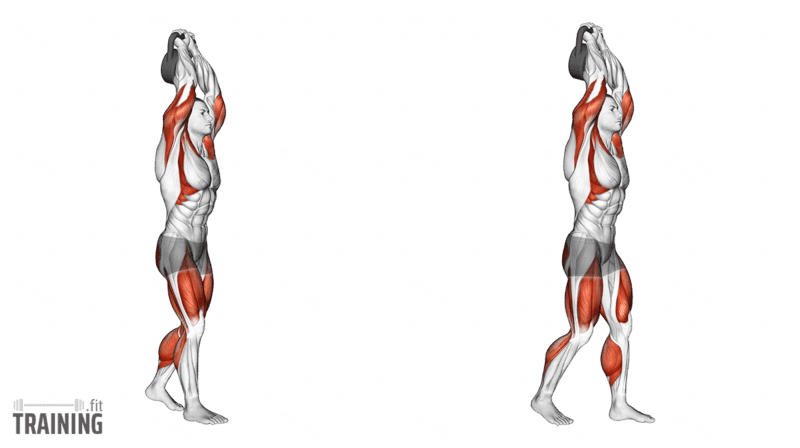
Main muscles
- Shoulder: Anterior deltoid muscle
(Musculus deltoideus, Pars clavicularis) - Triceps: Three-headed arm muscle
(Musculus triceps brachii) - Chest: Anterior sawtooth muscle
(Musculus serratus anterior) - Abdomen: Transverse abdominal muscle
(Musculus transversus abdominis) - Abdomen: External oblique abdominal muscle
(Musculus obliquus externus abdominis)
Training plans
Kettlebell Overhead Carry is a suitable substitute for similar exercises in Conditioning and full-body or as a supplement to various training plans.
Kettlebell Overhead Carry: Basics and alternatives
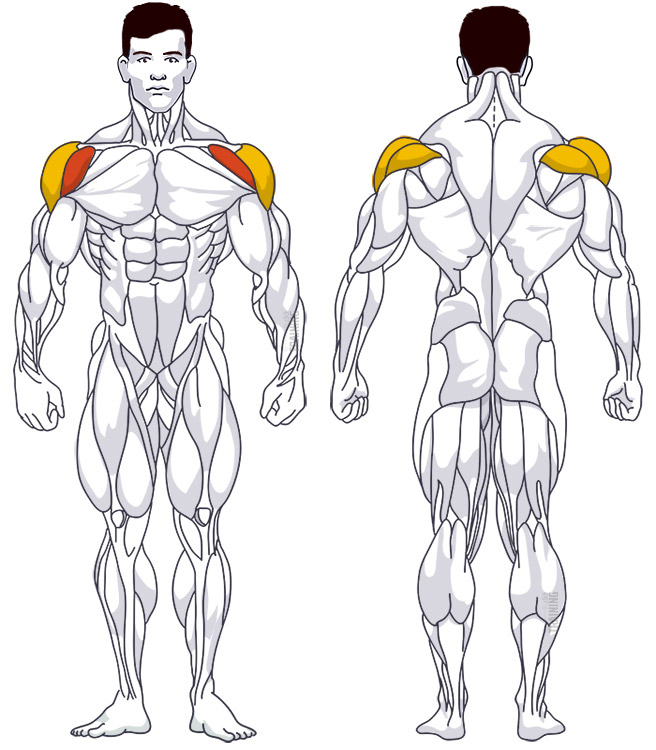
Involved main muscle groups:
Kettlebell Overhead Carry
The kettlebell overhead carry adds a walking challenge to a steady two-handed hold. Keep one bell overhead with both arms extended and take slow steps. Your shoulders and triceps support the weight while your core steadies your upper body.
The kettlebell farmer’s carry keeps the weights at your sides. The kettlebell thruster combines a squat with pressing two bells overhead. For this carry, choose a kettlebell you can comfortably raise, hold and lower with both hands before you start walking.
Correct execution
Clear a short, level route and check that there’s enough room above your head. Hold a light kettlebell securely with both hands on the handle, bring it to chest level and press it up under control. Before walking, find a steady hold with your elbows straight, without forcing your arms back behind your head.
Walk slowly with short steps and keep your upper body upright. Let your shoulders move up with your arms as you reach, and keep the bell from drifting farther behind your head with each step. Keep breathing, and stop before your arms start to bend or the arch in your lower back increases. Stand still, lower the bell in front of your upper body to chest level, then bend your hips and knees to return it to the floor.
Choose a handle that fits both closed hands without crowding your fingers or forcing your wrists sideways. Use a different bell if needed; don’t balance it on partly open hands. Keep the bell hanging beneath the handle; this isn’t a bottom-up carry.
Since holding one handle brings your hands closer together than carrying a weight in each hand, it’s worth practicing the overhead hold standing still with a light bell before you go heavier. You should be able to look straight ahead without moving your head around the bell. Keep the route short enough that you can hold this position through the final stop and lowering.
In the video below, you’ll see a related double-kettlebell overhead carry, with one bell in each hand. The instructions here use the single-bell, two-hand setup shown in the illustration; use the video only as a reference for slow steps, overhead control and stopping before the position breaks down.
Video tutorial
Step-by-step instructions
Check floor and overhead clearance, then take a secure two-handed grip on one light kettlebell.
Bring the bell to chest level and press it overhead under control.
Hold your arms extended and find a steady upright position before walking.
Take short, slow steps while keeping the bell and your trunk controlled.
Stop walking before you lose the overhead position. Lower the bell to your chest, then bend your hips and knees to place it on the floor.
Common mistakes
Leaning back to hold your arms overhead increases the arch in your lower back. Use less weight or a different carry if you can’t hold your arms overhead with a controlled torso.
As the walk goes on, the bell can slowly drift behind your head and your elbows start to bend, almost like a triceps extension. As soon as you can’t keep your arms extended anymore, stop and lower the bell. Quick turns with the weight overhead can also throw off your balance, so keep the route simple and the pace slow and steady.