Dumbbell Push Jerk
Compound exercise, Free weightsThis article is verified by 2 studies/publications.
Overview
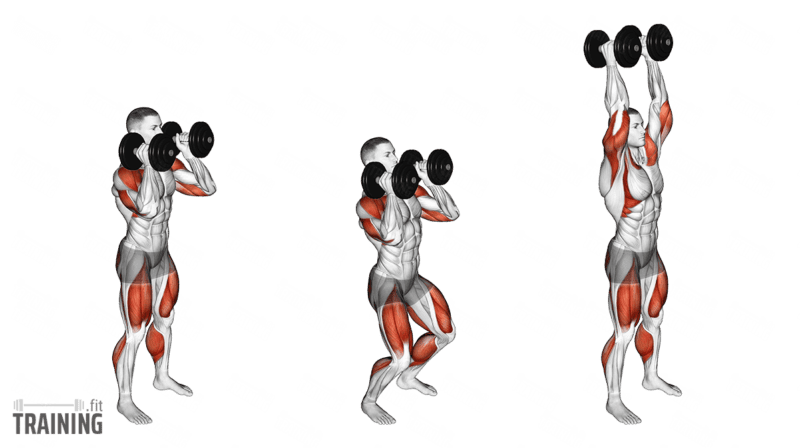
Main muscles
- Shoulder: Anterior deltoid muscle
(Musculus deltoideus, Pars clavicularis) - Shoulder: Medial deltoid muscle
(Musculus deltoideus, Pars acromialis) - Triceps: Three-headed arm muscle
(Musculus triceps brachii) - Thigh: Quadriceps
(Musculus quadriceps femoris) - Buttocks: Large gluteus maximus
(Musculus gluteus maximus) - Abdomen: Transverse abdominal muscle
(Musculus transversus abdominis)
Training plans
Dumbbell Push Jerk is a suitable substitute for similar exercises in Conditioning and full-body or as a supplement to various training plans.
Dumbbell Push Jerk: Basics and alternatives
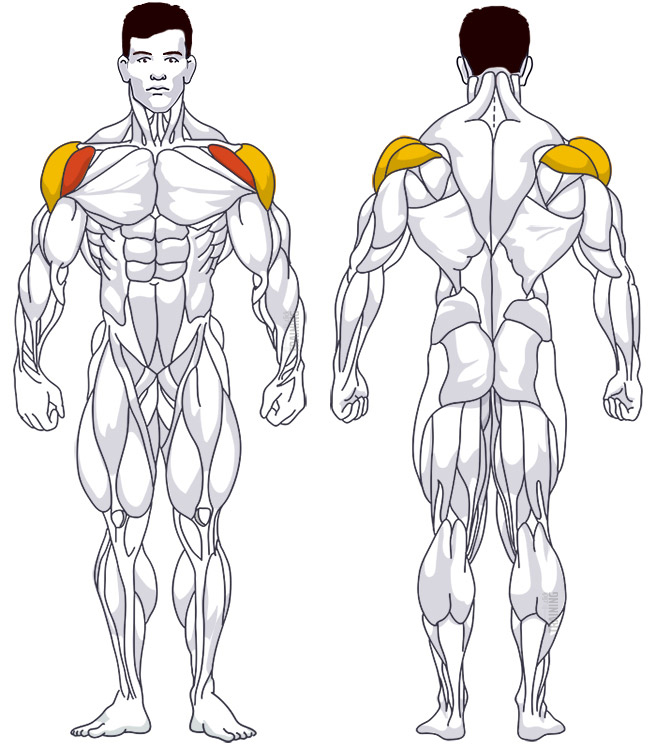
Involved main muscle groups:
Dumbbell Push Jerk
The dumbbell push jerk combines a quick leg drive with an overhead catch. Dip and drive, then bend your knees again as your arms straighten under the weights. Once both dumbbells are steady, stand up with them overhead. Your legs drive the weights up while your shoulders and triceps push you underneath and lock them out.
With the Push Press, you finish pressing with straight legs after the initial drive. Ordinary dumbbell shoulder presses leave out both the leg drive and the receiving dip. With the Squat Jerk, the barbell is received in a deep squat. The dumbbell push jerk described here uses a much shallower receiving position.
Correct execution
Bring two manageable dumbbells up to your shoulders with a secure grip, your palms facing in or slightly forward. Set your feet about hip- to shoulder-width apart and let your forearms support the weights. Before you go heavy, practice the sequence: dip, drive, catch, stand.
Dip a short way while staying upright, then straighten your hips and knees quickly. As the weights rise, bend your knees again and push yourself under them as your arms straighten. Catch both dumbbells overhead with your feet firmly planted and the weights balanced above you. Keep your torso controlled and actively hold the weights up with your arms and shoulders. Only stand once both sides are balanced. Lower the dumbbells to your shoulders, bending your knees slightly to cushion their return. Stand upright again before the next repetition. The brief second knee bend is the defining part of the jerk.
Keep the weights supported at your shoulders until the leg drive starts moving them. Pressing early can turn the dip into an awkward half press before your legs have finished extending. Rehearse the timing with empty hands at your shoulders, then use light dumbbells.
Land in a balanced stance; don’t jump forward to get under the weights. Once you’re standing, bring each dumbbell back down close to your shoulder on the same side instead of swinging it out around your head.
Video tutorial
Step-by-step instructions
Bring both dumbbells to your shoulders.
Take a balanced stance with a secure grip.
Brace your trunk and dip a short distance with an upright torso.
Extend your hips and knees quickly to drive both weights upward.
Bend your knees again as you extend your arms and receive the dumbbells overhead in a partial squat.
Stabilize both weights, then stand with your arms still extended.
Lower the dumbbells to your shoulders with control and reset before your next rep or before putting the dumbbells down.
Common mistakes
If you finish the lift by pressing with straight legs, you’re doing a push press, not a push jerk. Practice the second knee bend with light weights so your arms straighten just as you catch the dumbbells.
Standing before both weights settle can pull your torso out of position if one drifts or an arm bends. Stabilize first and use lighter weights if both sides can’t finish together. A deep, slow first dip also changes the timing; keep it short and controlled.
What the science says
The push jerk has been studied relatively little. The studies below looked at the barbell push jerk and related overhead lifts, so they describe the movement pattern rather than the dumbbell version.
In one study, 16 people with about 2 years of weightlifting experience (12 men and 4 women) did the push press, push jerk and split jerk. They used the same barbell load for all 3 lifts: 80% of the most they could push press once. Force and power during the dip and the drive didn’t differ meaningfully between the 3 lifts. With the same load, the leg drive was similar however the lift ended.[1]
A 2019 review found only 13 studies on overhead lifts from weightlifting, such as the push press, push jerk and split jerk. It describes them as lifts in which you produce force quickly by extending your hips, knees and ankles together, which is mechanically similar to many sports movements. The authors suggest these lifts may help athletes develop power and maximal strength, while noting that long-term training studies of these lifts were still lacking.[2]
For now, support for the push jerk comes mainly from its mechanics rather than training studies. This research doesn’t establish how dumbbells compare with a barbell.
Sources
- No differences in weightlifting overhead pressing exercises kinetics. Soriano MA, Lake J, Comfort P, Suchomel TJ, McMahon JJ, Jiménez-Ormeño E, et al. Sports Biomechanics. 2024;23(11):2080–2092. doi: 10.1080/14763141.2021.1993983.
- Weightlifting Overhead Pressing Derivatives: A Review of the Literature. Soriano MA, Suchomel TJ, Comfort P. Sports Medicine. 2019;49(6):867–885. doi: 10.1007/s40279-019-01096-8.