Cobra Yoga Pose
Compound exercise, Body weightThis article is verified by 4 studies/publications.
Overview
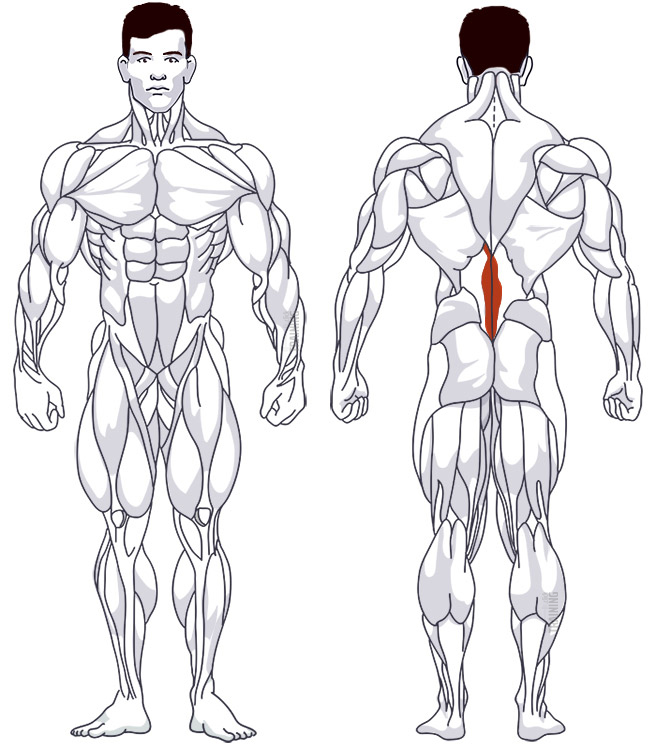
Main muscles
- Back: Back extensor
(Musculus erector spinae)
Training plans
Cobra Yoga Pose is a suitable substitute for similar exercises in Mobility and balance or as a supplement to various training plans.
Cobra Yoga Pose: Basics and alternatives
Involved main muscle groups:
Cobra Yoga Pose
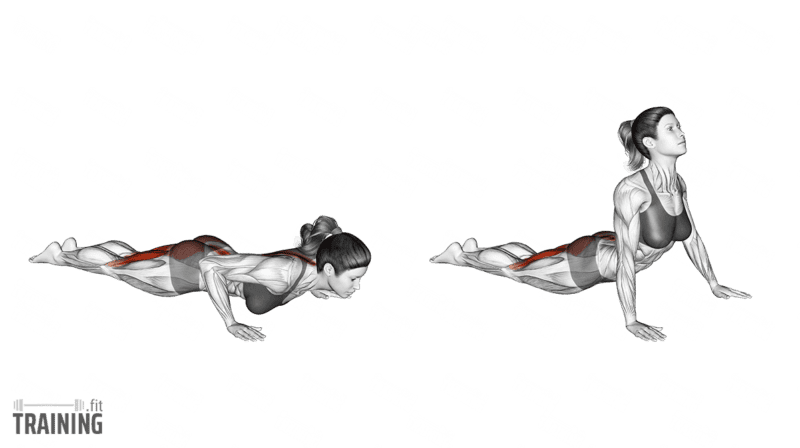
Cobra is a classic yoga backbend that you do lying on your stomach. You lift your chest while your pelvis and legs stay on the floor. Your back muscles help with the lift, and your hands can help you come up higher. How far you straighten your elbows depends on how high you can comfortably go.
The cat-and-cow movement alternates rounding and extending your back from your hands and knees. Downward-facing dog changes your body position by sending your hips upward and backward. You can practice these poses in the same yoga sequence, taking time to find the starting position for each one.
Correct execution
Cobra begins with lifting your chest, while your pelvis remains on the mat. You can keep the pose low and use your hands lightly instead of trying to straighten your arms at any cost.
Lie on your stomach with your legs comfortably close together or about hip-width apart. Point your feet back and place your palms beside your chest, below your shoulders, with your elbows pointing back. Lift your breastbone forward and up before adding pressure through your hands. Keep your pelvis in contact with the mat.
For a low cobra, leave your elbows clearly bent and use only light hand pressure. To rise farther, gradually press into your palms while keeping the backbend comfortable. The illustration shows a higher position, but you don’t have to go that far. Let your neck simply follow your upper back as your chest rises. Breathe while holding, then bend your elbows and lower your chest slowly. Lifting your thighs and pelvis turns the position into a different pose.
Keep your legs stretched out behind you on the mat, with your toes pointing straight back as your chest rises. You can leave a little space between your feet, so there’s no need to squeeze your knees together. Keep both palms flat on the mat so your hands don’t slide as your elbows move back.
In low cobra, briefly ease pressure on your hands to check whether your back muscles lift your chest or your arms are only pushing you up. Stay near the floor for this check. Add hand pressure smoothly, and stop if you find yourself forcing the bend into your lower back. Lower your chest toward the mat before relaxing your arms; don’t drop onto your chin.
Video tutorial
Step-by-step instructions
Lie on your stomach with your legs extended and the tops of your feet on the floor.
Place your palms near your shoulders and point your elbows back.
Inhale and lift your chest forward and up, keeping your pelvis down.
Add gentle hand pressure if you can rise farther without discomfort; keep your elbows bent as needed.
Keep breathing as you hold the position, then bend your elbows and lower your chest under control.
Common mistakes
Pushing immediately to straight arms can create a backbend you can’t comfortably support. Begin lower and use your hands gradually.
Lifting your pelvis changes cobra into another pose, so keep it on the mat. Let your head follow your chest rather than pulling back on its own. If your shoulders bunch near your ears, lower a little and keep your chest broad.
What the science says
Research on the cobra itself is limited to muscle activity. Other studies looked at the prone press-up, a similar backbend on straight arms that’s used in physical therapy, mostly in people with low back pain. None of these studies examined the effects of regular practice over several weeks.
In a 2020 study, 8 experienced yoga practitioners (5 women, 3 men) went through the sun salutation, a sequence of 12 poses that includes cobra. While they held the cobra, the broad back muscle (latissimus dorsi) worked at 37.4% of its maximum, its highest level in any held pose of the sequence. For every muscle measured, activity was greater during transitions between poses than during the holds.[1]
A 2018 study took MRI scans of 22 people with low back pain before and right after a session of press-ups. No statistically significant change in fluid content was detected in the 2 lowest discs in their lower back, and the fluid shifted only very slightly at 1 level. The authors concluded that changes in disc fluid probably don’t explain any symptom relief from these exercises.[2]
Another study with 30 adults with nonspecific low back pain compared a single session of press-ups with a single session of spinal mobilization by a therapist. Both groups had less pain and could bend their lower back further backward afterward, with no statistically significant difference detected between them. The authors nevertheless questioned whether the pain reduction was large enough to be meaningful in practice.[3]
An older study with 62 pain-free adults measured the lower back muscles in different positions. They were more active during a press-up than when lying flat on the stomach or standing, despite this type of back extension often being described as passive.[4]
Sources
- Exploration of muscle activity using surface electromyography while performing surya namaskar. Mullerpatan RP, Agarwal BM, Shetty TV. International Journal of Yoga. 2020;13(2):137–143. doi: 10.4103/ijoy.ijoy_72_19.
- MRI evaluation of the effects of extension exercises on the disc fluid content and location of the centroid of the fluid distribution. Abdollah V, Parent EC, Battié MC. Musculoskeletal Science and Practice. 2018;33:67–70. doi: 10.1016/j.msksp.2017.11.008.
- Effects of a Single Session of Posterior-to-Anterior Spinal Mobilization and Press-up Exercise on Pain Response and Lumbar Spine Extension in People With Nonspecific Low Back Pain. Powers CM, Beneck GJ, Kulig K, Landel RF, Fredericson M. Physical Therapy. 2008;88(4):485–493. doi: 10.2522/ptj.20070069.
- Are “Passive” Extension Exercises Really Passive?. Fiebert I, Keller CD. Journal of Orthopaedic & Sports Physical Therapy. 1994;19(2):111–116. doi: 10.2519/jospt.1994.19.2.111.