Band Shoulder Press
Compound exercise, Free weightsThis article is verified by 3 studies/publications.
Overview
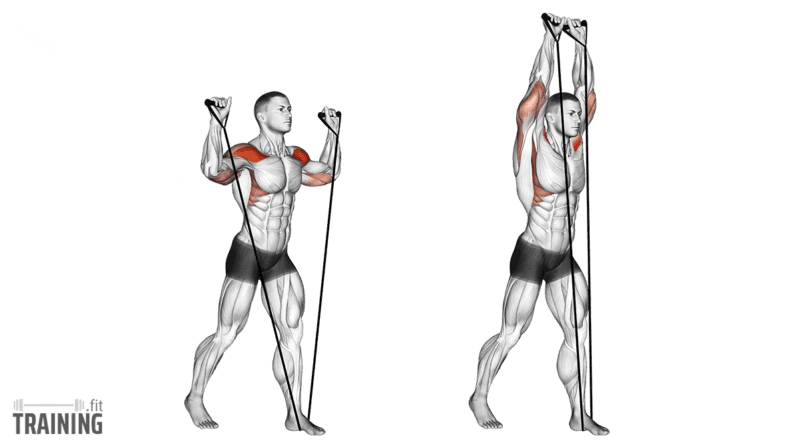
Main muscles
- Shoulder: Anterior deltoid muscle
(Musculus deltoideus, Pars clavicularis) - Shoulder: Medial deltoid muscle
(Musculus deltoideus, Pars acromialis) - Triceps: Three-headed arm muscle
(Musculus triceps brachii)
Training plans
Here you can find example plans for band shoulder press training:
Band Shoulder Press: Basics and alternatives
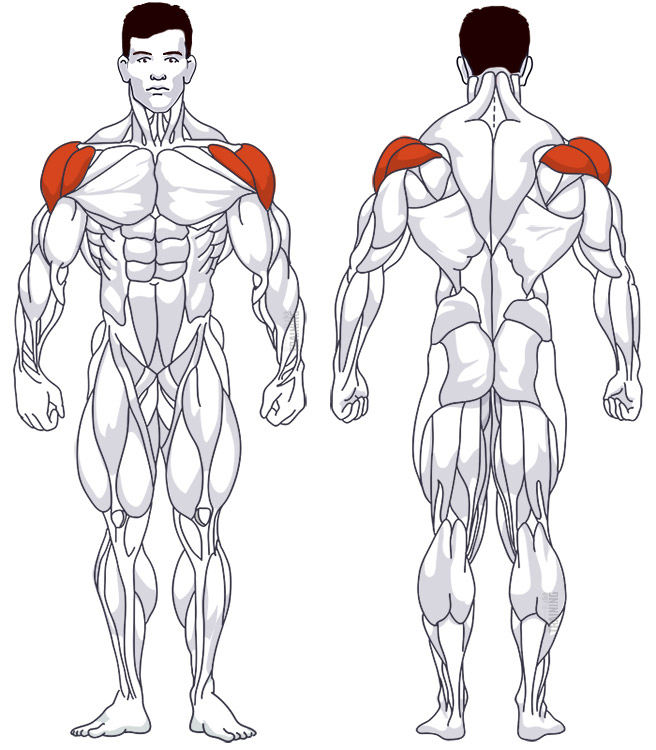
Involved main muscle groups:
Band Shoulder Press
The standing band shoulder press uses a simple band setup. You’ll stand on the band and press both hands from shoulder level to overhead. Your shoulders and triceps press while your abs keep you steady; you don’t need a bench or cable station.
If you prefer to sit, seated band shoulder presses use the same pressing movement with a different band setup. Single-arm band presses train one arm at a time. Here, both arms press together while your legs stay still.
Correct execution
The band pulls downward from your feet while your arms press up. Equal lengths on each side help you set up a balanced press without shifting your body to one side.
Anchor the band beneath the middle of both shoes and start with equal lengths on each side. Bring your hands beside your shoulders with your palms facing more or less forward. Your forearms stay roughly upright beneath your hands. Let your elbows point slightly forward.
Check that the band runs freely from your shoes to your hands, without catching behind your elbows. Lower your hands and let the band go slack before untwisting a handle strap or adjusting its position.
Press up while you stay tall, and let your shoulder blades rotate upward as your arms rise. Your hands can come a little closer together overhead, but the handles don’t need to touch. Lower slowly, keeping your hands above your elbows and your grip secure.
Choose a band that lets you finish the whole press without arching your back. If the top is too hard, use a lighter band or a longer working section. Keep your feet in place throughout. When finished, lower your hands until the band is slack before stepping off it.
Video tutorial
Step-by-step instructions
Place the band under the middle of both shoes and take an end or handle in each hand.
Stand upright and bring your hands to shoulder level, palms facing more or less forward.
Keep your ribs over your pelvis and position your wrists above your elbows.
Press both hands up and straighten your elbows, keeping your legs still.
Lower your hands slowly to the same shoulder-level starting position.
After the set, lower your hands until the band is slack before stepping off it.
Common mistakes
Leaning back to get the band up changes the angle of the press. If your upper body shifts as your hands rise, switch to a lighter band.
Lower your hands slowly so the band never pulls them down faster than you can control. Your wrists shouldn’t bend back under the handles; keep them in line with your forearms and adjust the handles before pressing again.
Don’t rise onto your toes to finish the press. Your feet hold the band in place, so lifting your heels changes that contact. If you can only get the handles up by lifting your whole body, use a lighter band so both feet can stay flat.
What the science says
Research on band shoulder presses has largely focused on judging exercise intensity when the band has no marked weight. In both band studies below, people rated how hard their first rep felt on a scale up to 10.
In 13 recreationally active adults, the harder the first rep of a band military press, fly or push press felt, the fewer reps they managed before they had to stop. Ratings were consistent across sessions. Training experience also influenced the number of reps completed.[1]
A 2026 study with 12 active older adults (6 women and 6 men, average age 67) used the same basic setup as this article: standing with the band under both feet and one end in each hand. The first-rep rating predicted how many reps they could do, and activity in the front shoulders and triceps rose clearly with higher ratings. Activity continued to rise through each set, although the increase was small during the final quarter.[2]
In 15 healthy men, standing dumbbell shoulder presses produced the most shoulder (deltoid) activity of 4 barbell and dumbbell versions. Rear shoulder activity was about a quarter lower seated than standing, even though the men’s dumbbell max was about 10% lower standing than seated.[3]
These single-session tests describe muscle activity during the exercises. They don’t establish which version produces greater muscle or strength gains over time.
Sources
- Rating of Perceived Exertion in the First Repetition is Related to the Total Repetitions Performed in Elastic Bands Training. Colado JC, Gené-Morales J, Jiménez-Martínez P, Flandez J, Ferri-Caruana AM, Babiloni-Lopez C. Motor Control. 2023;27(4):830–843. doi: 10.1123/mc.2023-0017.
- Perceived Exertion, Neuromuscular Activation, and Training Volume in Older Adults: Validating RPE-1 in Moderate-Velocity Elastic Band Resistance Training. Colado JC, Gene-Morales J, Chulvi-Medrano I, Babiloni-Lopez C, Moreno-Murcia JA, Saez-Berlanga Á. International Journal of Sports Physical Therapy. 2026;21(1):13–25. doi: 10.26603/001c.147897.
- Effects of Body Position and Loading Modality on Muscle Activity and Strength in Shoulder Presses. Saeterbakken AH, Fimland MS. Journal of Strength and Conditioning Research. 2013;27(7):1824–1831. doi: 10.1519/jsc.0b013e318276b873.