Dumbbell Side Plank With Rear Fly
Compound exercise, Free weightsOverview

Main muscles
- Abdomen: External oblique abdominal muscle
(Musculus obliquus externus abdominis) - Shoulder: Posterior deltoid muscle
(Musculus deltoideus, posterior deltoid muscle) - Neck: Trapezius muscle
(Musculus trapezius)
Training plans
Dumbbell Side Plank With Rear Fly is a suitable substitute for similar exercises in Abs workout or as a supplement to various training plans.
Dumbbell Side Plank With Rear Fly: Basics and alternatives
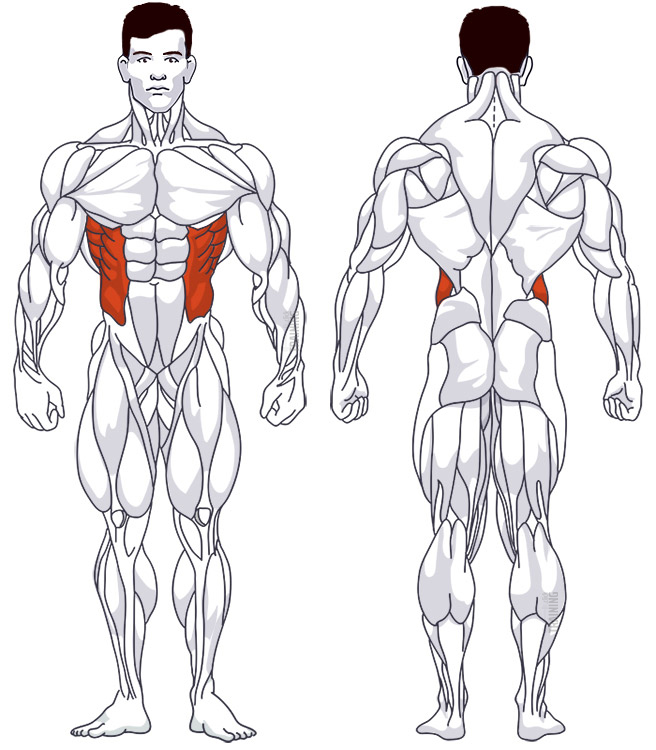
Involved main muscle groups:
Dumbbell Side Plank With Rear Fly
Combining a dumbbell rear fly with a side plank challenges your balance and coordination. In the version shown, you’re supported on your hand with your bottom arm straight. Lift the dumbbell in your top hand from in front of your torso toward the ceiling while keeping your waist lifted.
You’ll need to hold a side plank steadily before adding the arm movement. With Reverse Flys, you can work on the arm movement without balancing on one hand. Combining the movements makes coordination part of the exercise, so use a dumbbell that stays easy to control throughout the arc.
Correct execution
Place a light dumbbell within reach and set your bottom hand under your shoulder. Straighten your legs and stack your feet, or put your top foot slightly forward for a wider base. Lift your hips until your shoulders, hips and ankles form a straight line, then pick up the dumbbell with your top hand. Start with it in front of your chest and your elbow slightly bent.
Open your arm upward in a wide arc. Let your shoulder blade move with it, but keep your pelvis from rolling backward. Stop with your hand roughly above your shoulder, or earlier if your hips start to follow the weight, then lower slowly along the same arc. You can also practice the exercise on the forearm of your bottom arm, with your elbow under your shoulder, or with your bottom knee on the floor. Both change the support compared with the straight-arm version shown. Set the dumbbell down before lowering or changing sides.
Try the arm movement with an empty hand first. Spread your supporting fingers and press into the floor as your top hand moves. Follow the dumbbell with your eyes and let your upper body turn with your arm as far as is comfortable, but keep your pelvis steady. Keep your top wrist straight and return the weight within easy reach so you don’t lean far to set it down.
Video tutorial
Step-by-step instructions
Place a light dumbbell within reach.
Set your bottom hand beneath your shoulder.
Extend your legs, choose a stable foot position and lift into a side plank.
Hold the dumbbell in your top hand in front of your chest with a slight elbow bend.
Open that arm upward until your hand is roughly above your shoulder, or stop earlier if your hips start to turn. Keep your pelvis from rolling backward.
Lower the dumbbell slowly along the same arc and repeat as long as your side plank stays steady.
Set the weight down, lower your hips and set up on the other side.
Common mistakes
Throwing the weight upward can turn your whole body along with it, so the arm movement is no longer controlled. Use a lighter dumbbell and stop the arc before you start to roll.
Your supporting shoulder can sink or your waist sag when you’re focused on the dumbbell. Press into the floor and keep your hips lifted; practice the fly and plank separately if needed. Keep your top elbow slightly bent throughout, since bending and straightening it a lot turns the fly into a row.