Resistance Band Single Arm Overhead Shoulder Press
Compound exercise, Free weightsThis article is verified by 2 studies/publications.
Overview
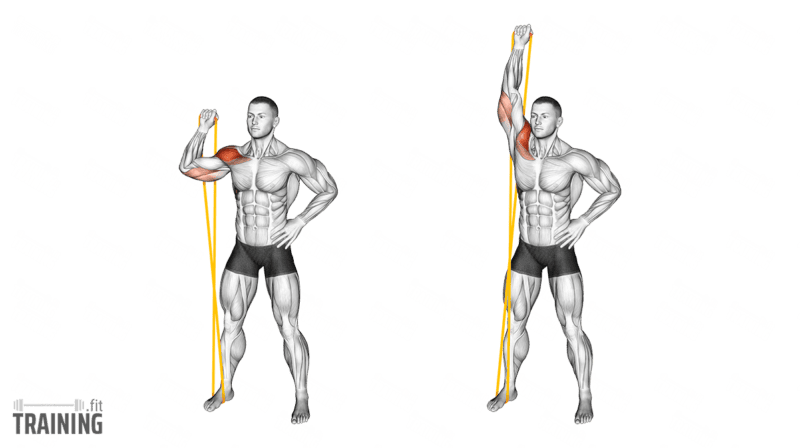
Main muscles
- Shoulder: Anterior deltoid muscle
(Musculus deltoideus, Pars clavicularis) - Shoulder: Medial deltoid muscle
(Musculus deltoideus, Pars acromialis) - Triceps: Three-headed arm muscle
(Musculus triceps brachii)
Training plans
Here you can find example plans for resistance band single arm overhead shoulder press training:
Resistance Band Single Arm Overhead Shoulder Press: Basics and alternatives
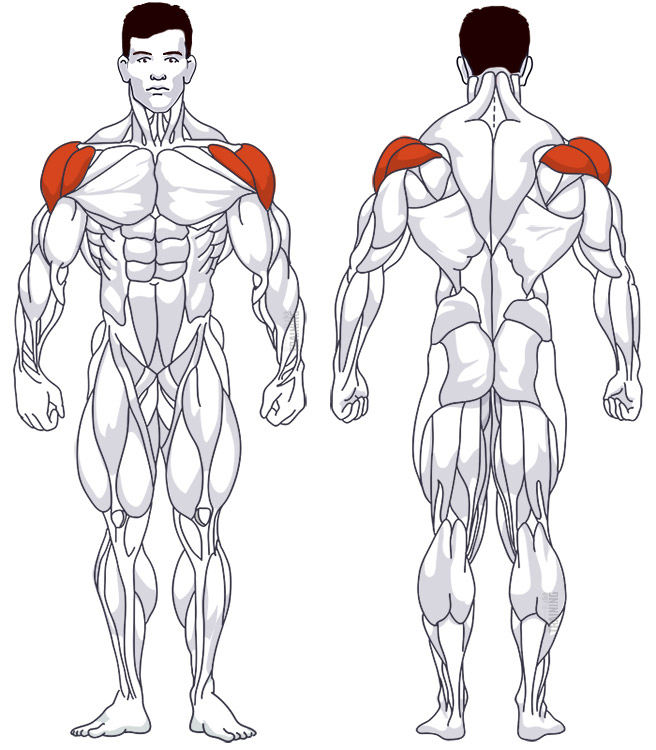
Involved main muscle groups:
Resistance Band Single Arm Overhead Shoulder Press
This band shoulder press uses a simple one-arm setup. Anchor the band under the foot on your working side and press from shoulder level to overhead, leaving your other arm free. Your shoulder and triceps drive the press while your torso stays upright against the downward pull.
Standing band shoulder presses use both arms together. For a free-weight alternative, you can do a dumbbell shoulder press with one dumbbell. You can adjust the band length separately for each side.
Correct execution
Check that the band length suits the distance from your foot to your overhead hand. Start with your hand near shoulder level and your forearm fairly upright. Place your elbow slightly in front of your torso if that gives you a more comfortable pressing path.
Keep your head in line with your trunk and let your shoulder blade move as your arm rises. There’s no need to lean away from the band or push your hip out to the side. If the top of the press pulls you off balance, use less resistance before you try to press higher.
Keep pressure through both feet, even though only one shoe anchors the band. Resting your free hand lightly on your waist helps you notice whether your pelvis shifts; just don’t push against your hip to help your working arm. Keep looking straight ahead as your hand rises.
After each press, guide your hand back to the same spot beside your shoulder, not across your chest or behind your head. Hold the handle firmly and make sure the band runs clear along the outside of your working arm; test that route before you stretch the band farther.
Video tutorial
Step-by-step instructions
Secure one end of the band beneath your working-side shoe and hold the other end in your hand on the same side.
Stand with your feet comfortably apart and bring your hand beside your shoulder.
Align your wrist with your forearm and brace your torso without leaning sideways.
Press your hand overhead while straightening your elbow and keeping your legs still.
Lower your hand slowly to shoulder level along the same path. Release the tension with control, change the band position and repeat on the other side.
Common mistakes
Leaning sideways is a common mistake, since it brings your torso into what should be a shoulder and elbow movement. Keep your torso centered over your feet and use a lighter band if needed.
Dipping your knees and driving upward turns the exercise into a push press, so keep your legs still. Also check that the band is secure beneath the other shoe after you change sides; an uneven or slipping anchor makes the resistance hard to control.
Release the tension before setting up the other side, and compare the free band length from shoe to hand. Your overhead range may differ between arms; use a comfortable hand and elbow position and don’t lean to make both hands reach the same height.
What the science says
The single-arm band shoulder press has received little direct research attention. The 2 studies below looked at a two-arm band overhead press and at one-arm versus two-arm shoulder presses. Both measured muscle activity in single sessions, which shows how hard muscles work, not how much they grow.
In a study, 12 active older men and women experienced with band training did standing band overhead presses to failure. They adjusted their grip on the band until the first rep matched a target effort rating, using 4 different targets. The harder the first rep felt, the more active the front shoulder and triceps were, and the fewer reps they managed. The authors conclude that older adults can reliably set band intensity this way.[1]
In a study with 11 adults (6 men, 5 women), a one-arm shoulder press made the lower back muscles that steady the trunk (erector spinae) work harder than a two-arm press. Trunk muscle activity during the shoulder press was unchanged when a Swiss ball replaced the bench.[2]
Together, these studies suggest that rating your effort can help you choose a band, at least in experienced older adults, and that pressing with one arm asks more of your back muscles. Neither study examined this exact exercise.
Sources
- Perceived Exertion, Neuromuscular Activation, and Training Volume in Older Adults: Validating RPE-1 in Moderate-Velocity Elastic Band Resistance Training. Colado JC, Gene-Morales J, Chulvi-Medrano I, Babiloni-Lopez C, Moreno-Murcia JA, Saez-Berlanga Á. International Journal of Sports Physical Therapy. 2026;21(1):13–25. doi: 10.26603/001c.147897.
- Trunk Muscle Electromyographic Activity With Unstable and Unilateral Exercises. Behm DG, Leonard AM, Young WB, Bonsey WA, MacKinnon SN. Journal of Strength and Conditioning Research. 2005;19(1):193–201. doi: 10.1519/1533-4287(2005)19<193:tmeawu>2.0.co;2.