Lateral Raise
Isolation exercise, Free weightsOverview

Main muscles
- Shoulder: Medial deltoid muscle
(Musculus deltoideus, Pars acromialis)
Training plans
Here you can find example plans for lateral raise training:
Lateral Raise: Basics and alternatives
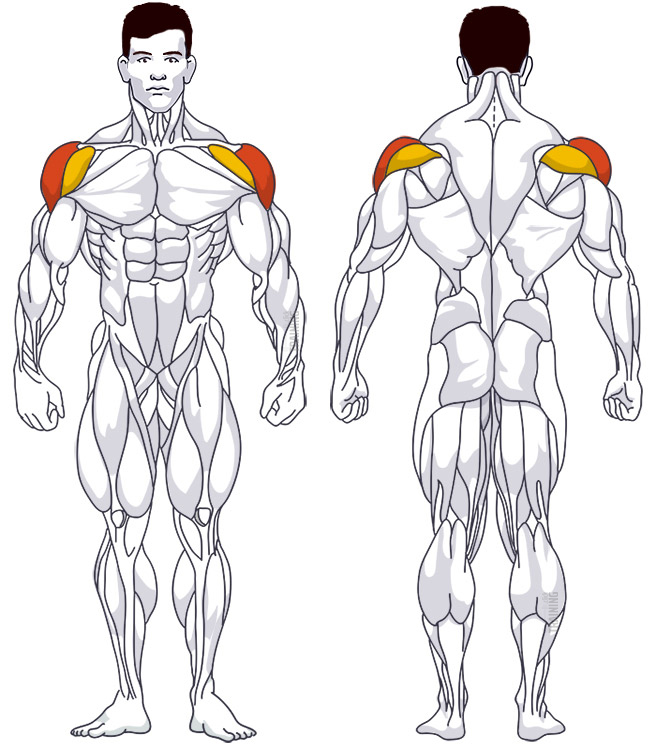
Involved main muscle groups:
Lateral Raise
The lateral raise is an awesome exercise that targets the middle part of your shoulders. To do this exercise, you’ll hold a dumbbell in each hand and raise them to the side, up to shoulder height, as the name suggests. The lateral raise is a super effective isolation exercise that not only focuses on the side deltoids but also works the front and back parts of your shoulders.
If you want to specifically target the front or back deltoids, you can try the front raise or the reverse fly. Both exercises use dumbbells and are excellent additions to the lateral raise.
For a comprehensive shoulder workout, give the dumbbell shoulder press a try. It works all three parts of your shoulder muscle. However, be mindful that this exercise can be hard on your joints, so if you’re dealing with shoulder pain, choose exercises and weights you can handle without making your symptoms worse.
Correct execution
When performing the lateral raise, keep a slight bend in your elbows and ensure the backs of your hands are facing up. How you rotate your arms can change which parts of your shoulder muscles do more of the work. If you turn your palms forward, the load will shift forward slightly.
Although it’s tempting to use heavy weights to build your shoulders, it’s best to resist this temptation. The lateral raise requires a lot of strength due to the lever, so even low weights (especially at first) will offer a good training stimulus. Using heavy weights can lead to an incomplete movement at the end because the lever effect becomes too great. So, start with lighter weights and gradually increase them.
Video tutorial
Step-by-step instructions
Grab dumbbells in both hands.
Stand in front of a mirror, with your feet about shoulder-width apart.
Bend your elbows slightly, with the backs of your hands facing away from your body and outward. This is the starting position.
Slowly lift the dumbbells until your arms are parallel to the ground, maintaining the slight bend in your elbows. Avoid rotating your arms during the lift.
Hold the position for a brief moment, and then lower your arms back to the starting position, slowly and under control.
Common mistakes
When doing the lateral raise, it’s crucial to avoid swinging the weight. If you can’t lift the weight smoothly and with control, lower the weight. Swinging reduces the training stimulus and puts extra stress on your shoulder joints.
Also, maintain a slight bend in your elbows and keep the backs of your hands facing up. Avoid rotating your arms during the exercise.