Dumbbell Front Squat
Compound exercise, Free weightsThis article is verified by 3 studies/publications.
Overview
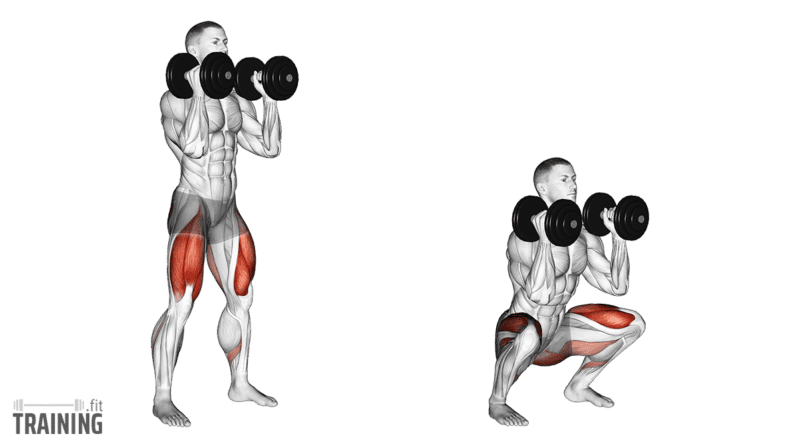
Main muscles
- Thigh: Long adductor muscle
(Musculus adductor longus) - Thigh: Quadriceps
(Musculus quadriceps femoris) - Thigh: Thigh flexor
(Musculus biceps femoris) - Buttocks: Large gluteus maximus
(Musculus gluteus maximus)
Training plans
Here you can find example plans for dumbbell front squat training:
Dumbbell Front Squat: Basics and alternatives
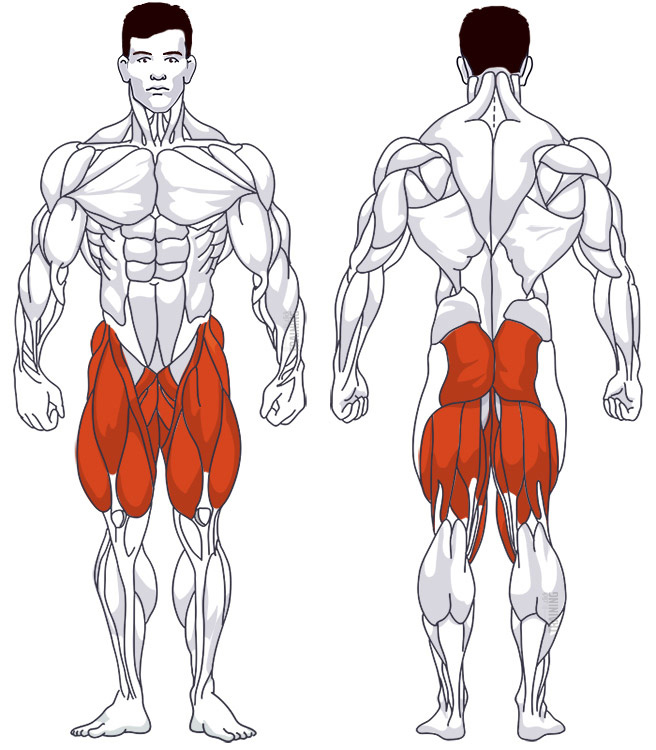
Involved main muscle groups:
Dumbbell Front Squat
In dumbbell front squats, you hold two weights close to your shoulders. Bend your hips and knees to lower yourself, then stand back up. Your thighs and butt lift you while your core steadies your upper body and the weights stay put.
With dumbbell goblet squats, you hold one weight in front of your chest. Front squats use a barbell across the front of your shoulders. Two dumbbells allow each hand its own grip, but you’ll need to keep both weights securely supported as you squat.
Correct execution
Bring a manageable dumbbell to each shoulder with your palms facing inward. Rest the weights against your shoulders where their shape allows and keep a firm grip. Your wrists should stay roughly in line with your forearms, with your elbows pointing forward enough to hold the dumbbells securely. Adjust your grip before starting so the weights don’t press against your jaw or slip forward.
Stand with your feet about shoulder-width apart, turning your toes slightly outward if comfortable. Brace your abs and bend your hips and knees together to lower yourself. Keep your feet firmly on the floor and your knees pointing in the same direction as your toes.
Your upper body can lean forward slightly to keep you balanced. Avoid rounding your back or deliberately arching it, and keep the weights at your shoulders. Squat only as low as you can control with both feet flat and the dumbbells secure.
Stand up by extending your hips and knees together, then pause briefly before the next repetition. The weights stay at your shoulders; you don’t press them overhead. Lower them with control when you’ve finished the set.
Video tutorial
Step-by-step instructions
Bring a dumbbell to each shoulder and hold both firmly with your palms facing inward.
Stand with your feet around shoulder-width apart and brace your abs.
Bend your knees and hips to lower into the squat, keeping both dumbbells close.
Squat to a comfortable depth, keeping your feet firmly on the floor and your knees in line with your toes.
Keep pressure across both feet and stand up without letting your hips shoot up first.
Regain your balance before repeating and lower the weights under control when finished.
Common mistakes
If your elbows drop and the dumbbells roll forward, you’ll struggle to hold your position through the squat. Use lighter weights and keep them close to your shoulders.
Don’t lift your heels or round your back to squat deeper; go only as low as you can control. Adjust your stance or shorten the movement until you can keep your feet flat and the weights steady. At the top, stand tall and don’t lean back.
Avoid pressing the dumbbells up at the top. If one starts to slide, stand steady, then lower both dumbbells and fix your grip.
What the science says
Few studies have examined the dumbbell front squat directly. One did; others used a barbell to test what changes when the weight sits in front of your body rather than on your back. All of them looked at single sessions, not at muscle or strength gains over time.
In a 2025 study, 12 men and 18 women with an average age of 48 and a few years of strength training experience did 16 exercises while a belt sensor measured the tension in their abdominal wall. Loads ranged from their 15-rep to their 1-rep max. The dumbbell front squat was among the exercises with the greatest increases, together with the Romanian deadlift and the leg press, and clearly above single-joint upper-body exercises. At heavier loads, the increase in the measured values was greater for men than for women.[1]
In a 2024 study, 10 men and 8 women squatted with a barbell and with a special bar that shifts the weight forward or backward, always with the same load. The farther forward the weight sat, the more upright their upper body stayed and the less their pelvis tilted forward, but the demand on the lower back went up. Loads at the hips, knees and ankles remained broadly similar.[2]
A 2015 study had 12 young adults do barbell front squats and back squats with their maximum load. On the way up, the inner front thigh muscle (vastus medialis) was more active in the front squat, while one of the hamstrings (semitendinosus) was more active in the back squat. Participants also leaned their upper body clearly farther forward in the back squat.[3]
Sources
- Changes of abdominal wall tension across various resistance exercises during maximal and submaximal loads in healthy adults: a cross-sectional study. Jurik R, Stastny P, Kolinger D, Vetrovsky T, Novak J, Kobesova A, et al. BMC Sports Science, Medicine and Rehabilitation. 2025;17(1):114. doi: 10.1186/s13102-025-01161-y.
- Biomechanical comparisons of back and front squats with a straight bar and four squats with a transformer bar. Goršič M, Rochelle LE, Layer JS, Smith DT, Novak D, Dai B. Sports Biomechanics. 2024;23(2):166–181. doi: 10.1080/14763141.2020.1832563.
- Kinematic and EMG activities during front and back squat variations in maximum loads. Yavuz HU, Erdağ D, Amca AM, Aritan S. Journal of Sports Sciences. 2015;33(10):1058–1066. doi: 10.1080/02640414.2014.984240.