Dumbbell Goblet Squat
Compound exercise, Free weightsThis article is verified by 3 studies/publications.
Overview
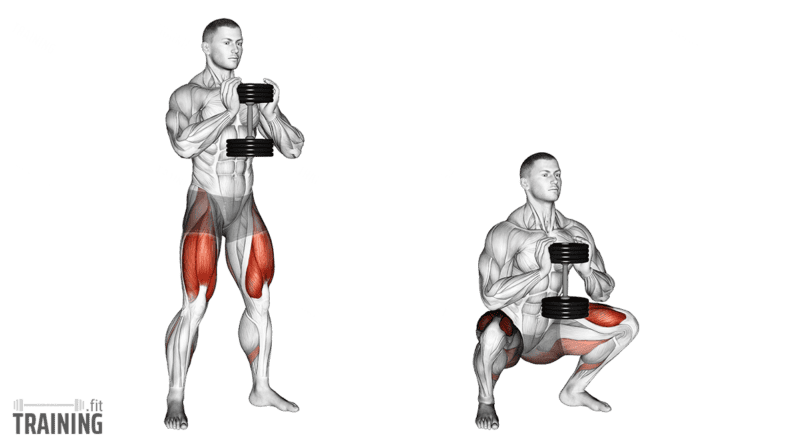
Main muscles
- Thigh: Long adductor muscle
(Musculus adductor longus) - Thigh: Quadriceps
(Musculus quadriceps femoris) - Thigh: Thigh flexor
(Musculus biceps femoris) - Buttocks: Large gluteus maximus
(Musculus gluteus maximus)
Training plans
Here you can find example plans for dumbbell goblet squat training:
Dumbbell Goblet Squat: Basics and alternatives
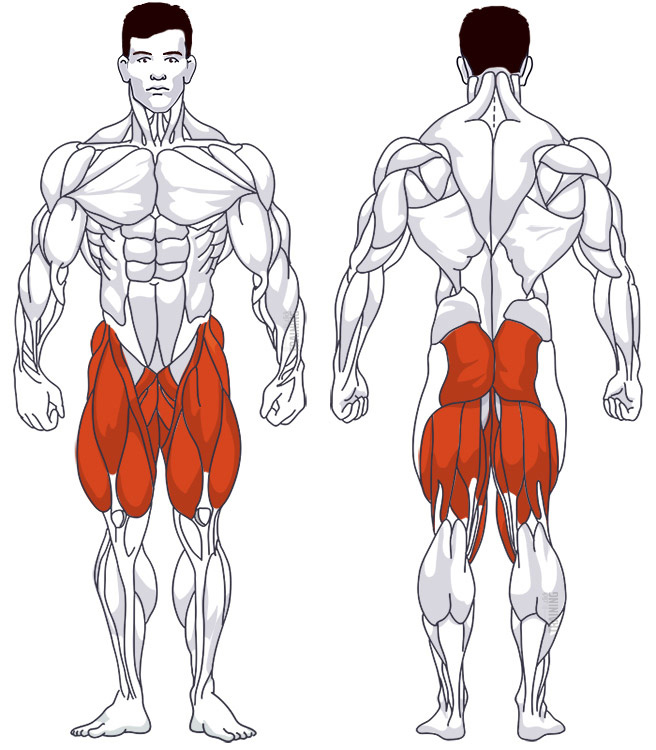
Involved main muscle groups:
Dumbbell Goblet Squat
The goblet hold keeps one dumbbell close to your chest through a classic squat. You’ll bend your hips and knees to lower yourself, then stand back up. Your thighs and butt do the squatting while your arms and core keep the weight in place.
Dumbbell front squats place a separate dumbbell at each shoulder. With squats, you can practice your stance and depth before adding a weight. You can also do goblet squats at home if you have a suitable dumbbell and enough space to set it down safely.
Correct execution
Cup both hands beneath the upper end of the dumbbell and keep it close to your chest. Check that any adjustable plates are firmly attached before using this grip. Your elbows point down and move between your thighs as you lower yourself; don’t use them to force your knees apart.
Start with your feet around shoulder-width apart and adjust your stance to suit your build. Lower yourself smoothly by bending your knees and hips together, keeping both feet flat on the floor and your knees in line with your toes. Go only as low as you can control with the dumbbell close to your chest. Pause at the bottom while staying tight, then stand back up.
Choose a dumbbell whose upper end rests securely on the heels of both hands. Keep your fingers clear of moving adjustment parts and fix an uncertain grip before you squat, not halfway down.
Your elbows can travel inside your knees, but your arms still support the weight at the bottom; don’t rest your elbows on your thighs. If the lower end of the dumbbell catches on your stomach or thighs, adjust your grip or stance before you continue.
Video tutorial
Step-by-step instructions
Check the dumbbell and hold it vertically in both hands just in front of your chest.
Set your feet around shoulder width, with your toes turned out at a comfortable angle.
Brace your trunk and bend your knees and hips to lower between your feet.
Keep the weight close and stop at a controlled, comfortable depth.
Press through both feet to stand upright, keeping your elbows beneath the weight. Reset your posture and repeat before putting the dumbbell down with both hands.
Common mistakes
Holding the dumbbell at arm’s length makes the position difficult to maintain. Keep it close to your chest so you can squat without leaning forward to balance it.
At the bottom of the squat, it’s easy to start bouncing or to use your elbows to pry your knees farther apart. Pause under control instead, and let your knees follow your toes on their own. If your feet lift or your pelvis suddenly shifts, squat a little less deep and adjust your stance. At the top, just stand tall; there’s no need to push your hips forward past the standing position.
Your legs may handle more weight than your goblet grip can support. If the hold becomes the hardest part, stop adding weight and choose a dumbbell you can bring to your chest and lower smoothly.
What the science says
The goblet squat itself has been examined in only a few studies. Research on other front-loaded squats helps explain what holding the weight in front of your body changes, although those studies used a barbell rather than a dumbbell at your chest.
A 2021 study with 16 men and 16 women compared the goblet squat with the landmine squat at a light load of 30% of body weight. The goblet squat produced more activity in the front thigh muscles and more vertical force, while the landmine squat shifted more of the force backward. Women showed greater front thigh muscle activity than men in both squat variations.[1]
In a 2024 study, 10 men and 8 women squatted with a barbell and with a special bar that moves the weight forward or backward. The farther forward the weight sat, the more upright their upper body stayed and the less their pelvis tilted forward, but the demand on the lower back increased. Loads at the hip, knee and ankle were largely unchanged.[2]
A frequently cited older study compared barbell front and back squats in 15 trained people. Muscle activity was similar, but the front squat put less compressive force on the knees. The authors therefore suggest that barbell front squats may be advantageous for people with knee problems, although nobody with knee problems took part in the study.[3]
Sources
- Differences in Muscle Activity and Kinetics Between the Goblet Squat and Landmine Squat in Men and Women. Collins KS, Klawitter LA, Waldera RW, Mahoney SJ, Christensen BK. Journal of Strength and Conditioning Research. 2021;35(10):2661–2668. doi: 10.1519/jsc.0000000000004094.
- Biomechanical comparisons of back and front squats with a straight bar and four squats with a transformer bar. Goršič M, Rochelle LE, Layer JS, Smith DT, Novak D, Dai B. Sports Biomechanics. 2024;23(2):166–181. doi: 10.1080/14763141.2020.1832563.
- A Biomechanical Comparison of Back and Front Squats in Healthy Trained Individuals. Gullett JC, Tillman MD, Gutierrez GM, Chow JW. Journal of Strength and Conditioning Research. 2009;23(1):284–292. doi: 10.1519/jsc.0b013e31818546bb.