Dumbbell Incline Hammer Press
Compound exercise, Free weightsThis article is verified by 4 studies/publications.
Overview
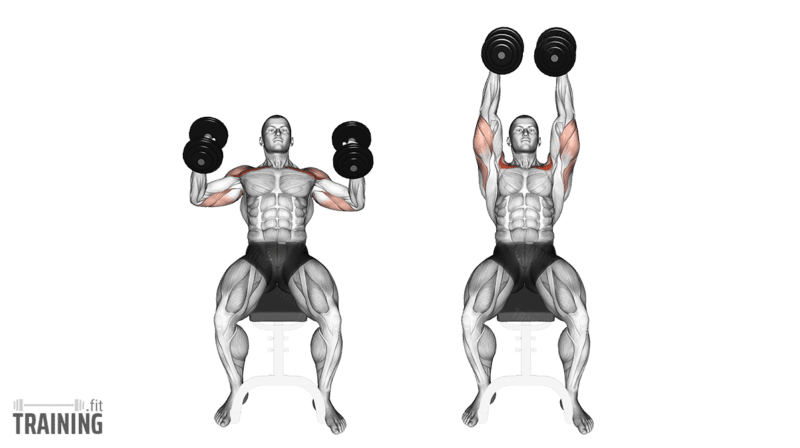
Main muscles
- Chest: Large pectoral muscle
(Musculus pectoralis major) - Chest: Small pectoral muscle
(Musculus pectoralis minor)
Training plans
Here you can find example plans for dumbbell incline hammer press training:
Dumbbell Incline Hammer Press: Basics and alternatives
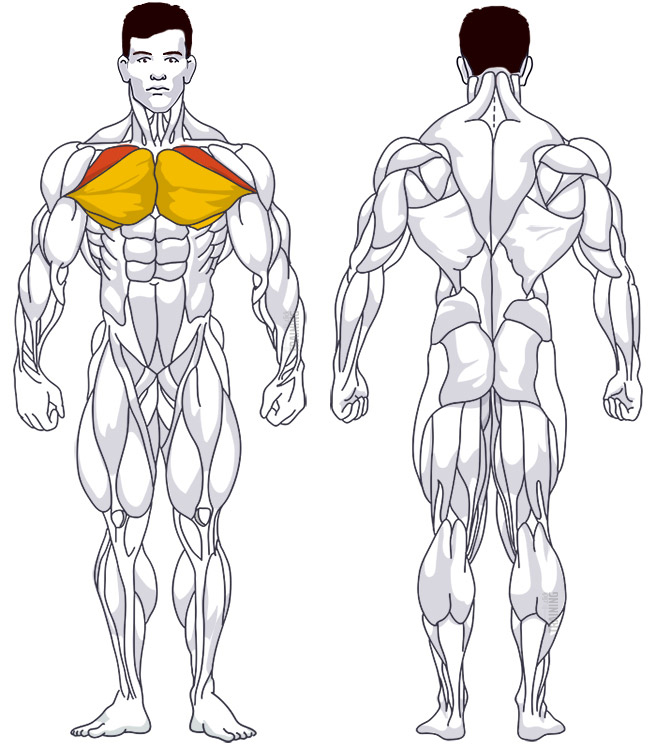
Involved main muscle groups:
Dumbbell Incline Hammer Press
A simple grip change distinguishes the incline dumbbell hammer press from incline dumbbell presses: your palms face each other throughout. You press from beside your chest to above it while lying on an incline. Your chest works with help from your shoulders and triceps.
Dumbbell bench presses use a flat bench. This version pairs an incline with a neutral grip; don’t rotate the dumbbells or squeeze them together.
Correct execution
Set the bench around 30 degrees and adjust it to an angle where the movement feels comfortable and controlled. Keep your feet planted and your butt against the seat. Rest your upper back on the pad and keep the arch in your lower back natural.
Your elbows stay a bit closer to your body than in a press with wide, flared elbows. Keep them under your hands so your wrists and forearms stay in line. Lower the dumbbells to a comfortable depth beside your chest; they don’t have to touch your body. Use a weight that lets both arms follow a similar path.
Bench angle changes the movement: a study of 30 trained adults found greater front-shoulder activation during barbell presses at 45- and 60-degree inclines than on a flat bench. The study measured activation rather than long-term muscle growth and didn’t test this specific dumbbell grip.[1]
A neutral grip doesn’t mean clamping your upper arms to your sides. Give the dumbbells enough room to pass your chest, keep each one above its forearm and let your upper arms follow a comfortable path.
Press both dumbbells upward at the same time. Breathe out as you press and in as you lower them. If you need a helper to get into or out of position, agree on that before you start, and keep holding the handles until your helper has the weights securely in hand.
Video tutorial
Step-by-step instructions
Set the incline bench, pick up the dumbbells and sit with them supported on your thighs.
Lean back with control and guide the dumbbells into position beside your chest, keeping your feet on the floor.
Turn both palms inward so they face each other and settle your upper back against the pad.
Press the dumbbells upward above your chest while keeping your palms facing each other.
Lower both weights slowly, keeping your forearms beneath the dumbbells and your butt on the bench.
After the set, lower the weights near your chest and guide them back onto your thighs as you sit up with control. Arrange help beforehand if you need it.
Common mistakes
Rotating the palms forward changes the variation. Keep your palms facing each other, but don’t force your wrists sideways to make the dumbbells perfectly parallel.
When a repetition gets tough, it’s tempting to lift your hips off the bench or push the weights toward your face. Keep your butt on the bench and press the dumbbells up above your chest instead. If one arm starts to lag, end the set, switch to lighter weights and check your shoulder position before you start again. There’s no need to bang the dumbbells together at the top.
What the science says
There doesn’t seem to be a study on this exact combination of an incline and a neutral grip. Studies that examine the incline or grip separately can still offer useful context. Most measure muscle activity in a single session rather than muscle growth.
A study tested 20 physically active adults with at least 4 years of strength training. A seated machine chest press with a neutral grip, palms facing each other, produced more upper chest activity than a barbell bench press with a medium-wide overhand grip. Front shoulder activity didn’t differ, and the authors considered the versions broadly similar. On the machine, they could lift less with the neutral grip than with a wider overhand grip.[2]
An 8-week training study assigned 47 untrained young men to the flat bench press, the incline bench press or both, with 1 training session per week and the same number of sets. All groups made similar gains in isometric (static) pressing strength. Muscle thickness changes differed at only 1 of 3 measuring points: at the upper chest, the incline group gained 0.5–0.6 cm more than the other 2 groups.[3]
In one study, 24 college-aged women pressed light dumbbells on a flat bench, a 45-degree incline and an almost upright seat for a dumbbell shoulder press. Activity in the front shoulders and the upper trapezius, between your neck and shoulders, rose step by step from flat to upright. The upper chest worked harder on the incline only while lowering the dumbbells. While pressing up, it worked harder on the flat bench. The results didn’t differ between trained women and novices.[4]
Across these studies, any additional upper chest effect from the incline was limited and inconsistent.
Sources
- Effect of Five Bench Inclinations on the Electromyographic Activity of the Pectoralis Major, Anterior Deltoid, and Triceps Brachii during the Bench Press Exercise. Rodríguez-Ridao D, Antequera-Vique JA, Martín-Fuentes I, Muyor JM. International Journal of Environmental Research and Public Health. 2020;17(19):7339. doi: 10.3390/ijerph17197339.
- Comparison of Muscle Activity between the Horizontal Bench Press and the Seated Chest Press Exercises Using Several Grips. Muyor JM, Rodríguez-Ridao D, Oliva-Lozano JM. Journal of Human Kinetics. 2023;87:23–34. doi: 10.5114/jhk/161468.
- Effects of Horizontal and Incline Bench Press on Neuromuscular Adaptations in Untrained Young Men. Chaves SFN, Rocha-JÚnior VA, EncarnaÇÃo IGA, Martins-Costa HC, Freitas EDS, Coelho DB, et al. International Journal of Exercise Science. 2020;13(6):859–872. doi: 10.70252/fdnb1158.
- Shoulder Muscle Activation of Novice and Resistance Trained Women during Variations of Dumbbell Press Exercises. Luczak J, Bosak A, Riemann BL. Journal of Sports Medicine. 2013;2013:612650. doi: 10.1155/2013/612650.