Side Plank
Compound exercise, Body weightThis article is verified by 3 studies/publications.
Overview
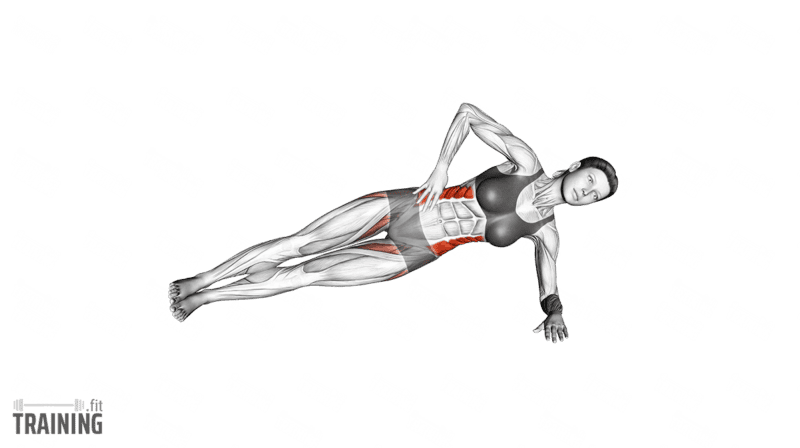
Main muscles
- Abdomen: External oblique abdominal muscle
(Musculus obliquus externus abdominis) - Abdomen: Square lumbar muscle
(Musculus quadratus lumborum) - Buttocks: Gluteus medius muscle
(Musculus gluteus medius)
Training plans
Side Plank is a suitable substitute for similar exercises in Abs workout or as a supplement to various training plans.
Side Plank: Basics and alternatives
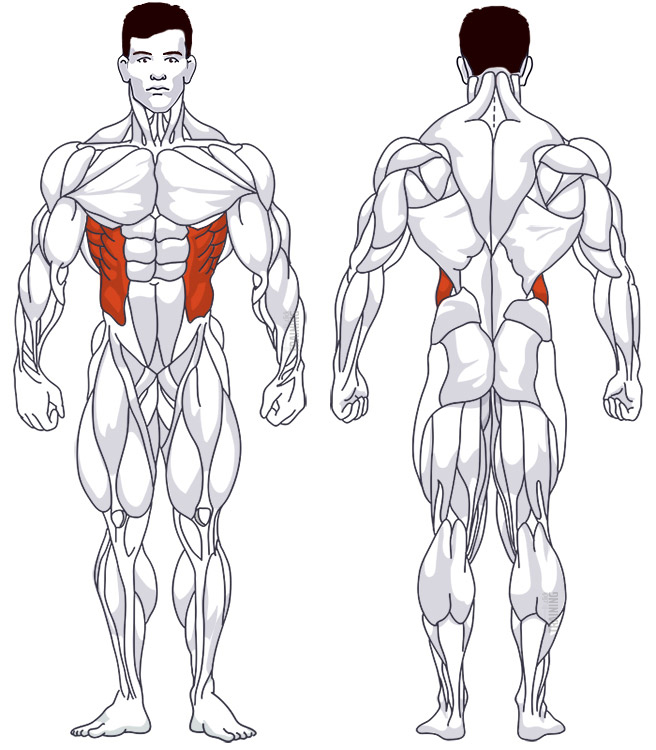
Involved main muscle groups:
Side Plank
The side plank is a classic sideways core hold. In this version, you support yourself on one straight arm and your stacked feet. Your side abs keep your waist lifted while your supporting shoulder and hip hold the position.
Compared with a front plank, you balance on one side instead of facing the floor. Once the position feels steady, the side plank with knee tuck adds a moving leg. Start with the simple hold so you can notice whether your hips or shoulders turn as the support becomes more demanding.
Correct execution
Place your bottom hand beneath your shoulder and extend your legs in line with your body. Press through your palm and lift your pelvis until your shoulders, hips and ankles form a roughly straight line. Stack your top shoulder and hip over the lower ones and rest your free hand on your hip; don’t use it to pull your torso around.
Keep your supporting arm straight without forcing your elbow backward. Look ahead with your neck in line with your trunk and breathe normally. If balancing with stacked feet is tricky, place your top foot slightly ahead of your bottom foot. You can also make it easier by bending your bottom knee and using it as a support. End the hold before your waist drops or your shoulder collapses, then lower yourself with control and switch sides.
Place your hand on a surface that won’t slide and spread your fingers before shifting your weight onto it, pressing through your whole palm. If your wrist isn’t comfortable supporting your weight in this position, do a forearm side plank with your elbow below your shoulder. It’s the same sideways hold, just supported on your forearm.
For the knee-supported version, rest the outside of your bent bottom knee on the mat and keep your top leg straight. As you lift, bring your pelvis forward so your bottom knee lines up with your hip and shoulder; if your butt stays behind you, you’re still folded at your hips. You can put your free hand on the floor for a moment to get into position, then place it on your hip.
Video tutorial
Step-by-step instructions
Sit sideways and place one hand on the floor beneath your shoulder.
Extend your legs and stack your feet, or stagger them for a wider base.
Press through your hand and bottom foot to lift your hips until your shoulders, hips and ankles form a straight line.
Keep your top hip and shoulder stacked and rest your free hand on your hip.
Hold the position with steady breathing, then lower your hips gently. Set up on the other side and repeat with the same control.
Common mistakes
Letting your waist sag toward the floor means your body is no longer in a straight line. Reset sooner or use the knee-supported variation.
You may want to roll your chest toward the ceiling to stay up, but keep your shoulders stacked and shorten the hold if you start to turn. Also set your hand under your shoulder before lifting, since a hand placed far away makes it harder to support your upper body.
As you tire, keep the side of your bottom foot firmly on the floor, not just your toes. Stagger your feet if you need to make balancing easier.
What the science says
Most research on the side plank measures muscle activity during a single hold. That shows which muscles the exercise challenges, not how much stronger or bigger they get over time.
A 2024 study with 21 healthy men compared 10 plank variations performed on the forearms or on straight arms. Compared with forearm planks, straight-arm versions such as the one described here produced more activity in the triceps and the lower part of the trapezius, a large upper back muscle. In the side plank, the upper trapezius was less active than the serratus anterior and the middle and lower trapezius, the muscles that steady your shoulder blade.[1]
In a 2016 study, 18 men and women aged 23–45 did 10 core exercises. The side plank on the feet made the external obliques work at 62% of their maximum, compared with 37% in the side plank on the knees and 28% in a crunch. The lower back muscles were also more active in the side-lying exercises than in all the others, whereas crunches and sit-ups generally produced more six-pack muscle activity.[2]
A 2014 study with 25 healthy, active young women and men tested 4 side plank variations. One had the feet raised, and another involved rolling in and out of the side plank. Muscles on the lower, supporting side were generally more active than on the upper side. The side hip muscle (gluteus medius) worked at more than 69% of its maximum in 3 of the 4 versions. The rolling version produced the most trunk activity.[3]
Sources
- Shoulder and Scapular Muscle Activity During Low and High Plank Variations With Different Body-Weight-Bearing Statuses. Can EN, Harput G, Turgut E. Journal of Strength and Conditioning Research. 2024;38(2):245–252. doi: 10.1519/jsc.0000000000004622.
- Muscle Activation Among Supine, Prone, and Side Position Exercises With and Without a Swiss Ball. Escamilla RF, Lewis C, Pecson A, Imamura R, Andrews JR. Sports Health: A Multidisciplinary Approach. 2016;8(4):372–379. doi: 10.1177/1941738116653931.
- Surface Electromyographic Analysis of Core Trunk and Hip Muscles During Selected Rehabilitation Exercises in the Side-Bridge to Neutral Spine Position. Youdas JW, Boor MM, Darfler AL, Koenig MK, Mills KM, Hollman JH. Sports Health: A Multidisciplinary Approach. 2014;6(5):416–421. doi: 10.1177/1941738114539266.