Banded Good Mornings
Compound exercise, Free weightsOverview

Main muscles
- Thigh: Thigh flexor
(Musculus biceps femoris) - Buttocks: Large gluteus maximus
(Musculus gluteus maximus) - Back: Back extensor
(Musculus erector spinae)
Banded Good Mornings: Basics and alternatives
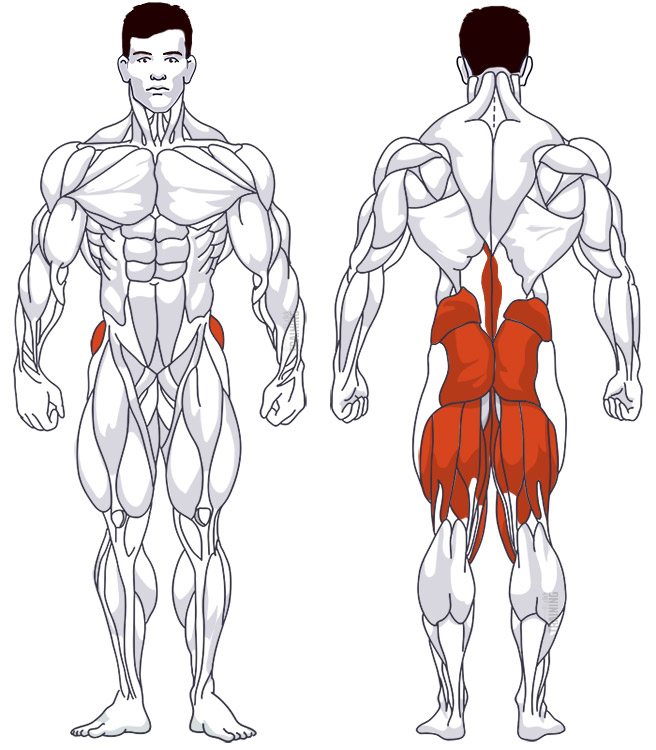
Involved main muscle groups:
Banded Good Mornings
Banded Good Mornings are some of the best exercises you can do at home. They let you target the lower back, which can be tough to isolate, without too much effort. The movement is similar to the barbell variation: You stand upright and bow with a straight back. The resistance band provides the necessary tension that activates your back extensor (erector spinae muscle).
In bodybuilding, Good Mornings is a more challenging exercise because the barbell rests on your upper back, making it crucial to have the right form when training. Even with the resistance band, this requirement doesn’t change, so it’s essential that you maintain proper back posture during this exercise.
For slightly easier alternatives, you can try lying back extension or hyperextension on the bench. Both exercises can be done at home too.
Correct Execution
To effectively perform Good Mornings with the resistance band, it’s important to choose the appropriate length or resistance. You can do the exercise with a closed band or an open band. As you straighten up, the band should provide enough tension to activate the lower back as much as possible. In the following, the execution with the closed band is described.
You can also choose from two different workout variations: Either perform Good Mornings with straight legs, or bend your knees slightly during the bow to engage the hamstrings (rear thigh) and the butt more strongly.
Video Tutorial
Step-by-Step Instructions
Stand upright, hip-width apart, and place the resistance band centered under your feet.
Squat down, raise the band above your head, and place it on the back of your neck. Now, when you stand back up, the band is placed around your neck and runs down the front of your body to your feet. Place your hands on the resistance band just below your shoulders.
Keep your back steady with its natural slight curve. Don’t force an exaggerated arch.
Bow by lowering your upper body forward with your back straight. Stick your butt out.
At the same time, bend your knees a little. Bend your knees only so far that your thighs aren’t parallel to the floor.
Try to bow forward until your upper body is parallel to the floor. Only go as far as you can without compromising your balance. As your training progresses, your range of motion will increase over time.
Straighten your upper body and extend your knees (keeping them slightly bent).
Common Mistakes
Keep the natural curve of your lower back and bend at your hips rather than rounding your torso to reach farther down. Rounding your back shifts the bend from your hips to your spine and makes the movement harder to control. If you cannot control your back position, shorten the movement or use a lighter band. Focus on a controlled hip hinge instead of forcing a deeper bend.