Dumbbell Jumping Squat
Compound exercise, Free weightsThis article is verified by 3 studies/publications.
Overview
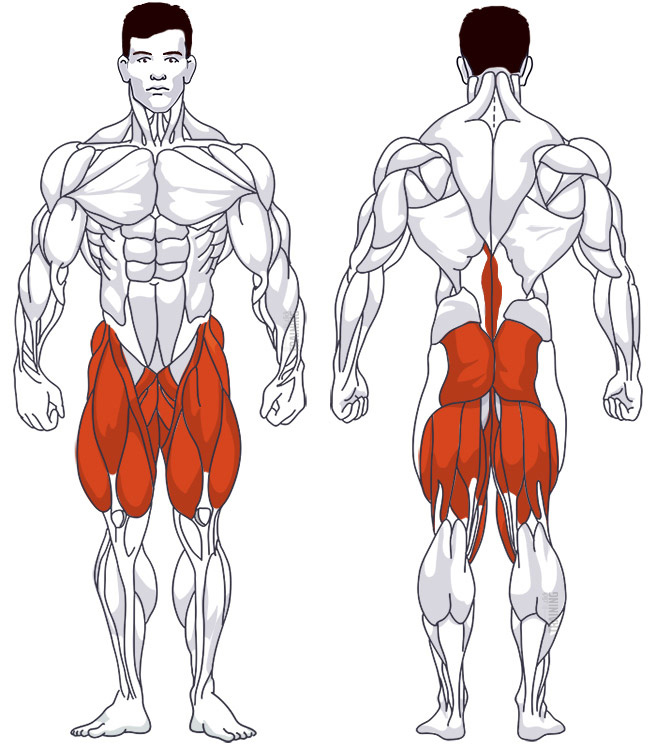
Main muscles
- Thigh: Quadriceps
(Musculus quadriceps femoris) - Buttocks: Large gluteus maximus
(Musculus gluteus maximus) - Lower leg: Twin calf muscle
(Musculus gastrocnemius) - Lower leg: Soleus muscle
(Musculus soleus) - Thigh: Thigh flexor
(Musculus biceps femoris)
Training plans
Dumbbell Jumping Squat is a suitable substitute for similar exercises in Conditioning and full-body or as a supplement to various training plans.
Dumbbell Jumping Squat: Basics and alternatives
Involved main muscle groups:
Dumbbell Jumping Squat
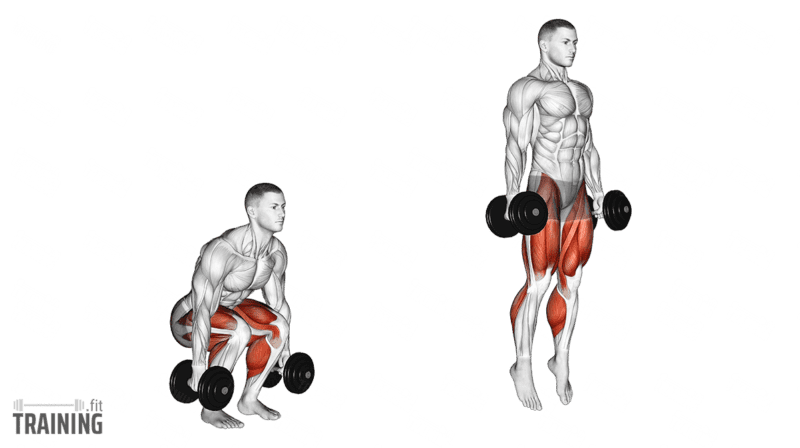
Dumbbell jumping squats add a small jump to classic dumbbell squats. Hold a weight at each side, lower into a squat, then extend your legs until both feet briefly leave the floor. Your thighs and butt power the jump, your calves help with takeoff and landing, and your arms keep the weights beside you.
With battling ropes jump squats, your arms make alternating waves during a squat jump. High Knee Sprints combine running on the spot with alternating knee lifts. Before adding dumbbells, practice a bodyweight squat jump until you can land and stop comfortably.
Correct execution
Use light dumbbells and a clear, level landing area. Stand with your feet about shoulder-width apart and your toes turned out to a comfortable angle. Hold the handles firmly with your palms facing inward and let your arms hang straight beside your thighs. Make sure the weights have room to pass the knees without hitting them.
Bend your hips and knees to a squat depth you can reverse under control, with your feet flat, your torso steady and your knees pointing the same way as your toes. Then straighten your legs quickly and push off the floor into a small, vertical jump while your arms stay beside you. Land on both feet and let your ankles, knees and hips bend together. Regain a stable stance before repeating; a deliberate pause is fine. When you finish, stop jumping and set the weights down with a controlled squat or hinge.
You should be able to stop and hold your balance after each landing. Start with a small jump, settle both feet and check that the weights are still beside you before attempting another. Try to land close to where you took off. If you keep traveling forward, you’re jumping forward instead of straight up.
Hold the dumbbells firmly so they stay secure as you jump. If they start moving around in your hands, jump lower or go back to the bodyweight version.
Video tutorial
Step-by-step instructions
Choose light dumbbells and clear a stable landing area.
Stand with your feet around shoulder-width apart and the dumbbells hanging beside your thighs.
Bend your hips and knees to a squat depth you can control.
Extend through your legs into a small two-foot jump while keeping the weights beside you.
Land on both feet and let your ankles, knees and hips bend under control. Regain your balance before repeating. When you’re finished, stop and lower the dumbbells to the floor with control.
Common mistakes
Heavy dumbbells can make the takeoff slow and the landing difficult to manage. Choose a load that lets you control both, even if that’s lighter than what you’d normally squat with.
Swinging your arms or curling the dumbbells as you jump changes the movement and can bring the weights into your knees or ribs. Keep your hands at your sides, and if they start to drift, use lighter dumbbells. Don’t land with stiff knees or bounce straight into the next jump from an unsteady position. Land softly, reset your feet and only repeat once you’ve got your balance.
What the science says
Only 1 of the studies below tested jumps performed with a dumbbell in each hand. The others looked at loaded jump squats in general, measuring power in single sessions or over a few weeks of training.
A 2015 meta-analysis pooled 27 studies with 468 participants to find the load at which people produce the most power in several lower-body exercises. In jump squats, peak power was highest with light loads, from no extra weight up to 30% of the 1-rep max. For the regular squat, power was highest at moderate loads.[1]
In a 2024 study, 32 young male athletes with strength training experience did jumps with 20–60 kg on a barbell, in a trap bar or split between 2 dumbbells. The dumbbell jumps produced significantly more force than the barbell and trap bar jumps, while the trap bar jumps reached the highest speed. The dumbbell jumps also had the highest power, but only their advantage over the trap bar was significant. The authors suggest that small arm swings with the dumbbells may have contributed. They also note that the wearable sensor sat on the waist for the dumbbell jumps but on the bar for the others. This may have inflated the dumbbell values.[2]
An 8-week training study had 26 athletic men do jump squats with either 30% or 80% of their squat maximum, or no jump squats at all. Squat strength increased in both groups that trained jump squats. The light-load group improved its power and speed at all 3 tested loads and tended to sprint faster, while the heavy-load group improved force and power mainly at the heavier loads but became slower over 20 m.[3]
Sources
- The Optimal Load for Maximal Power Production During Lower-Body Resistance Exercises: A Meta-Analysis. Soriano MA, Jiménez-Reyes P, Rhea MR, Marín PJ. Sports Medicine. 2015;45(8):1191–1205. doi: 10.1007/s40279-015-0341-8.
- A comparison of weighted countermovement jumps loading modes using wearable accelerometers. Radulovic V, Kwong D, Green A. South African Journal of Sports Medicine. 2024;36(1):v36i1a16929. doi: 10.17159/2078-516x/2024/v36i1a16929.
- The Effect of Heavy- Vs. Light-Load Jump Squats on the Development of Strength, Power, and Speed. McBride JM, Triplett-McBride T, Davie A, Newton RU. Journal of Strength and Conditioning Research. 2002;16(1):75–82. doi: 10.1519/1533-4287(2002)016<0075:teohvl>2.0.co;2.