Smith Machine Shoulder Press
Compound exercise, MachineThis article is verified by 3 studies/publications.
Overview
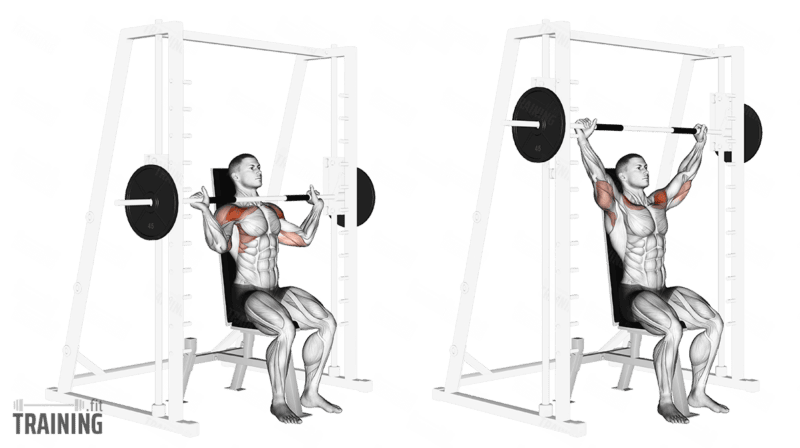
Main muscles
- Shoulder: Anterior deltoid muscle
(Musculus deltoideus, Pars clavicularis) - Shoulder: Medial deltoid muscle
(Musculus deltoideus, Pars acromialis) - Triceps: Three-headed arm muscle
(Musculus triceps brachii)
Training plans
Here you can find example plans for smith machine shoulder press training:
Smith Machine Shoulder Press: Basics and alternatives
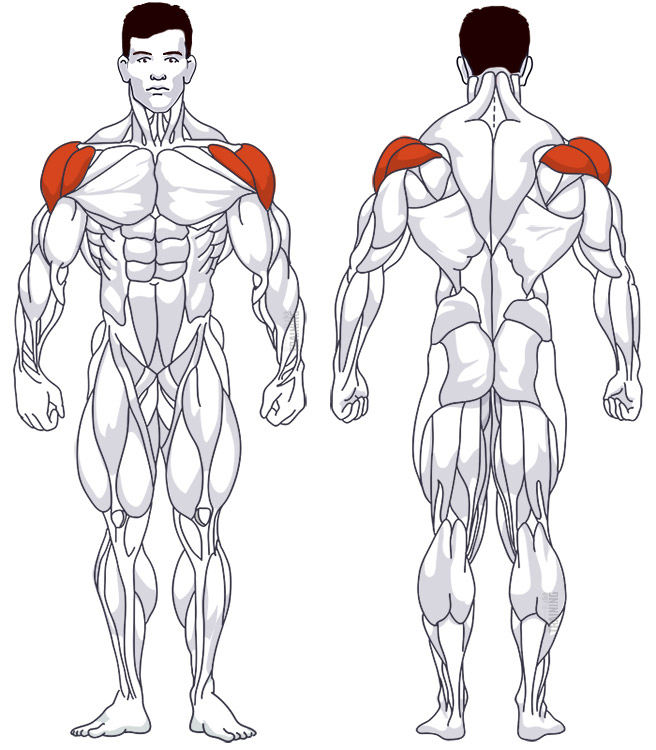
Involved main muscle groups:
Smith Machine Shoulder Press
The Smith machine shoulder press is a guided-bar variation of the overhead press. You’ll sit against a nearly upright backrest and press the bar overhead from in front of your shoulders. Your shoulders and triceps work while the backrest supports your upper body.
With dumbbell shoulder presses, each hand can follow its own path. Standing band presses let you train the pressing movement with a fitness band. For the Smith machine version, take time to position the bench so you can follow the fixed bar path comfortably.
Correct execution
The machine sets the bar path, so the bench needs to place you comfortably beneath it. Trying that path with little weight is part of finding the right setup for your shoulders.
Use the unloaded bar or a light load to position the bench. The bar should clear your face while your back stays against the pad and you don’t reach forward. With angled rails, orient the bench as the manufacturer recommends.
Set the safety stops just below the lowest bar position you can control and test how the hooks engage. Choose a grip width that keeps your forearms roughly vertical beneath the bar. Lower only as far as your shoulders allow while keeping this alignment; touching the upper chest is not a requirement.
Center the bench between the rails with all its feet firmly supported, then sit in the middle of the pad and use the markings on the bar to grip it evenly. Even with a fixed bar path, you can still sit off-center or push harder with one arm, so keep both shoulders against the backrest as your elbows follow the bar.
While the bar is still light, practice the turn that engages the hooks and check where you can rack the bar in both the lower and upper positions. Once you’ve loaded it, keep your hands wrapped around the bar as you turn it, and make sure both hooks have caught.
Video tutorial
Step-by-step instructions
Place an adjustable bench with a nearly upright backrest inside the machine.
Check its position using the light bar.
Set the bar supports and safety stops, then sit with your feet planted and your back against the pad.
Take an overhand grip and confirm that you can reach and release the hooks without losing your position.
Lift the bar slightly and rotate it to release the hooks, then press it overhead by straightening your arms with control. Keep your back against the pad.
Lower the bar slowly in front of your face to the chosen starting depth.
Repeat with control. After the final repetition, rotate the bar back into both hooks and check that it is fully supported before letting go.
Common mistakes
If the bench is too far forward or back, it’s hard to press along the fixed bar path while staying against the backrest, and you may start arching your back more and more to make up for it. Adjust the bench before you add weight.
Avoid bouncing out of the bottom or dropping the bar onto the safety stops during normal repetitions. Use a range you can control; the stops catch the bar if you need to put it down below that range. Keep your grip until the bar is securely re-racked.
An empty Smith bar can feel different from a free barbell because of counterweights or its bar assembly. Test its resistance before adding your usual free-weight load. Make a note of the machine and the plates you loaded so you can compare sessions.
What the science says
Research specifically on the Smith machine shoulder press is limited; the study below focused on bar speed. Muscle activity studies comparing a machine, a barbell and dumbbells help explain what a guided bar changes.
In a seated Smith machine press, with the backrest reclined by 10 degrees, 48 men pressed increasingly heavy loads up to their 1-rep max. Bar speed very closely predicted what percentage of their max each load represented, and at the max the bar moved at about 0.19 m/s regardless of strength level. Of these men, 24 then trained the press for 10 weeks and increased their max by about 17.5%, but the link between load and speed stayed the same. At heavy loads, bar speed reached its lowest point about halfway through the press.[1]
In a separate study, 8 competitive bodybuilders pressed with a barbell and on a lever-based shoulder press machine (not a Smith machine). Muscle activity was generally higher in the barbell versions. The authors attribute this to the additional work needed to stabilize a free bar. Pressing in front of the head involved the chest more, while behind-the-neck barbell pressing involved the side and rear shoulder muscles more.[2]
In 15 healthy men, seated free-weight shoulder presses produced about 24–25% less rear deltoid activity than standing presses. Seated dumbbell presses also produced less side deltoid activity than standing dumbbell presses. Dumbbells produced more front deltoid activity than a barbell. Standing with dumbbells was the least stable version. It produced the most deltoid activity, but allowed the lowest 1-rep max.[3]
These studies didn’t directly compare a Smith machine with a free barbell, and muscle activity in a single session doesn’t show which version builds more muscle.
Sources
- A comprehensive analysis of the velocity-based method in the shoulder press exercise: stability of the load-velocity relationship and sticking region parameters. Hernández-Belmonte A, Martínez-Cava A, Morán-Navarro R, Courel-Ibáñez J, Pallarés JG. Biology of Sport. 2021;38(2):235–243. doi: 10.5114/biolsport.2020.98453.
- Front vs Back and Barbell vs Machine Overhead Press: An Electromyographic Analysis and Implications For Resistance Training. Coratella G, Tornatore G, Longo S, Esposito F, Cè E. Frontiers in Physiology. 2022;13:825880. doi: 10.3389/fphys.2022.825880.
- Effects of Body Position and Loading Modality on Muscle Activity and Strength in Shoulder Presses. Saeterbakken AH, Fimland MS. Journal of Strength and Conditioning Research. 2013;27(7):1824–1831. doi: 10.1519/jsc.0b013e318276b873.