Push Press
Compound exercise, Free weightsThis article is verified by 4 studies/publications.
Overview
Main muscles
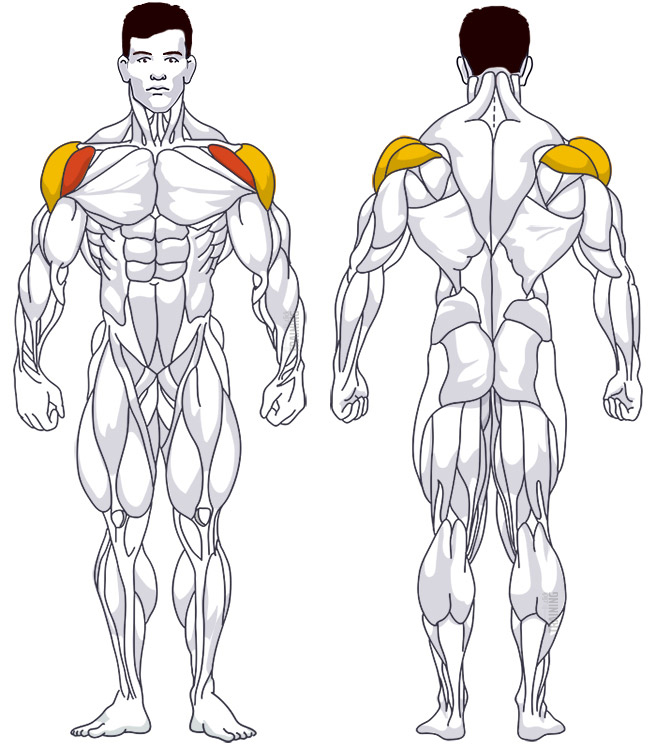
- Shoulder: Anterior deltoid muscle
(Musculus deltoideus, Pars clavicularis) - Shoulder: Medial deltoid muscle
(Musculus deltoideus, Pars acromialis) - Triceps: Three-headed arm muscle
(Musculus triceps brachii) - Thigh: Quadriceps
(Musculus quadriceps femoris) - Buttocks: Large gluteus maximus
(Musculus gluteus maximus) - Abdomen: Transverse abdominal muscle
(Musculus transversus abdominis)
Training plans
Push Press is a suitable substitute for similar exercises in Conditioning and full-body or as a supplement to various training plans.
Push Press: Basics and alternatives
Involved main muscle groups:
Push Press
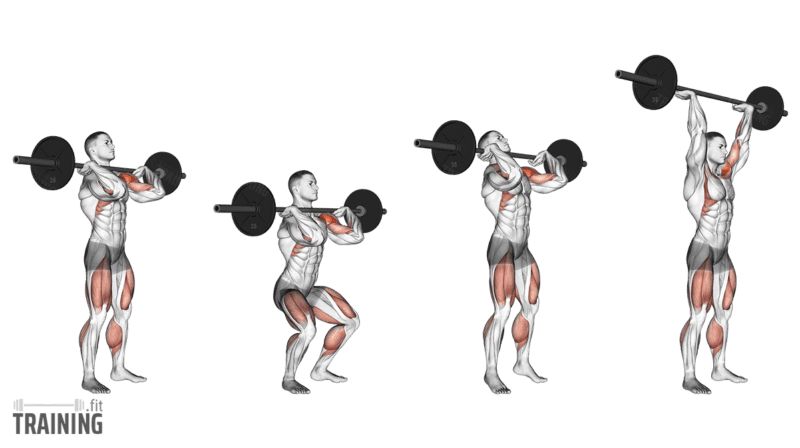
The push press pairs a short leg drive with a classic overhead press. Rest the bar on the fronts of your shoulders, dip briefly and drive upward through your legs, then finish with straight arms. Your thighs and butt start the lift, your shoulders and triceps finish it, and your abs steady you.
Unlike the Dumbbell Shoulder Press, this movement uses your legs to start the press. The Smith Machine Shoulder Press uses a guided bar. A related free-weight exercise is the Dumbbell Push Jerk, in which you catch the weights with a second knee bend. In a push press, your legs stay straight after the initial drive.
Correct execution
You can learn the timing by keeping the dip shallow and directing the push upward, without turning it into a full squat.
Set the rack low enough to take the bar out with both feet flat. Rest it on the fronts of your shoulders and take a full grip just outside them. Your elbows sit slightly in front of the bar, but they don’t need to be as high as possible. Step back and stand with your feet about hip-width apart and your toes at a comfortable angle.
Tighten your abs and dip a short distance by bending your knees. Keep your upper body upright and your whole foot on the floor. Reverse smoothly into a strong leg drive. As the bar leaves your shoulders, move your chin clear and continue pressing with your arms.
Finish with the bar steady overhead, your legs straight, your abs tight and your body upright. Your heels may come up briefly during the drive, but they’re back on the floor for the overhead hold. In a push press, you don’t bend your knees a second time to catch the bar.
Guide the bar down to your shoulders, bending your knees slightly to cushion its return. Stand upright and let the bar settle before starting another dip. End the set while you can still lower the bar and rerack it under control.
Video tutorial
Step-by-step instructions
Unrack the bar onto the fronts of your shoulders with a secure grip.
Step into a stable stance.
Brace your core and make a short, upright dip with your feet flat on the floor.
Drive upward through your legs and let the bar accelerate off your shoulders.
Move your chin out of the way and finish straightening your arms with the bar balanced overhead.
Hold the overhead position with straight legs, without a second receiving dip.
Lower the bar to your shoulders, bending your knees slightly to cushion its return, then stand and reset before repeating or reracking.
Common mistakes
Pressing with your arms too early makes it harder to use your leg drive. Let your legs get the bar moving, then keep pressing in one smooth motion as you straighten up.
Don’t lean back to get the bar past your face or let the dip tip you forward. Stay upright and move your chin just enough to let the bar pass. Bending your knees a second time to catch the bar turns the exercise into a jerk, while a strong leg drive on its own doesn’t.
What the science says
Research on the push press is limited. Most studies have examined the lift’s mechanics; only a few have investigated its use in training.
In a force-plate study, 16 people with about 2 years of weightlifting experience (12 men, 4 women) did the push press, the push jerk and the split jerk with 80% of the most they could push press once. Force and power during the dip and the leg drive didn’t differ meaningfully between the 3 lifts. The leg drive was similar whether lifters finished with a press or received the bar in a jerk.[1]
A 2019 review found only 13 studies on overhead lifts from weightlifting, including the push press. The authors describe these lifts as producing force quickly by extending your hips, knees and ankles together, and suggest they may help athletes develop power and maximal strength. They also highlight the lack of long-term training data.[2]
One of the few training studies had elite under-20 soccer players train for 6 weeks with either push presses or jump squats, using the load that gave each player the most power. Of the 17 players who finished, the jump squat group improved its jumps and sprints. Push press power rose by about 15% in the push press group, with little change in jump or sprint performance.[3]
In 17 strength-trained men, push press power peaked at around 65–75% of the most they could lift once, and going 10–20% heavier or lighter reduced it by 6–15%. In the 8 who also did jump squats, the push press produced similar peak power and about 9.5% more average power. The authors suggest that the exercise could save time by combining lower-body power work with strength training for the upper body and trunk.[4]
Sources
- No differences in weightlifting overhead pressing exercises kinetics. Soriano MA, Lake J, Comfort P, Suchomel TJ, McMahon JJ, Jiménez-Ormeño E, et al. Sports Biomechanics. 2024;23(11):2080–2092. doi: 10.1080/14763141.2021.1993983.
- Weightlifting Overhead Pressing Derivatives: A Review of the Literature. Soriano MA, Suchomel TJ, Comfort P. Sports Medicine. 2019;49(6):867–885. doi: 10.1007/s40279-019-01096-8.
- Improving Sprint Performance in Soccer: Effectiveness of Jump Squat and Olympic Push Press Exercises. Loturco I, Pereira LA, Kobal R, Maldonado T, Piazzi AF, Bottino A, et al. PLOS ONE. 2016;11(4):e0153958. doi: 10.1371/journal.pone.0153958.
- Power and Impulse Applied During Push Press Exercise. Lake JP, Mundy PD, Comfort P. Journal of Strength and Conditioning Research. 2014;28(9):2552–2559. doi: 10.1519/jsc.0000000000000438.