Brisk Walking
Compound exercise, Body weightThis article is verified by 4 studies/publications.
Overview
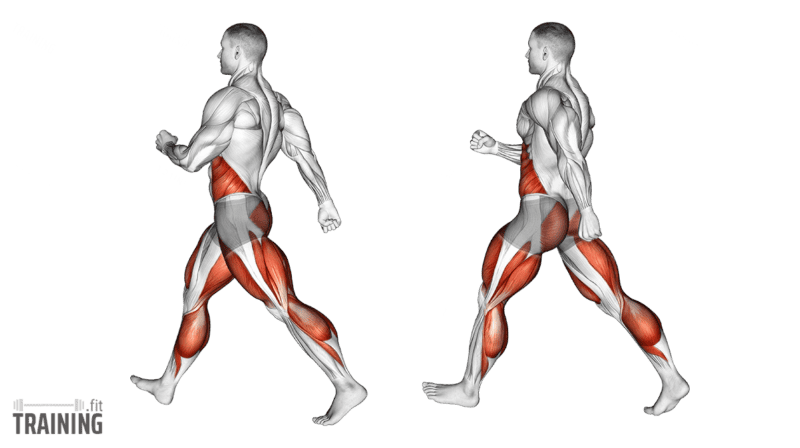
Main muscles
- Buttocks: Large gluteus maximus
(Musculus gluteus maximus) - Thigh: Quadriceps
(Musculus quadriceps femoris) - Thigh: Thigh flexor
(Musculus biceps femoris) - Lower leg: Twin calf muscle
(Musculus gastrocnemius) - Lower leg: Soleus muscle
(Musculus soleus) - Lower leg: Anterior tibial muscle
(Musculus tibialis anterior)
Training plans
Brisk Walking is a suitable substitute for similar exercises in Conditioning and full-body or as a supplement to various training plans.
Brisk Walking: Basics and alternatives
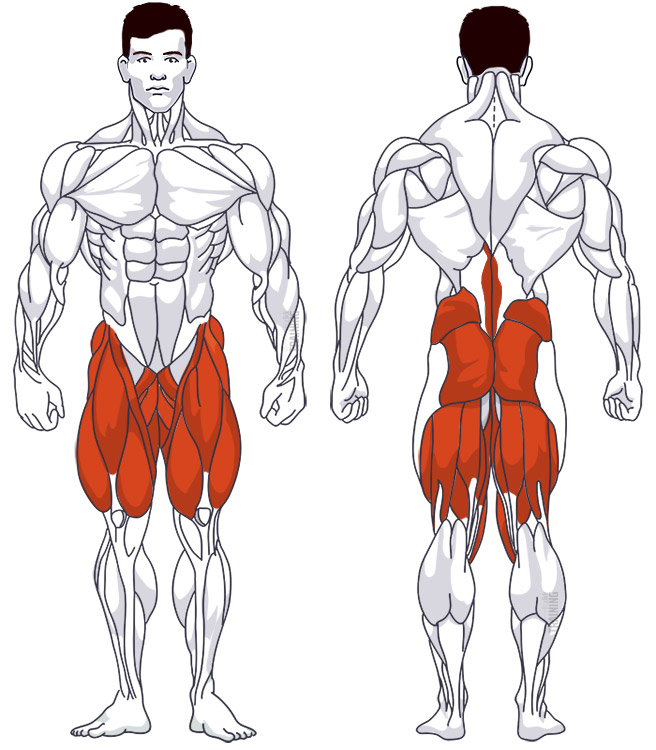
Involved main muscle groups:
Brisk Walking
Brisk walking is a simple way to get moving: take quicker steps than on a relaxed stroll and keep a steady pace. Swing your arms opposite your legs, keeping your upper body comfortably upright as your hips, thighs and calves move you along.
High Knee Sprints use high knee lifts while running on the spot. In the Dumbbell Farmers Carry, you walk with weights at your sides. Calf Raises move your heels up and down in place. For brisk walking, you’ll only need comfortable shoes and a suitable route.
Correct execution
Even at a brisk pace, your walk should still feel coordinated. You can build the pace gradually while keeping your steps comfortable and your arms swinging freely.
Choose a route where you can see the ground ahead and walk at a steady pace. Start slowly, keeping your head upright and your shoulders relaxed. Let your elbows bend naturally and your arms swing forward and back opposite your legs.
Build speed with a quicker rhythm and a comfortable stride; don’t force your step length or aim for a fixed speed. Let your front foot land gently and roll from heel to toe as your body passes over it, then push off with the trailing foot.
Walk with a natural step width, not on one narrow line. Let your feet point where they naturally want to and your hips and shoulders move in a relaxed way. If you can, keep your hands free so your arms can swing comfortably.
Shorten your steps and adjust your pace for turns, slopes or uneven ground. Downhill, don’t lengthen your stride just to maintain speed. Ease into a relaxed walk before stopping and start gently after a break.
Video tutorial
Step-by-step instructions
Choose a clear route, put on comfortable shoes and begin walking at an easy pace.
Look ahead, relax your shoulders and keep your upper body comfortably upright.
Swing your arms naturally, bringing the opposite arm forward with each step.
Quicken your steps while rolling smoothly from heel to toe.
Keep a manageable stride and adjust the pace for turns or changes in the surface.
Slow down to an easy walk, then stop somewhere you can stand steadily.
Common mistakes
Reaching far ahead with every step can make your walk feel like repeated braking. Shorten your stride and pick up the rhythm a little instead. And remember: walking briskly doesn’t mean jogging.
Stiff shoulders, clenched fists and exaggerated arm swings can make the movement awkward. Relax your hands and let your arms follow your steps. Try not to stare at your feet or phone the whole time; look ahead and glance at the ground coming up when you need to. Slow down whenever the surface makes it harder to keep your steps steady.
What the science says
Walking has been examined in both large population studies and controlled exercise programs. The population studies are observational: they link a brisk pace to a lower risk of dying early, but people who walk slowly may already be less healthy, so they can’t show that walking faster is the cause.
In the UK Biobank, about 420,000 adults aged 39–74 without heart disease or cancer rated their usual walking pace and were followed for 6.3 years. In the third with the lowest body mass index (BMI), slow walkers had about 2 times the risk of dying from any cause compared with brisk walkers; in the highest third, the risk was 1.3–1.4 times as high. Slow walkers’ risk of death from heart and circulatory disease was more than 1.7 times that of brisk walkers in every BMI group.[1]
An analysis pooled 11 British population surveys with 50,225 walkers. Compared with a slow pace, an average pace was linked to a 20% lower risk of dying from any cause. For a brisk or fast pace, the risk was 24% lower. The results were similar for heart and circulatory disease, but there was no link with cancer deaths. The links were clearest in people over 50 and those not meeting activity recommendations.[2]
A 2015 review pooled 32 articles on randomized trials comparing walking with no exercise in previously inactive adults. The walking programs lasted at least 4 weeks. Walking improved aerobic fitness and brought small reductions in blood pressure, waist size, weight (about 1.4 kg) and body fat. Blood fat levels didn’t change.[3]
Research has also considered the pace that counts as brisk walking. A 2017 review of 31 studies found that about 100 steps per minute is generally used as the threshold for moderate-intensity walking in adults, while older adults may need a quicker rhythm.[4]
Sources
- Association of walking pace and handgrip strength with all-cause, cardiovascular, and cancer mortality: a UK Biobank observational study. Yates T, Zaccardi F, Dhalwani NN, Davies MJ, Bakrania K, Celis-Morales CA, et al. European Heart Journal. 2017;38(43):3232–3240. doi: 10.1093/eurheartj/ehx449.
- Self-rated walking pace and all-cause, cardiovascular disease and cancer mortality: individual participant pooled analysis of 50 225 walkers from 11 population British cohorts. Stamatakis E, Kelly P, Strain T, Murtagh EM, Ding D, Murphy MH. British Journal of Sports Medicine. 2018;52(12):761–768. doi: 10.1136/bjsports-2017-098677.
- The effect of walking on risk factors for cardiovascular disease: An updated systematic review and meta-analysis of randomised control trials. Murtagh EM, Nichols L, Mohammed MA, Holder R, Nevill AM, Murphy MH. Preventive Medicine. 2015;72:34–43. doi: 10.1016/j.ypmed.2014.12.041.
- Walking Cadence to Exercise at Moderate Intensity for Adults: A Systematic Review. Slaght J, Sénéchal M, Hrubeniuk TJ, Mayo A, Bouchard DR. Journal of Sports Medicine. 2017;2017:4641203. doi: 10.1155/2017/4641203.