Trap Bar Farmers Carry
Compound exercise, Free weightsThis article is verified by 4 studies/publications.
Overview
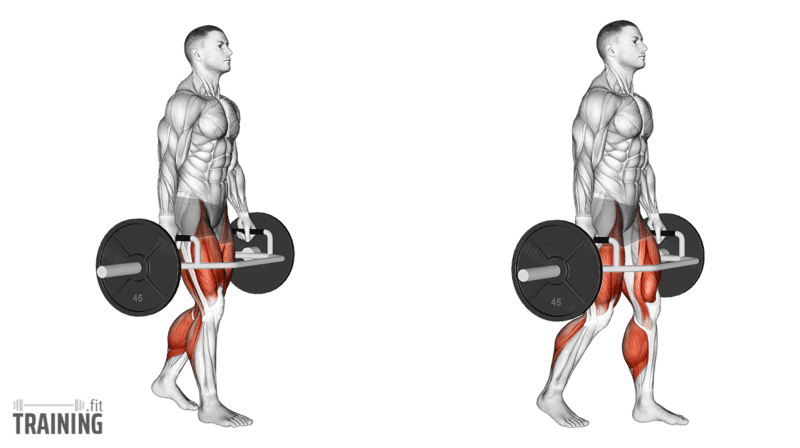
Main muscles
- Thigh: Quadriceps
(Musculus quadriceps femoris) - Buttocks: Large gluteus maximus
(Musculus gluteus maximus) - Back: Back extensor
(Musculus erector spinae) - Neck: Trapezius muscle
(Musculus trapezius) - Abdomen: External oblique abdominal muscle
(Musculus obliquus externus abdominis)
Training plans
Trap Bar Farmers Carry is a suitable substitute for similar exercises in Conditioning and full-body or as a supplement to various training plans.
Trap Bar Farmers Carry: Basics and alternatives
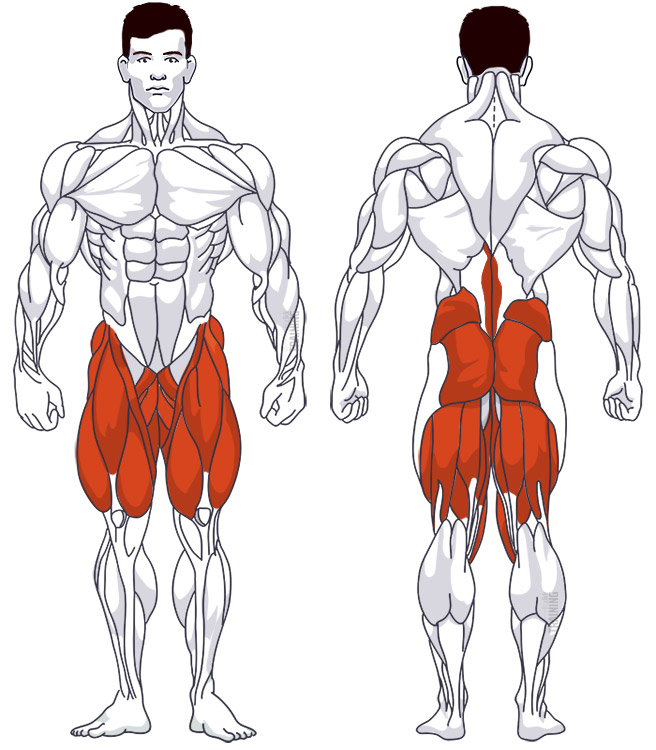
Involved main muscle groups:
Trap Bar Farmers Carry
A trap-bar farmer’s carry uses one frame around your body rather than two separate weights. You’ll stand inside it, lift by the side handles and walk with the frame steady. Your grip, upper back and core hold the load while your legs do the walking.
You lift the bar as you would in a Trap Bar Deadlift, then walk with it. The dumbbell farmer’s carry uses two separate weights that can move independently. The trap bar also needs more clear space, especially when its loaded sleeves extend beyond the frame.
Correct execution
Pick matching handles at the height you want, then load the bar evenly and secure the plates with collars. Check your route for obstacles and make sure the frame leaves your knees and feet enough room. Stand in the center and brace your torso. Push your hips back and bend your knees with a neutral back, grip both handles at their balance points and stand up with the frame level.
Let the load settle before you start walking. Keep your arms straight, look ahead with your chest open and trunk steady, and take short steps that keep your legs clear of the frame. Only carry it as far as you can keep the frame level and your grip secure. Slow down well before a turn and take several small steps. When you’re done, stop completely, then bend your hips and knees to lower the frame with control.
Remember that the loaded bar is much wider than the space between the handles, so the sleeves and plates need to clear nearby equipment the whole way. Walk the route with an empty bar first, including where you’ll stop, and pick a path where you won’t have to step over anything or squeeze sideways through a doorway.
Handle height affects the room your legs have inside the frame. Choose short steps that keep your legs clear. If your legs come close to hitting the frame, stop and adjust your setup before continuing; don’t try to solve a clearance problem by walking faster.
Video tutorial
Step-by-step instructions
Choose matching handles at the intended height before loading the bar evenly and securing the plates.
Check that the full bar has room along the route and at turns.
Stand in the center, brace your torso, bend your hips and knees with a neutral back and grip both handles evenly.
Stand up with straight arms and a level frame.
Walk with short controlled steps, keeping your legs clear of the frame.
Slow down for turns and stop while you still control the load.
Brace again, bend your hips and knees with a neutral back and set the bar fully on the floor before releasing it.
Common mistakes
An off-center grip can tip the frame forward or backward. Set the bar down and reposition your hands instead of correcting it with bent wrists while walking. If your back rounds during the pickup or set-down, reduce the load and reset before continuing.
Long strides and tight turns make it more likely that your legs hit the frame or a sleeve hits something. Keep your steps short and your route clear. If your fingers start opening, stop and lower the bar under control, even before the end of the route.
Pivoting sharply on one planted foot is another typical mistake, because the loaded frame keeps turning around you. Slow down before you change direction. If something unexpectedly blocks your path, stop and set the bar down once there’s room rather than shuffling sideways with it.
What the science says
Research on the trap bar farmer’s carry specifically is limited. In a 2022 study, 15 recreationally trained adults did 5 sets of 2 carries over 20 meters with a high-handle trap bar. The study only looked at the response to this single session: participants reported mild muscle soreness, and the authors judged the muscle damage to be negligible.[1] Other research on the farmer’s walk has used strongman handles or dumbbells, and it mainly describes how the carry is performed and how hard the trunk muscles work. None of these studies shows how much strength or muscle a carry builds over time.
A 2019 review of 11 biomechanics studies on strongman exercises found that the farmer’s walk was the most studied carrying event. Better performers took longer and quicker strides and spent less time with each foot on the ground. The authors regard the overall evidence as preliminary.[2]
In a 2024 study, 18 college-aged adults (12 women and 6 men) did a farmer’s carry with 2 dumbbells (about 51 kg in total on average) and also held the same dumbbells while standing still. The carry produced more activity in the abs and the lower back muscles on both sides than the static hold. Compared with a plank held for the same duration, the carry produced greater lower back activity and less ab activity.[3]
A 2009 study estimated the load on the lower back during 7 strongman events, including the farmer’s walk and a one-handed suitcase carry. The yoke carry, with a heavy frame on the shoulders, produced the highest spine loads. The authors attribute this to its weight combined with very strong tensing of the trunk muscles. They conclude that carries challenge the body differently from lifting events, making loaded carries a possible addition to a lifting-based strength program.[4]
Sources
- The Effect of an Acute Farmers Walk Exercise Bout on Muscle Damage and Recovery in Recreationally Trained Adults. Struder JF, Newmire DE, Boham MD, Webb HE. Journal of Science in Sport and Exercise. 2022;4(2):156–167. doi: 10.1007/s42978-021-00135-z.
- The Biomechanics and Applications of Strongman Exercises: a Systematic Review. Hindle BR, Lorimer A, Winwood P, Keogh JWL. Sports Medicine – Open. 2019;5(1):49. doi: 10.1186/s40798-019-0222-z.
- The Quantification of Muscle Activation During the Loaded Carry Movement Pattern. Ellestad SH, Holcomb TP, Swiergol AM, Holmstrup ME, Dicus JR. International Journal of Exercise Science. 2024;17(1):480–490. doi: 10.70252/nwue9985.
- Comparison of Different Strongman Events: Trunk Muscle Activation and Lumbar Spine Motion, Load, and Stiffness. McGill SM, McDermott A, Fenwick CM. Journal of Strength and Conditioning Research. 2009;23(4):1148–1161. doi: 10.1519/jsc.0b013e318198f8f7.