Kettlebell Snatch
Compound exercise, Free weightsThis article is verified by 4 studies/publications.
Overview
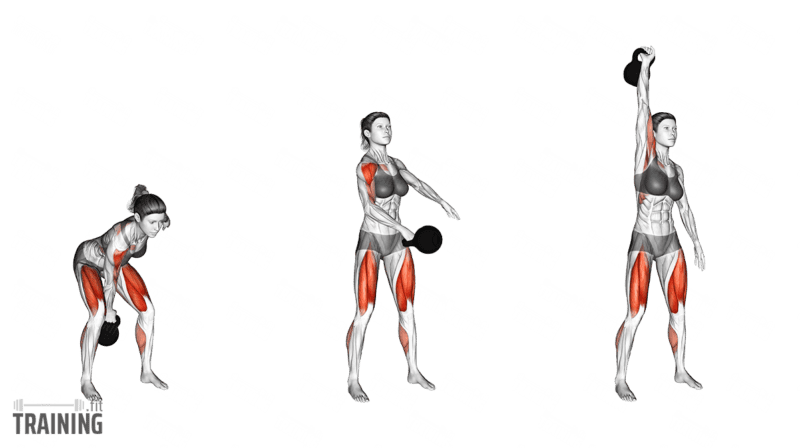
Main muscles
- Buttocks: Large gluteus maximus
(Musculus gluteus maximus) - Thigh: Thigh flexor
(Musculus biceps femoris) - Thigh: Quadriceps
(Musculus quadriceps femoris) - Back: Back extensor
(Musculus erector spinae) - Shoulder: Anterior deltoid muscle
(Musculus deltoideus, Pars clavicularis) - Neck: Trapezius muscle
(Musculus trapezius) - Abdomen: Transverse abdominal muscle
(Musculus transversus abdominis)
Training plans
Kettlebell Snatch is a suitable substitute for similar exercises in Conditioning and full-body or as a supplement to various training plans.
Kettlebell Snatch: Basics and alternatives
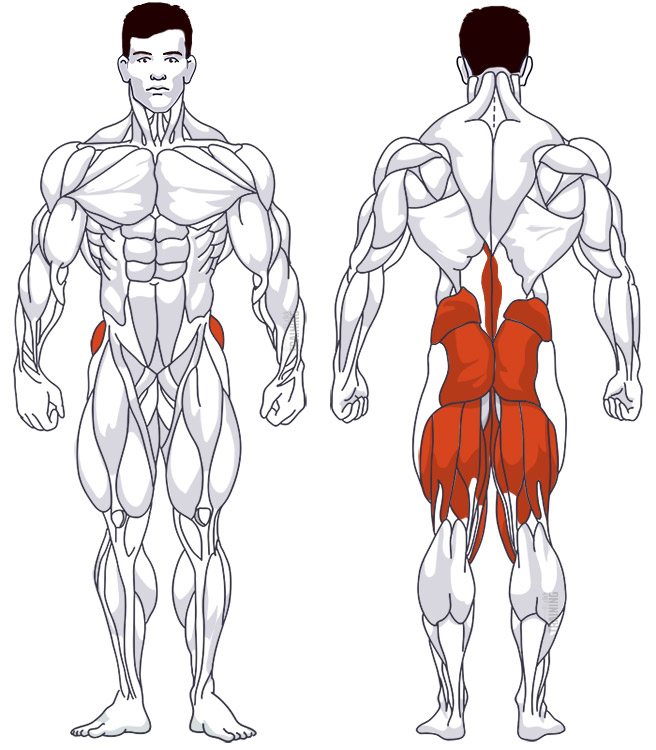
Involved main muscle groups:
Kettlebell Snatch
The kettlebell snatch is a classic lift that takes practice: you’ll swing one bell between your legs and guide it into a stable overhead hold in one continuous movement. Your hips drive it upward, then your arm guides it as your hand moves through the handle. Your butt and thighs power the rise; your shoulder and core control the finish.
In the Kettlebell Swing, the bell stops around chest height and your hands keep the same grip throughout. In the Kettlebell Turkish Get Up To Hand, you practice supporting a kettlebell above your shoulder through a slower floor transition. A different way to bring weights overhead is the Kettlebell Thruster, where a squat leads into a press. The snatch rises without a pause at the shoulder or a separate press.
Correct execution
Practice a controlled one-arm swing and a steady overhead hold before learning the snatch. Start with a light bell on the floor slightly ahead of you. Hinge back, bend your knees enough to reach the handle and keep your back steady and your abs braced. Hike the bell between your thighs, then extend your hips and knees to stand tall.
Guide the rising bell in a compact arc, bending your elbow to keep it close. Near the top, slide your hand through the handle and straighten your arm so the bell settles against your forearm instead of flipping over and striking it. Keep your wrist straight and your abs braced so you don’t lean back. While learning, lower through the shoulder rack before the backswing; a direct overhead return takes more practice. Guide the bell down and hinge as it swings between your legs, rather than stopping its full weight abruptly with your arm.
Video tutorial
Step-by-step instructions
Check the overhead space and grip a light kettlebell securely with one hand.
Push your hips back and hike the bell between your thighs, keeping your trunk steady.
Extend your hips and knees to drive the weight upward.
Keep the bell close to your body so you can control its arc, letting your elbow bend as it rises.
Move your hand through the handle and extend your arm into a balanced overhead hold.
Lower through the shoulder rack while learning, then hinge as you guide the bell into the backswing or set it down under control.
Before changing hands, put the kettlebell down, then practice the other side with the same manageable load.
Common mistakes
If the bell keeps banging into your forearm, your timing and the bell’s path usually need work. Don’t just put up with the impacts: reduce the weight and practice slipping your hand through the handle with coaching.
A stalled snatch shouldn’t become a slow overhead press. Choose a load your hip drive can carry overhead, and don’t lean back under a bell that’s traveled too far forward. On the return, keep your grip secure and hinge as the bell swings between your legs rather than stopping it abruptly with a bent arm.
What the science says
Most kettlebell snatch research involves small groups of trained men or athletes. Much of it looks at the snatch as a conditioning exercise, often in kettlebell sport, where lifters snatch one bell continuously for several minutes.
In a 2020 study, 10 men did a graded test of continuous snatches with a 16-kg kettlebell and, separately, a maximal test on a rowing machine. During the snatches, their heart rate reached 98% of its maximum and their oxygen uptake 83% of the maximum reached on the rower. Using training guidelines, the authors judged this snatch protocol demanding enough to potentially improve aerobic fitness in people who aren’t already very fit.[1]
In a 2015 study, 17 female college soccer players trained 3 times a week for 4 weeks. They did either kettlebell snatch intervals, alternating 15-second bouts of snatching and rest, or circuit weight training. The snatch group increased its aerobic capacity by about 6%, while the circuit group showed no significant change.[2]
In 14 resistance-trained adults, a 2017 study compared muscle activity in the one-arm kettlebell swing, snatch and clean. The lower back muscles worked harder in the swing than in the snatch, while the obliques on the opposite side worked harder in the snatch and clean. The authors concluded that the 3 lifts don’t simply duplicate one another.[3]
A 2017 study recorded 12 kettlebell-trained men during a 6-minute snatch set with a 24-kg bell. The force they applied to the bell on the way down was almost as high as on the way up (814 vs. 885 newtons), and each leg was loaded differently during a rep. Peak force on the bell dropped between the first and last 14 reps and grip strength fell, which the authors interpret as a possible sign of fatigue.[4]
Sources
- Cardiopulmonary Demand of 16-kg Kettlebell Snatches in Simulated Girevoy Sport. Chan M, MacInnis MJ, Koch S, MacLeod KE, Lohse KR, Gallo ME, et al. Journal of Strength and Conditioning Research. 2020;34(6):1625–1633. doi: 10.1519/jsc.0000000000002588.
- Effects of Kettlebell Training on Aerobic Capacity. Falatic JA, Plato PA, Holder C, Finch D, Han K, Cisar CJ. Journal of Strength and Conditioning Research. 2015;29(7):1943–1947. doi: 10.1519/jsc.0000000000000845.
- Electromyographical Comparison of Muscle Activation Patterns Across Three Commonly Performed Kettlebell Exercises. Lyons BC, Mayo JJ, Tucker WS, Wax B, Hendrix RC. Journal of Strength and Conditioning Research. 2017;31(9):2363–2370. doi: 10.1519/jsc.0000000000001771.
- External kinetics of the kettlebell snatch in amateur lifters. Ross JA, Keogh JW, Wilson CJ, Lorenzen C. PeerJ. 2017;5:e3111. doi: 10.7717/peerj.3111.