High Knee Sprints
Compound exercise, Body weightThis article is verified by 2 studies/publications.
Overview
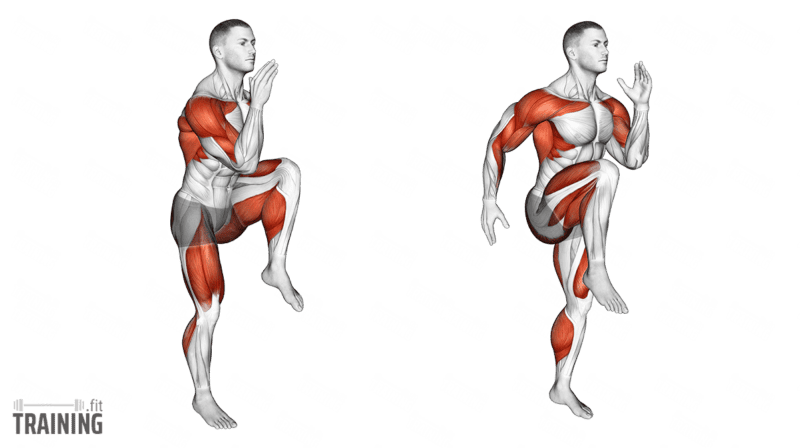
Main muscles
- Thigh: Quadriceps
(Musculus quadriceps femoris) - Thigh: Straight muscle of the thigh
(Musculus rectus femoris) - Lower leg: Twin calf muscle
(Musculus gastrocnemius) - Lower leg: Soleus muscle
(Musculus soleus) - Buttocks: Large gluteus maximus
(Musculus gluteus maximus) - Abdomen: Transverse abdominal muscle
(Musculus transversus abdominis)
Training plans
High Knee Sprints is a suitable substitute for similar exercises in Conditioning and full-body or as a supplement to various training plans.
High Knee Sprints: Basics and alternatives
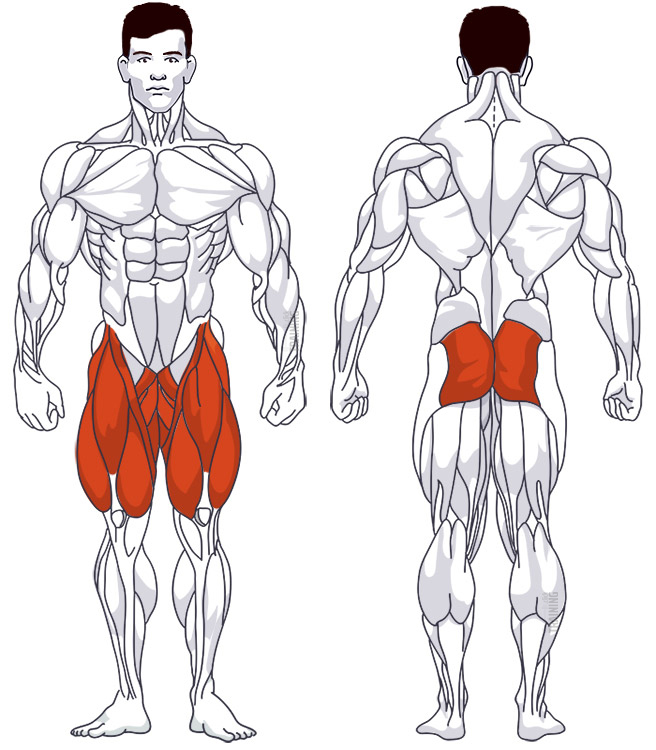
Involved main muscle groups:
High Knee Sprints
High-knee sprints are a classic running-on-the-spot exercise. Lift one knee as your opposite arm swings forward, then switch. Your hip flexors raise your thighs, your calves and thighs help you push off and land, and your abs steady your upper body.
With High Knee Jump Rope, the knee lifts must also match the rope turns. If you prefer walking, try Brisk Walking. For an alternating leg movement with hand support, Banded Mountain Climbers bring your knees forward from a plank position.
Correct execution
Find a level, non-slip spot with room for your knees and arms. Stand tall with your feet about hip-width apart and start with a slow march: bring your right knee up together with your left arm, then switch sides. Keep your shoulders relaxed and your arms comfortably bent.
Then speed up your steps into small alternating hops, staying roughly in the same place. Bring each knee toward hip height only as far as you can while keeping your torso upright. Land with each foot under your body and let your ankle and knee bend a little as you touch down. Keep breathing, and slow down to a march before you stop so the transition stays controlled.
Keep a little space between your feet as you run. Lift your thigh with your knee bent, then bring your leg straight back down beneath you. It helps to look at a fixed point ahead, so you’ll notice if you start drifting across the floor. Keep your hands loose and your shoulders relaxed as your bent arms swing forward and back.
Video tutorial
Step-by-step instructions
Stand on a clear, stable surface with your feet about hip-width apart.
Begin marching, lifting your right knee and left arm together, then switching sides.
Quicken the rhythm into alternating small hops on the spot.
Lift each knee to a height that lets your torso stay tall and controlled.
Return each foot beneath your body and let your ankle and knee bend on contact. Slow to marching steps, then stop in a balanced stance.
Common mistakes
Leaning backward turns the knee lift into a whole-body sway. Use a lower knee lift and slow down until you can keep your upper body upright.
Reaching out in front with your landing foot can make you travel forward and brake with every step. Keep your steps compact and beneath you. Watch your arms, too: if they swing too far across your chest, your upper body can twist along with them, so swing them forward and back instead. And once you can’t land with control or keep a steady rhythm anymore, slow down to a march.
What the science says
High-knee sprints haven’t been studied under that name. The most closely related research examines running on the spot. It mainly uses small groups of young women and often compares land-based and water-based exercise.
In a 2011 study, 12 women ran on the spot on land and in water, at 3 moderate step rates and as fast as they could. On land, their oxygen uptake, a measure of how hard the heart and lungs work, rose with the step rate. Activity in the front and back thigh muscles didn’t rise across the moderate rates, but it increased significantly at full speed.[1]
In a 2013 study, 9 active women completed maximal tests on a treadmill and while running on the spot, both on land and in water. Running on the spot on land took their heart rate about as high as treadmill running did, but their maximal oxygen uptake was significantly lower than on the treadmill.[2]
Running on the spot can raise your heart rate considerably, with greater demands as you increase the pace. Keep in mind that these small studies measured single sessions, not what regular training changes.
Sources
- Cardiorespiratory, neuromuscular and kinematic responses to stationary running performed in water and on dry land. Alberton CL, Cadore EL, Pinto SS, Tartaruga MP, da Silva EM, Kruel LF. European Journal of Applied Physiology. 2011;111(6):1157–1166. doi: 10.1007/s00421-010-1747-5.
- Cardiorespiratory responses to stationary running in water and on land. Kruel LF, Beilke DD, Kanitz AC, Alberton CL, Antunes AH, Pantoja PD, et al. Journal of Sports Science & Medicine. 2013;12(3):594–600. PMID: 24149170.