Band Biceps Curl
Isolation exercise, Free weightsThis article is verified by 3 studies/publications.
Overview
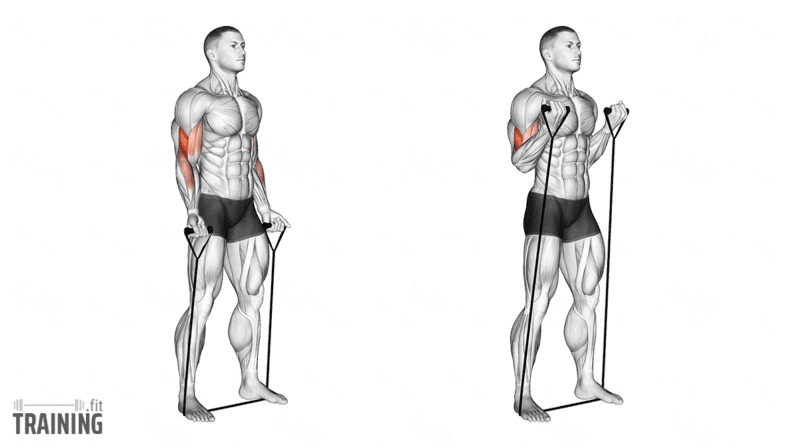
Main muscles
- Biceps: Arm flexor
(Musculus biceps brachii)
Workout plan
Here you can find example plans for band biceps curl training:
Band Biceps Curl: Basics and alternatives
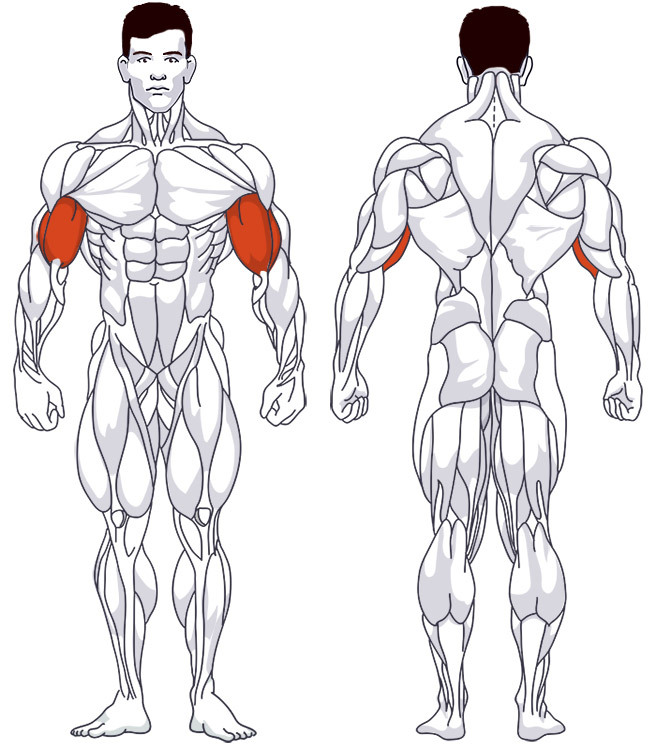
Involved main muscle groups:
Band Biceps Curl
Band biceps curls keep the setup simple: you stand on a resistance band and curl your hands toward your shoulders. You don’t need dumbbells to train the muscles that bend your elbows, including your biceps and brachialis.
If you have dumbbells, you can do the classic Biceps Curls with free weights. With the same band, you can also try Resistance Band Hammer Curls, where your palms face each other throughout the repetition.
Correct execution
Choose a band that lets you finish the curl with your elbows at your sides and your upper body upright. Check it for splits and keep it flat under the middle of your shoes. Hold both sides at a similar length so each arm gets about the same resistance.
As your hands rise, the band stretches further. That means the last part of the curl can feel quite different from the start. If you can begin the movement but can’t finish it smoothly, leave more band between your feet and hands or choose a lighter band.
Keep the two strands separate as they run straight up beside your legs. Hold each handle firmly in your palm, and if you’re using a flat loop band, keep it spread across your palm.
Keep an underhand grip as you bend and straighten your elbows; there’s no need to twist your hands at the top. Leave enough room for your hands to pass freely in front of your thighs.
Video tutorial
Step-by-step instructions
Stand on the middle of the band with your feet about hip-width apart and take one end in each hand.
Stand upright with your arms beside you and your palms facing forward. Keep your wrists in line with your forearms.
Bend both elbows and bring your hands upward while your upper arms stay close to your sides. Breathe out as you curl.
Stop before you have to lift your elbows or pull your shoulders forward to move farther.
Lower your hands slowly, breathing in, until your arms return to the starting position. Keep hold of the band between repetitions.
Common mistakes
A common mistake is rocking your torso, which turns the curl into a whole-body pull. If your hips start driving each repetition, reduce the resistance. Also avoid bending your wrists toward your shoulders for extra height; your hands should rise because your elbows bend.
Don’t let the band snap your arms downward. Control the return and stop to reposition it if it begins slipping from under your shoes.
To increase resistance by widening your stance, lower your hands and release the tension before adjusting your feet. Test the new setup with an easy, complete curl, checking control at both the start and the top.
What the science says
A few small studies have used band curls, usually alongside other exercises or special training methods. The findings suggest that bands can train the elbow flexors, although the studies used very different levels of band resistance.
A 12-week study with 17 healthy adults aged 61–85 used light band curls and triceps pushdowns 2 times a week. Only the group that also wore inflated cuffs on their upper arms to restrict blood flow gained muscle: their elbow flexors grew by 17.6% and their isometric strength rose by 7.8%. The group doing the same light band exercises without cuffs didn’t improve significantly. Since the loads were very low, these findings don’t establish what more demanding band curls could achieve.[1]
In a 4-week study, 20 untrained young women trained with heavy, slow sets of 4–6 repetitions, using either resistance bands or dumbbells, and both programs included biceps curls. The dumbbell group improved both the lifting and the lowering strength of their elbow flexors, while the band group only improved its lowering strength. However, the groups didn’t differ significantly from one another.[2]
In a study with 21 mostly male students, adding an elastic band between the cable and the handle reduced how many curls they could complete at 70% of their max. The load’s acceleration also fell more smoothly as the set went on. The authors suspect the more even resistance kept the muscles under more tension. However, a single set provides no evidence of long-term muscle growth.[3]
Sources
- Effects of Low-Load, Elastic Band Resistance Training Combined With Blood Flow Restriction on Muscle Size and Arterial Stiffness in Older Adults. Yasuda T, Fukumura K, Uchida Y, Koshi H, Iida H, Masamune K, et al. The Journals of Gerontology Series A: Biological Sciences and Medical Sciences. 2015;70(8):950–958. doi: 10.1093/gerona/glu084.
- Concentric and Eccentric Force Changes with Elastic Band and Isotonic Heavy Resistance Training: A Randomized Controlled Trial. Folkins E, Sahni S, Ryan J, Wooden S, Bushby G, Radzinski C. International Journal of Sports Physical Therapy. 2021;16(3):756–765. doi: 10.26603/001c.23672.
- Influence of “In Series” Elastic Resistance on Muscular Performance During a Biceps-curl Set on the Cable Machine. García-López D, Herrero AJ, González-Calvo G, Rhea MR, Marín PJ. Journal of Strength and Conditioning Research. 2010;24(9):2449–2455. doi: 10.1519/jsc.0b013e3181e3482f.