Rope Cable Hammer Curl
Isolation exercise, Cable pullThis article is verified by 3 studies/publications.
Overview
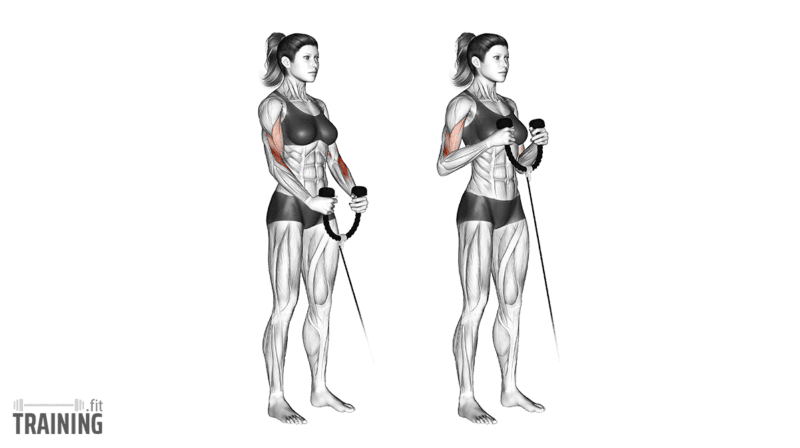
Main muscles
- Biceps: Arm flexor
(Musculus biceps brachii) - Biceps: Upper arm muscle
(brachialis muscle) - Forearm: Brachioradialis
(Musculus brachioradialis)
Workout plan
Here you can find example plans for rope cable hammer curl training:
Rope Cable Hammer Curl: Basics and alternatives
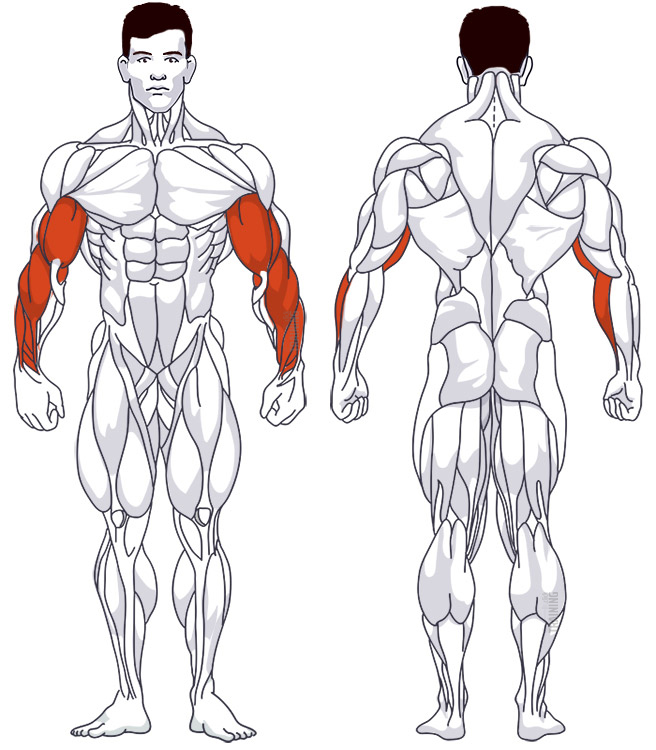
Involved main muscle groups:
Rope Cable Hammer Curl
Rope cable hammer curls bring the classic neutral grip of Hammer Curls to a cable machine. With your palms facing each other, hold a rope end in each hand and bend your elbows to curl upward. Your biceps and other elbow flexors lift the weight while your hands grip firmly.
If you’d prefer to curl with your palms facing upward, try Cable Curls with a bar attachment. The rope version keeps your palms facing each other during both the lift and the return.
Correct execution
You can concentrate on bending your elbows while holding both ends at the same height.
Set the pulley low and choose a manageable weight. Grip both rope ends at the same height beside the end stops. Hold the rope firmly instead of letting the end stops rest against loosely open fingers.
Stand facing the station and step back enough to take up the cable slack. Leave room for the rope to clear your thighs and the machine. Keep your upper arms near your body as you bend your elbows, raising both hands together through a comfortable range. You don’t need to aim for a fixed height with the rope ends.
Lower both hands slowly together. Keep your feet planted and use a weight you control at both ends of the movement. If one hand reaches the top first, don’t let either elbow drift forward or up to even things out. Lower the weight and check the rope lengths before continuing.
Your grip affects how your arm muscles work. In a study of 10 trained male bodybuilders, palms-up cable curls produced higher biceps and brachioradialis activation during lifting than neutral-grip curls with a rope attachment. The study measured muscle activity, rather than long-term muscle growth.[1]
Video tutorial
Step-by-step instructions
Attach a rope to the lowest suitable pulley setting and select a manageable weight.
Face the station and take an end of the rope in each hand, palms facing each other.
Stand upright with relaxed knees and your arms extended beside your torso. Step back enough to take up the cable slack.
Bend your elbows and bring your hands up, keeping your shoulders down and your hips still.
Lower your hands slowly along the same path, keeping the neutral grip. Control the return so the plates don’t crash together, then start the next curl.
Common mistakes
Leaning back or pushing your hips forward lets your body do part of the lifting. If you need that momentum to start the curl, choose a lighter setting.
Turning your palms up halfway loses the neutral grip that makes this a hammer curl. Keep them facing each other and your wrists aligned with your forearms; don’t bend your wrists to pull the rope higher. There’s no need to pull the rope ends far apart at the top.
What the science says
The study of 10 bodybuilders described above directly measured muscle activity during rope cable hammer curls. The studies below examine other curl variations. They offer useful context, but they did not test long-term training with rope hammer curls.
In a 2026 study, 12 resistance-trained men did barbell curls with 3 bars that held their hands palms up, partly turned or with the palms facing each other, as in a hammer curl. Both the biceps and the brachioradialis, the forearm muscle on the thumb side, were more active during lifting than lowering. While lowering, the brachioradialis was more active than the biceps, especially with the palms-up and partly turned bars. These results show how hard the muscles worked in a single session, not how much they would grow.[2]
In a 10-week study, 35 untrained young men and women did preacher curls 3 times a week in a full-body program, either on a cable machine or with a barbell. The cable loaded the biceps most with the elbows bent, the barbell with the arms closer to straight. Both groups got stronger and gained similar biceps thickness. The barbell group gained more strength only when tested with the arms almost straight. Both groups did regular preacher curls, not hammer curls.[3]
Sources
- Biceps Brachii and Brachioradialis Excitation in Biceps Curl Exercise: Different Handgrips, Different Synergy. Coratella G, Tornatore G, Longo S, Toninelli N, Padovan R, Esposito F, Cè E. Sports. 2023;11(3):64. doi: 10.3390/sports11030064.
- Effects of grip variation on biceps brachii and brachioradialis electromyographic activity during concentric and eccentric phases of the barbell curl exercise. Uysal A, Karaduman B, Soslu R, Lök S, Govindasamy K, Tejaswi J, et al. BMC Sports Science, Medicine and Rehabilitation. 2026. doi: 10.1186/s13102-026-01867-7.
- Placing Greater Torque at Shorter or Longer Muscle Lengths? Effects of Cable vs. Barbell Preacher Curl Training on Muscular Strength and Hypertrophy in Young Adults. Nunes JP, Jacinto JL, Ribeiro AS, Mayhew JL, Nakamura M, Capel DMG, et al. International Journal of Environmental Research and Public Health. 2020;17(16):5859. doi: 10.3390/ijerph17165859.