Resistance Band Hammer Curls
Isolation exercise, Free weightsThis article is verified by 4 studies/publications.
Overview
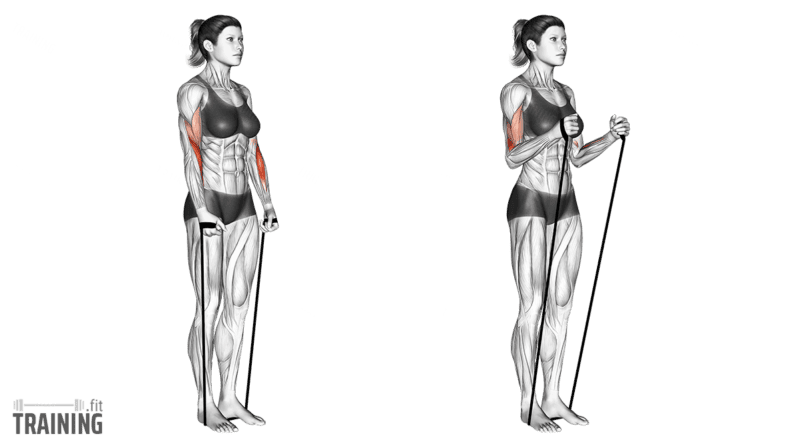
Main muscles
- Biceps: Arm flexor
(Musculus biceps brachii) - Biceps: Upper arm muscle
(brachialis muscle) - Forearm: Brachioradialis
(Musculus brachioradialis)
Training plans
Resistance Band Hammer Curls is a suitable substitute for similar exercises in or as a supplement to various training plans.
Resistance Band Hammer Curls: Basics and alternatives
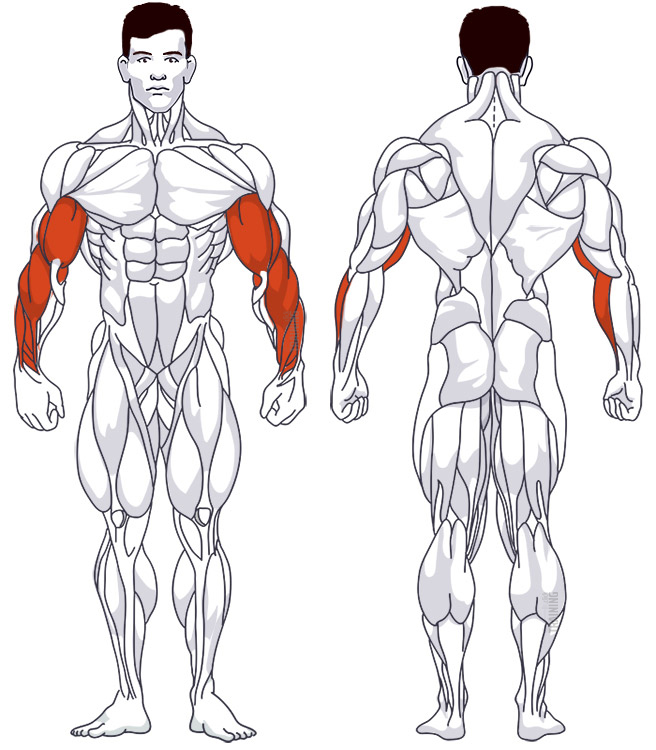
Involved main muscle groups:
Resistance Band Hammer Curls
Resistance band hammer curls are the band version of a classic arm exercise: you stand on the band and lift its ends with your palms facing each other. It’s similar to Hammer Curls, with the band taking the place of the dumbbells. Your biceps, brachialis and brachioradialis all help bend your arms.
It’s a handy variation if you have a band at home. For the palms-up version with the same setup, try the Band Biceps Curl. Keep your upper arms beside your body in both versions; the main difference is how you hold your hands.
Correct execution
Choose a resistance you can control at the top of the curl as well as in the starting position.
Keep the band secure under the middle of both shoes. Handles make the hammer grip straightforward; with a loop band, hold the ends with your palms facing inward and don’t wrap it tightly around your fingers.
Start with equal lengths on both sides. Since the band gets harder to stretch as your hands rise, make sure you can finish the curl smoothly.[1] If the band pulls you out of position near the top, give yourself more band length or use a lighter band.
Curl your hands toward the front of your shoulders with your wrists in line with your forearms. Keep your palms facing one another throughout. Your elbows bend to lift the handles; your wrists don’t tip backward to add height.
Run the band outside your legs, clear of your knees. Hold both handles the same way and keep their straps untwisted.
Video tutorial
Step-by-step instructions
Place the middle of the band under both feet and stand with your feet about hip-width apart.
Take one side in each hand and stand upright with your arms beside your torso.
Turn your hands so the palms face each other. Keep your wrists aligned with your forearms.
Bend your elbows and lift your hands toward the front of your shoulders without swinging your body.
Stop before your upper arms have to lift forward to gain extra height. Lower your hands steadily, keeping the same grip until you return to the starting position.
Common mistakes
A band can pull your hands downward quickly if you relax at the top. Keep hold of it and control the return. Stop to reset the band if it starts sliding beneath your feet.
Rocking backward or tipping your wrists adds unwanted movement to the curl. Keep the action at your elbows and use a resistance that lets both arms follow the same controlled path.
Keep your elbows near your sides, but leave them a little room so your forearms can move freely. If the band rubs against one leg, release the tension and fix its path, so you’re not twisting your torso away from it on every rep. Let both hands reach the bottom before you start the next rep with both arms together.
What the science says
There doesn’t seem to be a study specifically on band hammer curls. Research on curls with other equipment shows what the neutral grip changes, and a small training study compared bands with weights.
In a 2023 study, 10 male competitive bodybuilders did cable curls with a bar, palms up or down, and with a rope, as in rope cable hammer curls. While lifting, the biceps was about 12% more active with palms up than with the neutral rope grip, and the thumb-side forearm muscle (brachioradialis) was more active too. Like the next study, it shows how hard the muscles worked in a single session, not which grip builds more muscle.[2]
A 2026 study with 12 resistance-trained men compared barbell curls with 3 bars, including one that held the palms facing each other. Lifting produced more activity than lowering in both the biceps and brachioradialis. While lowering, the brachioradialis was more active than the biceps, especially with the palms-up and partly turned bars.[3]
In a 4-week study, 20 untrained young women trained 3 times a week with heavy, low-repetition exercises, including biceps curls with either elastic bands or dumbbells. In the muscles that bend the elbow, the band group got stronger at lowering against resistance, but their lifting strength didn’t improve significantly, while the dumbbell group improved in both. There were no significant differences between the groups. The band exercise was described as a biceps curl, not a hammer curl, and the study’s 10 women per group made it a very small trial.[4]
Sources
- Thera-band® elastic band tension: reference values for physical activity. Uchida MC, Nishida MM, Sampaio RAC, Moritani T, Arai H. Journal of Physical Therapy Science. 2016;28(4):1266–1271. doi:10.1589/jpts.28.1266. Study.
- Biceps Brachii and Brachioradialis Excitation in Biceps Curl Exercise: Different Handgrips, Different Synergy. Coratella G, Tornatore G, Longo S, Toninelli N, Padovan R, Esposito F, et al. Sports. 2023;11(3):64. doi: 10.3390/sports11030064.
- Effects of grip variation on biceps brachii and brachioradialis electromyographic activity during concentric and eccentric phases of the barbell curl exercise. Uysal A, Karaduman B, Soslu R, Lök S, Govindasamy K, Tejaswi J, et al. BMC Sports Science, Medicine and Rehabilitation. 2026. doi: 10.1186/s13102-026-01867-7.
- Concentric and Eccentric Force Changes with Elastic Band and Isotonic Heavy Resistance Training: A Randomized Controlled Trial. Folkins E, Sahni S, Ryan J, Wooden S, Bushby G, Radzinski C. International Journal of Sports Physical Therapy. 2021;16(3):756–765. doi: 10.26603/001c.23672.