Barbell Drag Curl
Isolation exercise, Free weightsOverview
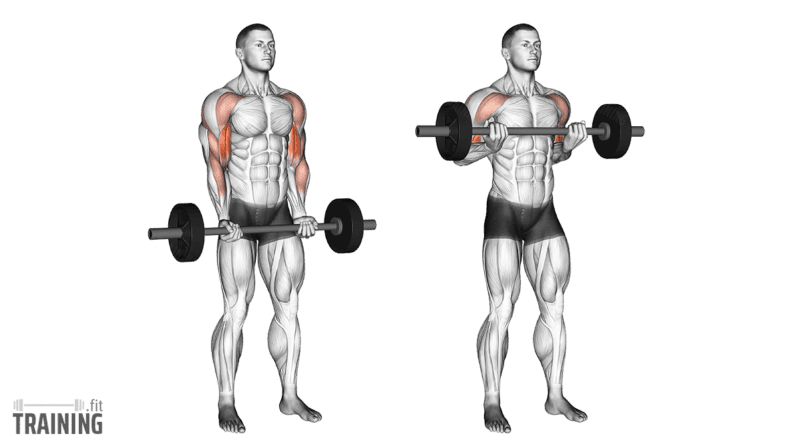
Main muscles
- Biceps: Arm flexor
(Musculus biceps brachii)
Training plans
Barbell Drag Curl is a suitable substitute for similar exercises in or as a supplement to various training plans.
Barbell Drag Curl: Basics and alternatives
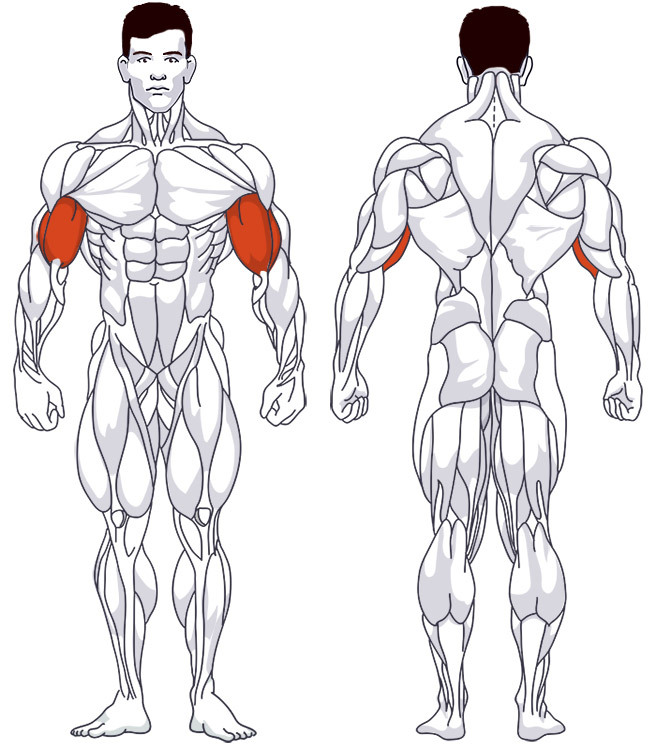
Involved main muscle groups:
Barbell Drag Curl
The barbell drag curl changes the path of the classic barbell curl: you keep the bar close to your body as your elbows bend and move slightly backward. In a regular curl, your elbows stay beside you. Your biceps and other elbow flexors still do the work.
For the familiar forward arc, use Barbell Curls. The Cable Drag Curl offers a similar movement close to your body, with a cable providing the resistance.
Correct execution
Unlike a conventional curl, this version lets your elbows travel backward. That change should come from the arms while your torso stays upright, rather than from leaning away from the bar.
Stand upright and hold the bar in front of your thighs with an underhand grip. Place your hands the same distance from the center and choose a width that feels comfortable for your wrists. Keep your knees slightly bent and your feet fully planted.
Bend your elbows and let them move backward as the bar rises close to your body. Both happen together; don’t pull your elbows all the way back before curling. Keep your shoulders down as the bar rises, even near the top.
Your arm proportions and control determine how high the bar rises; it doesn’t need to reach your neck. Stop before you’d have to lean back or swing the bar away from your body, and keep a firm grip with your wrists in line with your forearms.
Lower the bar along the same close path. Let your elbows return toward your sides as your arms straighten, so you finish in the upright starting position. If you need to change your grip width, put the bar down securely first.
Video tutorial
Step-by-step instructions
Stand upright and hold the bar in front of your thighs with your palms facing forward.
Brace your torso gently and keep your wrists aligned with your forearms.
Bend your elbows and draw them backward, guiding the bar upward close to your body.
Pause at the top, just before you’d have to lift your shoulders or swing the bar away from your body.
Lower the bar along the same close path, letting your elbows return to your sides as your arms straighten. Settle back into the upright starting position before repeating.
Common mistakes
Despite the name, you don’t need to scrape the bar along your shirt or press it into your ribs; keep it close, but don’t use your body as a lever. Also watch your elbows: if they drift out to the sides, the curl turns into something like an upright row.
Leaning backward or rocking onto your heels adds momentum. Keep your feet planted and use less weight if you can’t lift and lower the bar with your upper body steady.
Both ends of the bar should rise together. If one side tips up first, check your hand spacing and reduce the weight if needed. Even though the bar stays close to your body, make sure the plates have room to clear any nearby equipment.