Battling Ropes
Compound exercise, Free weightsThis article is verified by 4 studies/publications.
Overview
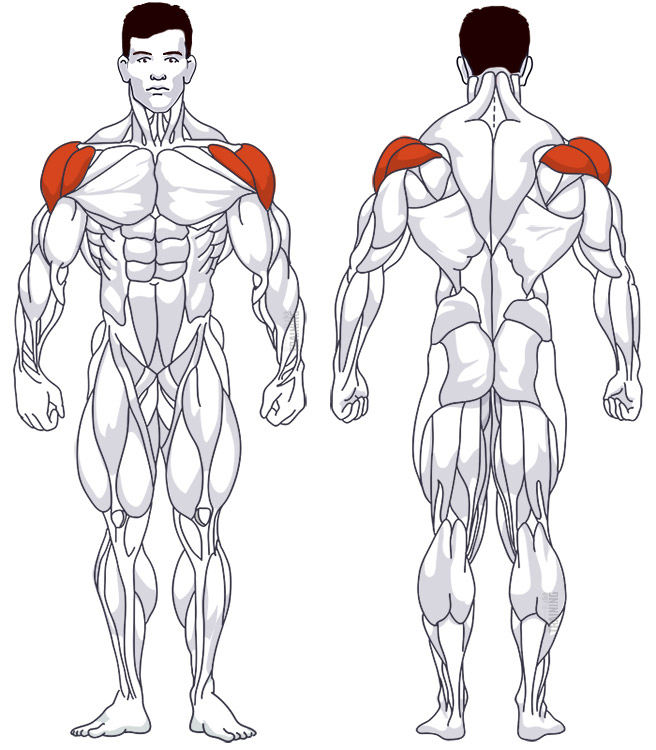
Main muscles
- Shoulder: Anterior deltoid muscle
(Musculus deltoideus, Pars clavicularis) - Shoulder: Posterior deltoid muscle
(Musculus deltoideus, posterior deltoid muscle) - Biceps: Arm flexor
(Musculus biceps brachii) - Triceps: Three-headed arm muscle
(Musculus triceps brachii) - Abdomen: Transverse abdominal muscle
(Musculus transversus abdominis) - Abdomen: External oblique abdominal muscle
(Musculus obliquus externus abdominis)
Training plans
Battling Ropes is a suitable substitute for similar exercises in Conditioning and full-body or as a supplement to various training plans.
Battling Ropes: Basics and alternatives
Involved main muscle groups:
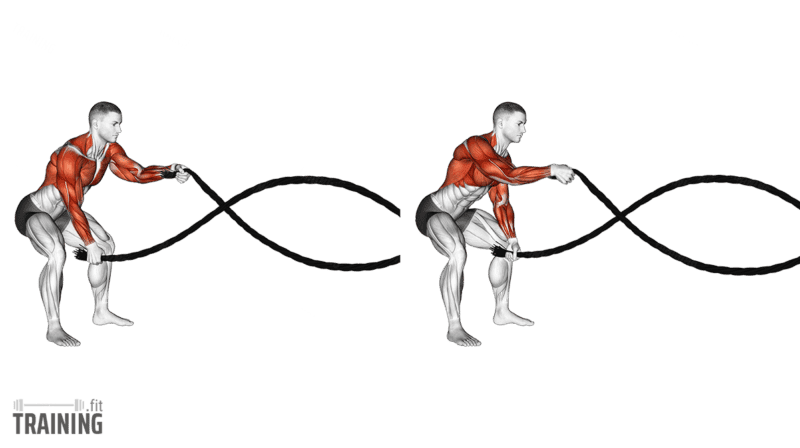
Battling Ropes
Alternating waves are a classic way to use battle ropes. You’ll hold one end of an anchored rope in each hand and send waves toward the anchor, raising one hand as the other moves down. Your shoulders and arms move the ropes while your core and legs steady your stance.
The same ropes allow several variations. Kneeling battle-rope waves keep both knees down. Battle-rope flys move your hands outward and inward, while battle ropes with squat jumps add repeated jumps. Learn the standing wave rhythm before combining movements.
Correct execution
The ropes need a little slack for waves to travel toward the anchor. Once that distance is right, you can concentrate on an alternating rhythm without bouncing your whole body.
Use an anchor designed for battle ropes and make sure it can’t slide or come loose, with nothing in the path of the ropes or around your hands. Face the anchor, hold one end in each hand with your palms facing in and stand with your feet about shoulder-width apart. Bend your knees slightly and push your hips back, keeping your chest up.
Leave similar slack in both rope sections so waves can form. If they’re pulled tight, step a little closer to the anchor before starting. Hold the handles firmly in your palms without wrapping rope around your wrists.
Raise one hand as you lower the other, then reverse. Start with small waves and let your elbows bend naturally. Your hands don’t need to reach shoulder height every time. Breathe steadily and choose a wave height and pace that let you keep your body still.
Look along the ropes to check that they move freely. If one catches or its wave stops, pause and check the rope path and your grip. To finish, make the waves smaller, let the ropes settle and put both ends down.
Video tutorial
Step-by-step instructions
Check the anchor and clear the path of both rope sections.
Hold one end in each hand, face the anchor and take a stable shoulder-width stance.
Bend your knees slightly, move your hips back and leave enough slack for waves.
Raise one hand as you lower the other, then reverse the arm positions.
Keep alternating at a pace that lets you hold your feet in place and your upper body steady. Reduce the waves to stop, then place both ends on the floor.
Common mistakes
Pulling the ropes tight makes you lean toward the anchor and keeps the waves from forming. When a wave stalls, adjust your distance first; pulling harder won’t fix it.
Moving your arms too fast or too far can make your shoulders shrug and your upper body bounce. Make the waves smaller or slow down until you can move both arms deliberately. Also keep your hands alternating, since lifting both together turns this into a different rope exercise. Keep your fingers around the handles until the ropes have stopped moving.
What the science says
Battle rope studies have mainly involved young, active participants, many of them athletes. These studies cover muscle activity, how demanding rope workouts are for your heart and lungs, and what changes after several weeks of rope training.
In a 2018 study, 30 male college basketball players did 8 weeks of interval training 3 times a week, either with battle ropes or with shuttle runs. The rope group improved their aerobic fitness (by 17.6%), upper-body power, jump height, core endurance and shooting accuracy. In the shuttle-run group, improvements were limited to aerobic fitness and chest-pass speed.[1]
A 2015 study with 21 volunteers measured muscle activity during alternating waves, like the ones in this article, and waves with both arms together. The front shoulders, outer obliques and lower back muscles worked at 51–73% of their maximum, while the side glute muscle (gluteus medius) stayed at 14–18%. Oblique activity was greater during alternating waves, while double-arm waves produced more lower back activity. This shows how hard the muscles work in a single session, not how much they grow.[2]
A 2026 review pooled 21 controlled studies with 590 people aged 11–25, most of them male. Compared with control groups, battle rope training improved upper-body power, grip strength, upper-body muscular endurance and core endurance, while the effect on leg power wasn’t clear. The authors note substantial variation between study results and call for further confirmation.[3]
Another study tested 13 exercises on separate days in 10 resistance-trained men. Oxygen uptake, a measure of how hard your heart and lungs work, was highest during a battle rope circuit and burpees when averaged over each session, including rests. That was more than during squats and much more than during planks.[4]
Sources
- Eight-Week Battle Rope Training Improves Multiple Physical Fitness Dimensions and Shooting Accuracy in Collegiate Basketball Players. Chen WH, Wu HJ, Lo SL, Chen H, Yang WW, Huang CF, et al. Journal of Strength and Conditioning Research. 2018;32(10):2715–2724. doi: 10.1519/jsc.0000000000002601.
- Muscle Activity During Unilateral vs. Bilateral Battle Rope Exercises. Calatayud J, Martin F, Colado JC, Benítez JC, Jakobsen MD, Andersen LL. Journal of Strength and Conditioning Research. 2015;29(10):2854–2859. doi: 10.1519/jsc.0000000000000963.
- Effects of battle rope training on sporting performance: a systematic review and meta-analysis. Cao Y, Luo Y, Nazarudin MN, Koh D, Li S, Chen P. BMC Sports Science, Medicine and Rehabilitation. 2026;18(1):431. doi: 10.1186/s13102-026-01970-9.
- Comparison of the Acute Metabolic Responses to Traditional Resistance, Body-Weight, and Battling Rope Exercises. Ratamess NA, Rosenberg JG, Klei S, Dougherty BM, Kang J, Smith CR, et al. Journal of Strength and Conditioning Research. 2015;29(1):47–57. doi: 10.1519/jsc.0000000000000584.