training.fit Sample Plan: 5×5 Strength
This article is verified by 1 study/publication.
Plan overview
Muscle focus
See how the planned working sets are spread across muscle groups.
Loading training plans…
Share by muscle group
Contributing exercises
How are these percentages calculated?
Each working set counts once for every distinct muscle group listed for that exercise in the training.fit library. Two muscles in the same group still count as one. Warm-up sets are excluded; optional exercises count only when selected.
The percentage is a group’s set count divided by the total of all group counts. One exercise can contribute to several groups. This describes planned sets, rather than measured muscle activation, effort or expected growth.
“All listed sessions” counts each session once. A group with no counted sets may still work during an exercise. Muscle groups without a separate area on the body map appear in the list only.
Exercises included in this view
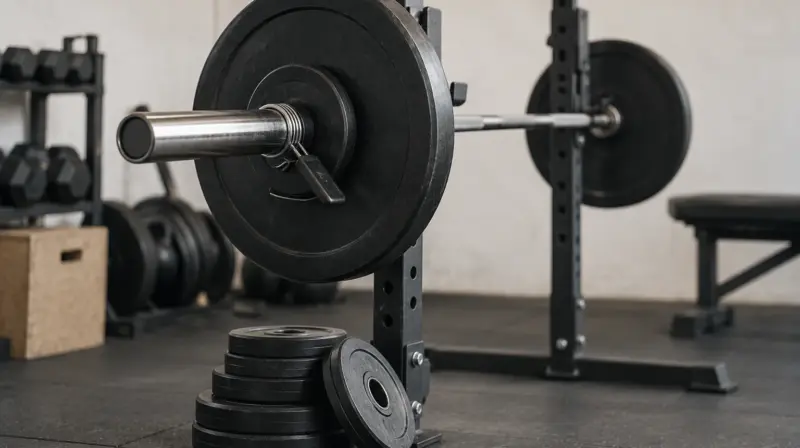
This training.fit sample uses five sets of five on selected compound exercises. Two alternating workouts combine that strength-focused work with a smaller amount of higher-repetition pulling. The exercise choices and progression below are our own example of a common 5×5 structure.
Who this plan suits
Use this sample if you already know the exercises and have access to the listed equipment. Start with manageable loads. Adjust the workload to your experience and recovery rather than treating the table as a requirement for everyone.
Schedule and workout structure
Train on Monday, Wednesday and Friday, or on three other non-consecutive days. Alternate A/B/A and B/A/B across successive weeks.
A
| Exercise | Sets | Repetitions |
|---|---|---|
| Barbell Squats | 5 | 5 |
| Bench Press | 5 | 5 |
| Cable Row | 3 | 8–12 |
B
| Exercise | Sets | Repetitions |
|---|---|---|
| Deadlift | 3 | 5 |
| Dumbbell Shoulder Press | 5 | 5 |
| Cable Lat Pulldown | 3 | 8–12 |
How progression works
Start at the lower end of each repetition range. When you reach the upper target in every set with control and about two repetitions left, add the smallest practical load and return to the lower end. For fixed five-repetition sets, increase only after completing every set at that effort. If you miss the minimum repeatedly, reduce the load or remove a set and reassess recovery. Keep a training log so those decisions follow your actual performance.
What the science says
A meta-analysis found similar strength and muscle growth with split and full-body routines when training volume was matched. The schedule is therefore a way to organize your training; it does not establish these exact workouts as optimal. [1]
Programme source and version
This is an independently written training.fit sample. Its exercise selection, set targets and progression are editorial examples, not a reproduction of a named coach’s programme or a workout tested as a complete package in the cited research.
training.fit Sample Plan: 5×5 Strength alternative exercises
You can perform the following exercises as alternatives to training.fit Sample Plan: 5×5 Strength.
Filter the exercises below by muscle group and difficulty.
| Exercise | Main muscle group | Difficulty | Type of training |
| Barbell Squats | Thigh training |
Hard |
Compound exercise |
| Bench Press | Triceps training |
Medium |
Compound exercise |
| Cable Lat Pulldown | Upper back |
Easy |
Compound exercise |
| Cable Row | Neck training |
Medium |
Compound exercise |
| Deadlift | Thigh training |
Hard |
Compound exercise |
| Dumbbell Shoulder Press | Shoulder training |
Easy |
Isolation exercise |
Sources
- Efficacy of Split Versus Full-Body Resistance Training on Strength and Muscle Growth: A Systematic Review With Meta-Analysis. Ramos-Campo DJ, Benito-Peinado PJ, Andreu-Caravaca L, Rojo-Tirado MA, Rubio-Arias JÁ. Journal of Strength & Conditioning Research. 2024; 38(7):1330–1340. doi: 10.1519/JSC.0000000000004774.