r/Fitness Basic Beginner Routine
This article is verified by 2 studies/publications.
Plan overview
Muscle focus
See how the planned working sets are spread across muscle groups.
Loading training plans…
Share by muscle group
Contributing exercises
How are these percentages calculated?
Each working set counts once for every distinct muscle group listed for that exercise in the training.fit library. Two muscles in the same group still count as one. Warm-up sets are excluded; optional exercises count only when selected.
The percentage is a group’s set count divided by the total of all group counts. One exercise can contribute to several groups. This describes planned sets, rather than measured muscle activation, effort or expected growth.
“All listed sessions” counts each session once. A group with no counted sets may still work during an exercise. Muscle groups without a separate area on the body map appear in the list only.
Exercises included in this view
The r/Fitness Basic Beginner Routine is a short introduction to barbell training. You alternate two full-body workouts across three lifting days, practise the main movements and track both weight and repetitions. It is intended to get you started, rather than remain your only training plan indefinitely.
Who this plan suits
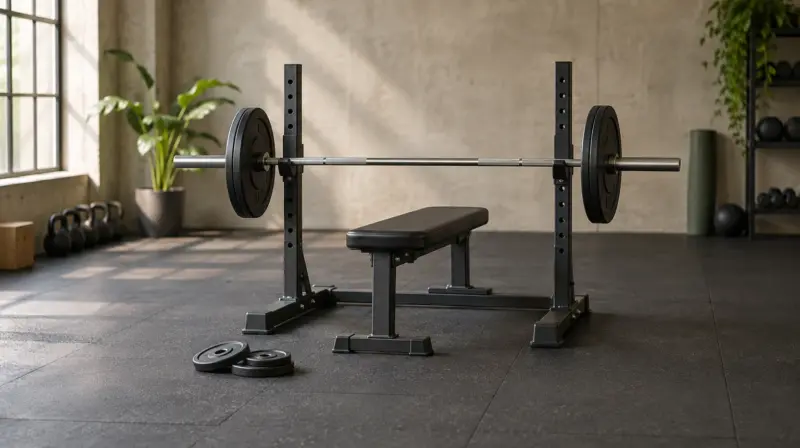
Choose it if you are new to structured lifting and want a small number of exercises to learn. You need a barbell, rack, bench and a suitable pulling setup. The community recommends moving to a more comprehensive routine within about three months; that is a programme guideline, not a deadline for your progress.
Schedule and workout structure
Alternate A/B/A and B/A/B on three non-consecutive days. The table selects chin-ups for workout B; assistance is an alternative if you need it. The + applies only to the last set, with 1–2 good repetitions left.
A
| Exercise | Sets | Repetitions |
|---|---|---|
| Barbell Row | 3 | 5, 5, 5+ |
| Bench Press | 3 | 5, 5, 5+ |
| Barbell Squats | 3 | 5, 5, 5+ |
B
| Exercise | Sets | Repetitions |
|---|---|---|
| Chin-up | 3 | 5, 5, 5+ |
| Standing barbell overhead press | 3 | 5, 5, 5+ |
| Deadlift | 3 | 5, 5, 5+ |
How progression works
The published rules add 2.5 lb to upper-body lifts and 5 lb to squats and deadlifts each time you repeat them. If the final set exceeds 10 repetitions, the increments double. If you cannot complete 15 total repetitions, reduce that lift by 10% next time. Use the source’s alternatives if your equipment cannot accommodate the smaller increments.
Popularity and user feedback
The community wiki values its simplicity and treats it as an entry point. That is an editorial recommendation, rather than a representative survey of results.
Its main home is the r/Fitness programme catalogue. Its visibility comes from an established lifting community.
What the science says
An ACSM overview supports progressive resistance training for healthy adults. Its findings fit the routine’s emphasis on repeatable practice and gradual progression, without establishing a special three-month cutoff. [1]
A narrative review discusses concentrating time-limited training around useful movements. This supports keeping a starter plan manageable; it does not show that the fewest exercises always produce the best results. [2]
These papers examine training principles and prescriptions. They do not establish that the r/Fitness Basic Beginner Routine is superior to other well-designed programmes.
Programme source and version
This overview follows the community’s current A/B routine, including its progression and transition rules. r/Fitness: programme source.
r/Fitness Basic Beginner Routine alternative exercises
You can perform the following exercises as alternatives to r/Fitness Basic Beginner Routine.
Filter the exercises below by muscle group and difficulty.
| Exercise | Main muscle group | Difficulty | Type of training |
| Barbell Bench Squat | Thigh training |
Hard |
Compound exercise |
| Barbell Row | Shoulder training |
Hard |
Compound exercise |
| Barbell Squats | Thigh training |
Hard |
Compound exercise |
| Bench Press | Triceps training |
Medium |
Compound exercise |
| Cable Bent Over Reverse Grip Row | Shoulder training |
Medium |
Compound exercise |
| Deadlift | Thigh training |
Hard |
Compound exercise |
| Safety Bar Squat | Thigh training |
Hard |
Compound exercise |
| Smith Machine Bench Press | Chest training |
Medium |
Compound exercise |
| Smith Machine Squats | Thigh training |
Medium |
Compound exercise |
| Trap Bar Deadlift | Thigh training |
Medium |
Compound exercise |
Sources
- American College of Sports Medicine Position Stand. Resistance Training Prescription for Muscle Function, Hypertrophy, and Physical Performance in Healthy Adults: An Overview of Reviews. Currier BS et al. Medicine & Science in Sports & Exercise. 2026; 58(4):851-872. doi: 10.1249/mss.0000000000003897.
- No Time to Lift? Designing Time-Efficient Training Programs for Strength and Hypertrophy: A Narrative Review. Iversen VM et al. Sports Medicine. 2021; 51(10):2079-2095. doi: 10.1007/s40279-021-01490-1.