Battling Ropes Jump Squat with Alternating Waves
Compound exercise, Free weightsOverview
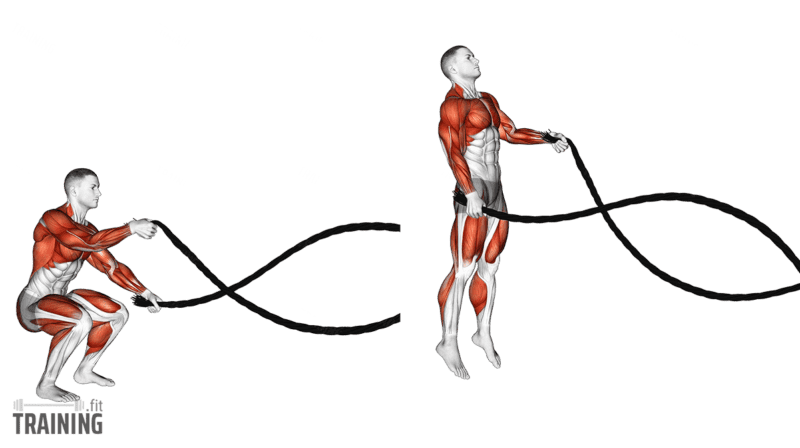
Main muscles
- Thigh: Quadriceps
(Musculus quadriceps femoris) - Buttocks: Large gluteus maximus
(Musculus gluteus maximus) - Lower leg: Twin calf muscle
(Musculus gastrocnemius) - Lower leg: Soleus muscle
(Musculus soleus) - Shoulder: Anterior deltoid muscle
(Musculus deltoideus, Pars clavicularis) - Abdomen: Transverse abdominal muscle
(Musculus transversus abdominis)
Training plans
Battling Ropes Jump Squat with Alternating Waves is a suitable substitute for similar exercises in Conditioning and full-body or as a supplement to various training plans.
Battling Ropes Jump Squat with Alternating Waves: Basics and alternatives
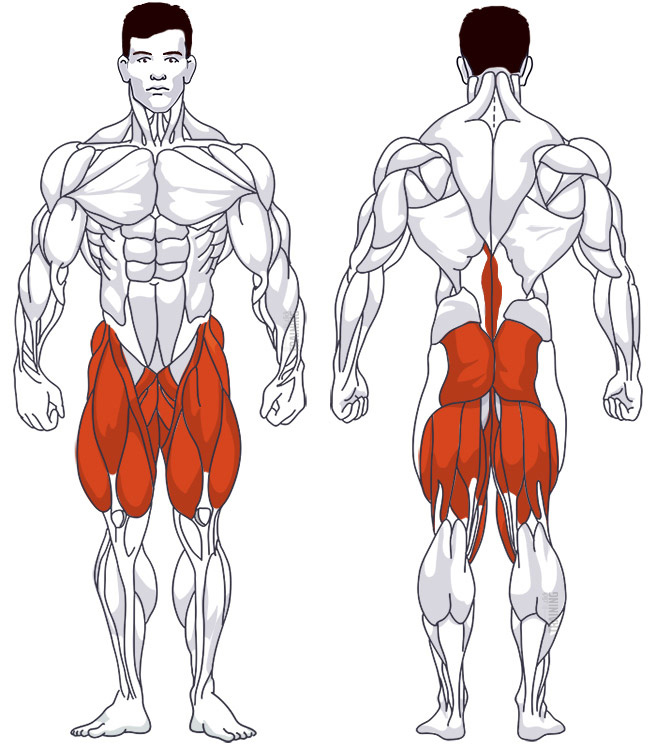
Involved main muscle groups:
Battling Ropes Jump Squat with Alternating Waves
Squat jumps add a leg-driven challenge to alternating battle-rope waves. You’ll keep your hands moving in turn as you squat, jump and land. Your thighs, butt and calves power the jump, your shoulders and arms move the ropes, and your abs steady you.
It’s best to learn the arm rhythm with Battling Ropes before adding the jump. Dumbbell squat jumps also have you jumping from a squat, but you hold the weights beside your body. High Knee Sprints let you run on the spot without any equipment.
Correct execution
This combination asks you to keep the arm rhythm going through a jump and landing. Small waves and a modest jump let you learn the timing before trying a more demanding effort.
Check the anchor and clear a firm, non-slip landing area. Practice a few bodyweight squat jumps first. Then begin small alternating waves from a comfortable shoulder-width stance, leaving enough slack that the ropes don’t pull you forward as you rise.
Keep alternating your hands as you bend your hips and knees. From a depth you can control, push through your feet into a small jump straight up. Your hands stay in front of you, slightly out to the sides, and keep the alternating rhythm going throughout.
Land on both feet with your knees following your toes. Let your ankles, knees and hips bend to absorb the landing. Regain your balance before jumping again. Pause the waves if you can no longer coordinate them with the jump.
Try to land where you took off, since moving toward or away from the anchor changes the slack. Keep the handles clear of your knees, and keep your legs underneath you while you’re in the air. If you need to, go back to squats with alternating waves for a while before adding the jump again. Finish with both feet planted, gradually stop the waves and put the handles down.
Video tutorial
Step-by-step instructions
Check the anchor and clear a stable area for a two-foot landing.
Take a shoulder-width stance, grip both rope ends and begin small alternating waves.
Bend your hips and knees while continuing to alternate your hands.
Extend through your legs into a small upward jump without turning the waves into a two-arm slam.
Land on both feet and bend your ankles, knees and hips under control. Regain balance before repeating; stop the waves with both feet planted and set the handles down.
Common mistakes
Going for a maximal jump can make the rope rhythm and your landing hard to control. Keep the jump modest, and if you can’t coordinate the two, practice them separately again.
Landing stiff-legged or jumping again before you’ve regained your balance leaves you little room to reset. Bend your ankles, knees and hips on landing, then regain balance. If the ropes pull you toward the anchor, stop and adjust your distance so there’s enough slack as you rise.