Battling Ropes Fly
Compound exercise, Free weightsOverview
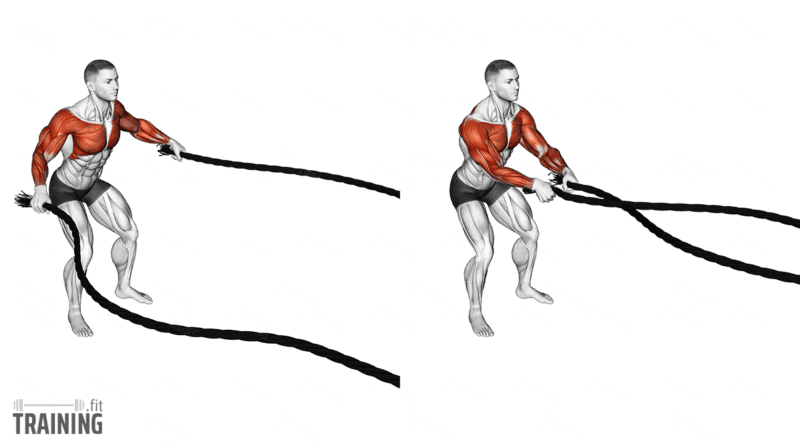
Main muscles
- Chest: Large pectoral muscle
(Musculus pectoralis major) - Shoulder: Anterior deltoid muscle
(Musculus deltoideus, Pars clavicularis) - Shoulder: Posterior deltoid muscle
(Musculus deltoideus, posterior deltoid muscle) - Abdomen: Transverse abdominal muscle
(Musculus transversus abdominis)
Training plans
Battling Ropes Fly is a suitable substitute for similar exercises in Conditioning and full-body or as a supplement to various training plans.
Battling Ropes Fly: Basics and alternatives
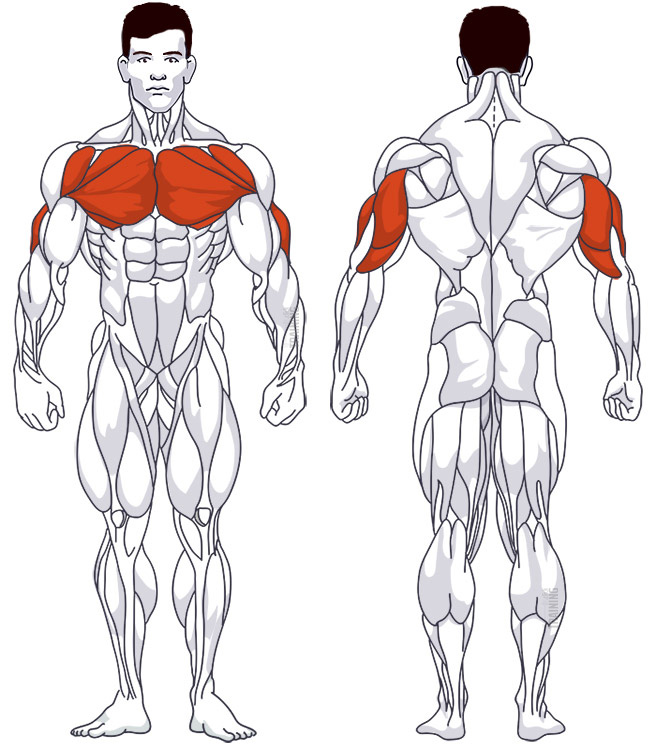
Involved main muscle groups:
Battling Ropes Fly
Battle rope flys take the classic fly movement and turn it into rope waves: you’ll open and close both arms together. Standing with slightly bent knees and facing the anchor, you sweep the rope ends outward and inward. Your chest helps bring your upper arms together, while your shoulders guide the opening and your abs help keep you steady.
In ordinary Battling Ropes, your hands alternate up and down. Here they move together more horizontally. The arm motion resembles dumbbell flys and band flys, but you create repeated rope waves rather than moving slowly against a weight or band.
Correct execution
Both arms create the sideways waves together in this variation. You can begin below shoulder height and focus on an even opening and closing rhythm rather than making the biggest waves.
Check the rope anchor and give both rope sections enough clear floor space to move sideways. Stand with your feet about shoulder-width apart, your knees slightly bent and your hips a little back. Hold the handles with your palms facing in, keep your elbows slightly bent and leave some slack in the ropes.
Move both hands out to the sides, then sweep them inward in front of your body. Start below shoulder height, keeping your upper arms from traveling far behind you. Bring your hands close together without letting them touch or cross, and don’t knock the handles together. Keep your chest facing the anchor and let your shoulder blades move with your arms. Find a repeatable outward-and-inward rhythm before making the waves larger. Reduce the movement gradually when you finish and set down both handles after the ropes settle.
Keep your wrists in line with your forearms as your hands approach the center; there’s no need to roll the handles inward to finish the sweep. Check that each rope has its own clear lane on the floor; loose coils between your feet can catch as the waves spread sideways. Stop to straighten the ropes instead of stepping across them while they move.
Video tutorial
Step-by-step instructions
Check the anchor and clear enough room for both ropes to move sideways.
Face the anchor in a stable, slightly bent-knee stance and grip one rope end in each hand.
Leave some rope slack and hold your hands in front of you with gently bent elbows.
Sweep both arms outward, then bring them inward together to create horizontal waves.
Repeat without striking the handles together or twisting your upper body to follow one arm. Make the waves smaller until they stop and place the ends on the floor.
Common mistakes
Opening your arms too far behind your body can pull you out of your stance. You don’t need a deep chest stretch to create a wave. Shorten the sweep so your shoulders and upper body stay controlled.
Bending and straightening your elbows sharply turns the fly into more of a push-and-pull movement. Keep a similar elbow bend as your upper arms open and close. If one hand whips higher or the ropes catch, slow down and rebuild an even rhythm.