Cable Seated Pullover
Isolation exercise, Cable pullOverview
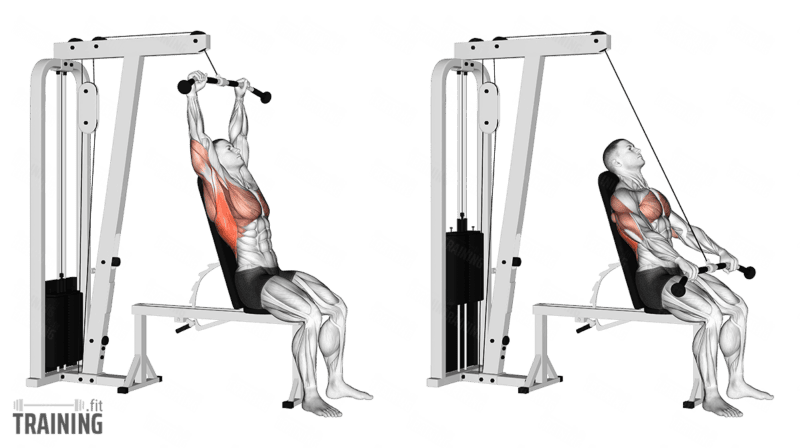
Main muscles
- Back: Large round muscle
(Musculus teres major) - Back: Large back muscle
(Musculus latissimus dorsi) - Back: Larger rhomboid muscle
(Musculus rhomboideus major) - Back: Small round muscle
(Musculus teres minor)
Training plans
Cable Seated Pullover is a suitable substitute for similar exercises in upper back training or as a supplement to various training plans.
Cable Seated Pullover: Basics and alternatives

Involved main muscle groups:
Cable Seated Pullover
The seated cable pullover is a useful option for working your lats with your back supported. You’ll face away from a high pulley and sweep the bar from overhead toward your thighs against the pull from behind and above. Keep a slight, steady elbow bend as your arms move at the shoulders.
Straight-arm pulldowns use a similar arm movement, but you stand facing the machine. Pull-Ups involve more elbow bending as you lift your body toward a bar. In the seated pullover, your back stays supported through the overhead reach.
Correct execution
The backrest supports your torso while your upper arms bring the attachment down. Bench placement should give the bar a clear path so you can focus on that arm movement.
Place an incline bench with its back toward the cable tower and attach a bar to the upper pulley. Try the setup with a light weight first: the cable should clear the bench and your head, and the bar needs room to travel to your thighs without hitting the support.
Sit with your feet firmly planted and your back against the pad. Start with your arms comfortably overhead and your elbows slightly bent. Sweep the bar forward and down while keeping that bend almost the same. Stop around your thighs, or earlier if the bar path or your shoulder mobility calls for it. Then return overhead with control, keeping your ribs down and your back on the bench.
Set the bench angle and distance before using the working weight. You should be able to reach the starting position without sliding your hips forward on the seat. Keep your grip symmetrical around the middle of the attachment so the bar doesn’t tilt as it passes above your face.
Your arms sweep around your shoulders, so the bar follows an arc, not a straight vertical line. Keep the elbow angle and body position steady. Trace the path with empty hands and your back on the pad first.
Video tutorial
Step-by-step instructions
Position the incline bench facing away from the high pulley.
Attach a suitable bar.
With a light load, sit with your back supported and feet planted, then take the bar with an overhand grip.
Hold the bar overhead with a small elbow bend and check cable clearance.
Draw your upper arms forward and down, bringing the bar toward your thighs.
Pause at a depth you can control, then return your arms overhead slowly.
Keep your back supported throughout and lower the weight stack gently before releasing the bar.
Common mistakes
Bending and then forcefully straightening your elbows makes the movement more like an overhead triceps extension. Keep your elbow angle steady and choose less weight if necessary.
Arching your back away from the bench only makes the overhead position look deeper. Use a range where your upper body stays still against the bench instead. If the cable catches the bench or touches your head, stop and fix the setup before you continue.
Plan how to take and return the bar before loading. If reaching behind the bench means twisting awkwardly, change the setup or have someone hand you the bar. After the set, lower the stack under control before releasing the bar; never let go of the bar while it’s under load above your head.