High Knee Jump Rope
Compound exercise, Free weightsThis article is verified by 2 studies/publications.
Overview
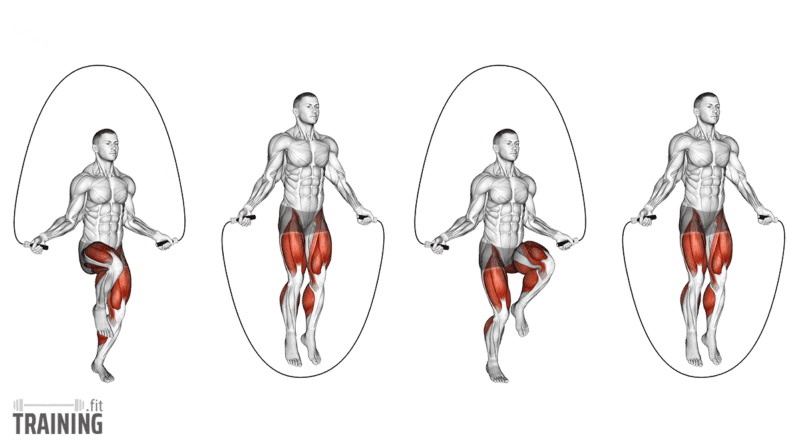
Main muscles
- Thigh: Quadriceps
(Musculus quadriceps femoris) - Thigh: Straight muscle of the thigh
(Musculus rectus femoris) - Lower leg: Twin calf muscle
(Musculus gastrocnemius) - Lower leg: Soleus muscle
(Musculus soleus) - Buttocks: Large gluteus maximus
(Musculus gluteus maximus) - Abdomen: Transverse abdominal muscle
(Musculus transversus abdominis)
Training plans
High Knee Jump Rope is a suitable substitute for similar exercises in Conditioning and full-body or as a supplement to various training plans.
High Knee Jump Rope: Basics and alternatives
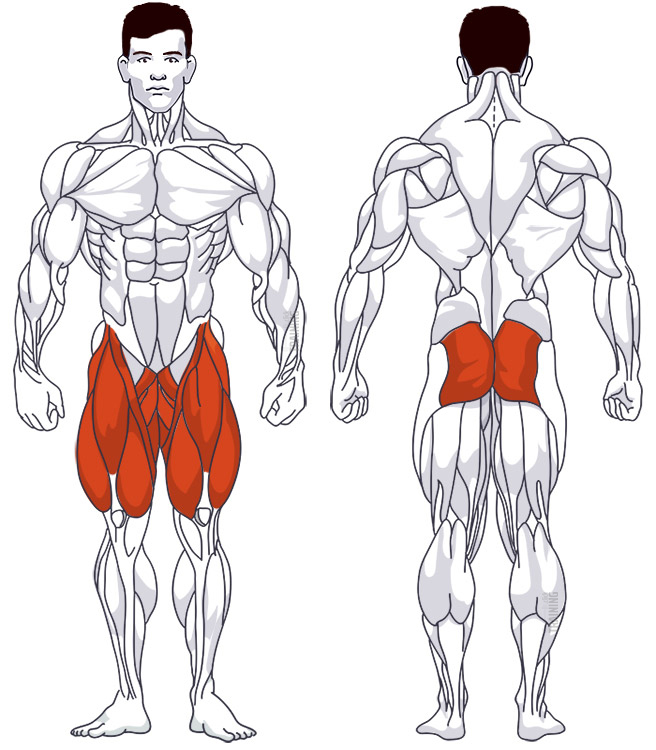
Involved main muscle groups:
High Knee Jump Rope
High-knee rope skipping adds a coordination challenge once basic skipping feels comfortable. As the rope passes under your supporting foot, you’ll lift your other knee. Your hip flexors raise your thigh; your calves and thighs handle takeoff and landing. Keep turning the rope with small arm movements close to your sides.
The movement is related to High Knee Sprints, with the extra task of timing each step to a rope turn. A simpler rhythm adds a basic two-foot bounce between knee lifts. You can practice this rhythm before trying continuous alternating knee lifts.
Correct execution
Before you start, get comfortable with the basic two-foot bounce and alternating-foot steps, using a rope that fits your height. Keep your hands beside your hips, your elbows comfortably close to your body and your shoulders relaxed. You’ll also need enough space for your knees and the rope’s full path.
Start with a basic two-foot jump, then lift your right knee on the next turn and land on your left foot. Follow with another basic two-foot jump, then lift the left knee and land on the right. Once that rhythm is controlled, you can leave out the basic jumps and switch raised knees on successive turns. Bring your knee up toward hip height, but only as far as you can while staying upright. A small hop on your supporting foot is all you need to clear the rope; you don’t have to jump high just because your knee comes up. If the rope keeps catching, slow down or go back to ordinary skipping.
Keep rope turns evenly spaced through the basic bounce and knee lift. Counting the four-part rhythm aloud can help you keep the one-foot landing at the same pace. Keep your raised knee bent; don’t kick your lower leg forward. Return that foot under your hip before the next two-foot bounce so both feet can land together.
Video tutorial
Step-by-step instructions
Choose a rope that fits your height and clear the space around you.
Begin with a steady two-foot bounce.
On the next rope turn, lift your right knee and land on your left foot.
Make a basic two-foot jump on the following turn.
Lift your left knee and land on your right foot, then repeat the four-part rhythm.
To progress once the rhythm is steady, leave out the basic jumps and alternate knee lifts on each turn.
Keep your body upright and stop the rope before untangling or resetting.
Common mistakes
Leaning back to make your knee look higher pulls you out of your upright posture. Stay tall and lower the knee lift if needed; your thigh doesn’t have to reach an exact horizontal angle.
Pulling your hands outward to make room for your knees shortens the rope under your feet. Keep your turns small and close to your body, and check your rope length if your feet keep catching. If you lose the rhythm, turning faster won’t fix it. Go back to the basic bounce or practice the footwork without the rope first.
What the science says
There doesn’t seem to be a study on high-knee rope skipping itself. In teenagers, 2 biomechanics studies compared similar alternating-foot skipping techniques with other rope skills or running.
In a 2022 study, 16 teenage boys skipped rope with a two-foot bounce and with alternating feet. Alternating skipping led to higher landing forces, with less bending at the hips and knees and more inward angling of the knees. Muscle activity shifted too: the two-foot bounce relied more on the calf and shin muscles, while alternating skipping involved more activity in one of the hamstrings (semitendinosus) and the hip flexors (iliopsoas). The authors regard the two-foot bounce as the gentler option for the legs.[1]
A 2023 study with 16 teenage competitive rope skippers compared double unders (2 rope turns per jump) and speed step, a fast alternating-foot sprint, with running. All 3 activities produced similar peak landing forces. Speed step placed more demand on the hip, while double unders placed more on the knee. Speed step also put 9–20% more peak load on the ankle than the other 2 activities, and in both rope skills the ankle absorbed landing energy at a 39–114% higher peak rate than in running.[2]
Neither study included a high knee lift, so the extra work for your hip flexors in this variation hasn’t been measured directly. Both studies examined single sessions rather than changes in fitness or injury rates over time.
Sources
- The Influence of Different Rope Jumping Methods on Adolescents’ Lower Limb Biomechanics during the Ground-Contact Phase. Lin Y, Lu Z, Cen X, Thirupathi A, Sun D, Gu Y. Children. 2022;9(5):721. doi: 10.3390/children9050721.
- Lower-limb joint kinetics in jump rope skills performed by competitive athletes. Bruce OL, Ramsay M, Kennedy G, Edwards WB. Sports Biomechanics. 2023;22(11):1398–1411. doi: 10.1080/14763141.2020.1801823.