Narrow Grip Push-Ups
Compound exercise, Body weightThis article is verified by 5 studies/publications.
Overview
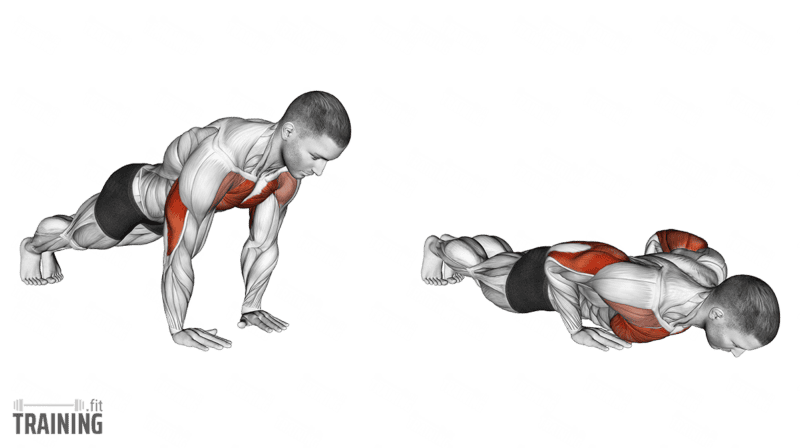
Main muscles
- Chest: Large pectoral muscle
(Musculus pectoralis major) - Shoulder: Anterior deltoid muscle
(Musculus deltoideus, Pars clavicularis) - Triceps: Three-headed arm muscle
(Musculus triceps brachii)
Training plans
Here you can find example plans for narrow grip push-ups training:
Narrow Grip Push-Ups: Basics and alternatives
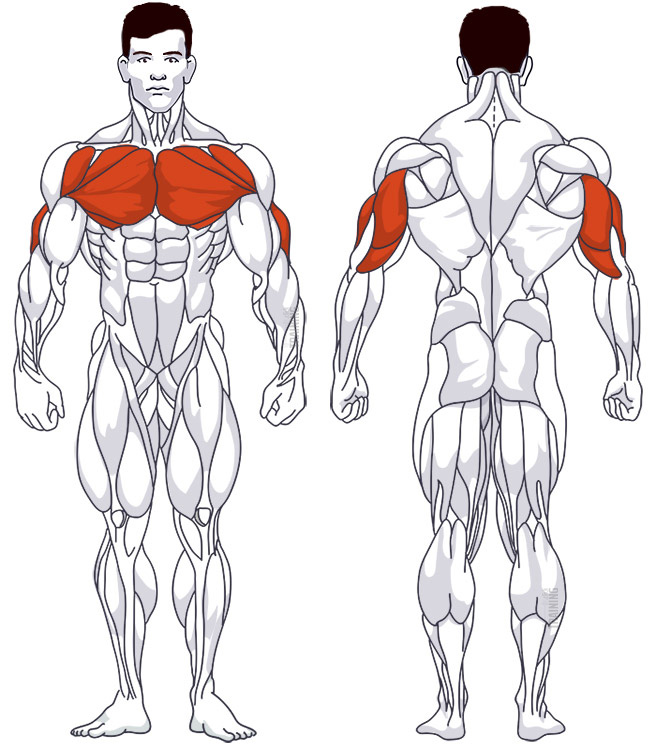
Involved main muscle groups:
Narrow Grip Push-Ups
Narrow-grip push-ups use a simple setup change: bring your hands closer together than in regular push-ups. You lower and raise your body as one unit while your chest, front shoulders and triceps do the work, and your elbows stay fairly close to your sides.
You don’t need to join your thumbs and fingertips into a diamond. Choose a narrow hand position that lets you lower and press comfortably. If you’d rather keep your usual hand width and add resistance, band push-ups are another option.
Correct execution
A narrower hand position changes how you support yourself, but you don’t need to squeeze your hands together. Leave yourself enough room to lower and press back up smoothly.
Place your hands beneath your chest, closer than shoulder-width apart. Spread your fingers and turn your hands slightly outward if that feels comfortable. Keep enough space between them to lower with control, with your shoulders supported over your hands.
Step your feet back into a stable position. They don’t have to be tightly together just because your hands are narrow. Tighten your abs so your chest and hips move together, and look down at the floor with your head in line with your body.
Bend your elbows as you lower; don’t slide your body behind your wrists to shorten the movement. Press up smoothly until your arms straighten, maintaining your body position.
In a study of 12 healthy male students, push-ups with the hands at half shoulder width produced higher triceps activation than shoulder-width or wider placements. This indicates a change in emphasis, rather than proving greater muscle growth over time.[1]
If the floor version is too hard, place your hands on a stable raised surface with room for both palms. Check that it can’t tip or roll. Keep the same basic hand spacing and use a height that lets you control the full repetition.
Video tutorial
Step-by-step instructions
Kneel down and place your hands closer than shoulder-width on the floor beneath your chest.
Step your feet back and support yourself on your hands and toes.
Align your head, torso and legs, keeping your hips from sagging or lifting excessively.
Bend your elbows and lower your chest, keeping your elbows close to your sides.
Press through your hands to straighten your arms and lift your chest and hips together. Reset your body position before repeating, or lower your knees to finish the set.
Common mistakes
If a tight diamond grip forces your arms into an uncomfortable path, move your hands slightly farther apart. You don’t need to press your elbows against your ribs.
Avoid pushing your hips up first and letting your chest follow later. This shortens the pressing movement. If you can’t keep your body moving as one unit, switch to the elevated version.
What the science says
Researchers have compared push-ups performed with a range of hand widths. Most measured muscle activity during a single session, which shows how hard a muscle works, not how much it grows over time.
In 8 healthy young volunteers who did 10 reps each of 5 push-up variations, the triceps and the chest (pectoralis major) were most active with a narrow hand position. Abdominal and back muscle activity was highest when the hands were placed farther forward or backward instead.[2]
A 2026 study with 20 recreationally active young men compared regular push-ups with wide push-ups and diamond push-ups, in which the thumbs and index fingers form a diamond under the chest. The chest and triceps were more active in the diamond and regular versions than in the wide one. However, the difference between diamond and regular push-ups wasn’t significant.[3]
In a larger study, 40 adults (11 men and 29 women) did 1 push-up each with shoulder-width, wide and narrow hand positions. The narrow hand position produced more chest and triceps activity than the wide position.[4]
A 1993 study with 9 healthy men focused on elbow loading. With the hands together, the muscles that straighten the elbow had to work against a load of up to 71% of their maximal strength. That compares with 56% in the normal hand position and 29% with the hands farther apart.[5]
These studies consistently found greater triceps demands with a narrow hand position than with a wide one.
Sources
- Effect of the push-up exercise at different palmar width on muscle activities. Kim YS, Kim DY, Ha MS. Journal of Physical Therapy Science. 2016;28(2):446-449. doi: 10.1589/jpts.28.446.
- Selective Activation of Shoulder, Trunk, and Arm Muscles: A Comparative Analysis of Different Push-Up Variants. Marcolin G, Petrone N, Moro T, Battaglia G, Bianco A, Paoli A. Journal of Athletic Training. 2015;50(11):1126–1132. doi: 10.4085/1062-6050-50.9.09.
- Electromyographic Activation of the Pectoralis Major and Triceps Brachii Muscles During Standard, Diamond, and Wide Hand Position Push-Ups. Intziegianni K, Katsamis E, Michaelides M, Parpa K. Muscles. 2026;5(1):18. doi: 10.3390/muscles5010018.
- Comparison of Muscle Activation Using Various Hand Positions During the Push-Up Exercise. Cogley RM, Archambault TA, Fibeger JF, Koverman MM, Youdas JW, Hollman JH. Journal of Strength and Conditioning Research. 2005;19(3):628–633. doi: 10.1519/15094.1.
- Hand position affects elbow joint load during push-up exercise. Donkers MJ, An KN, Chao EY, Morrey BF. Journal of Biomechanics. 1993;26(6):625–632. doi: 10.1016/0021-9290(93)90026-b.