Bench Press Grip Technique
Compound exercise, Free weightsThis article is verified by 3 studies/publications.
Overview
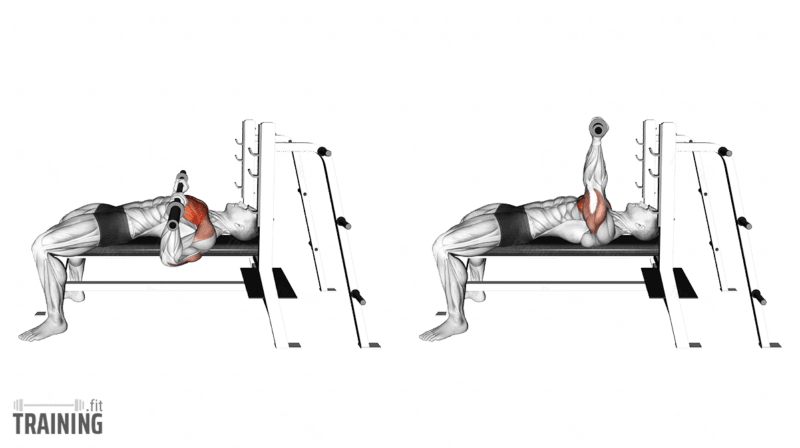
Main muscles
- Chest: Large pectoral muscle
(Musculus pectoralis major) - Chest: Small pectoral muscle
(Musculus pectoralis minor) - Shoulder: Anterior deltoid muscle
(Musculus deltoideus, Pars clavicularis) - Triceps: Three-headed arm muscle
(Musculus triceps brachii)
Training plans
Bench Press Grip Technique is a suitable substitute for similar exercises in Chest training or as a supplement to various training plans.
Bench Press Grip Technique: Basics and alternatives
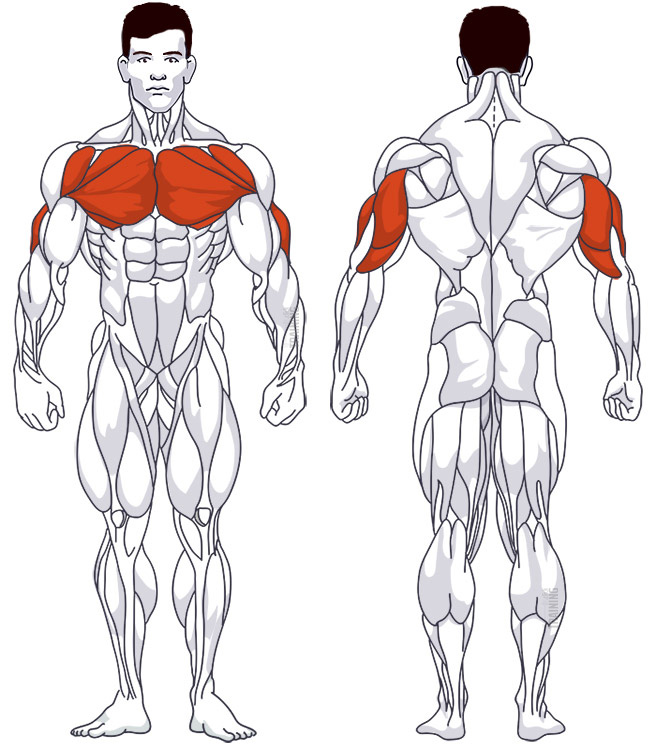
Involved main muscle groups:
Bench Press Grip Technique
A secure bench-press grip starts with a few simple habits: space your hands evenly, rest the bar in your palms and wrap your thumbs around it. Your chest, front shoulders and triceps do the pressing; your hands control the bar as you lower it to your chest and press it back up.
You’ll find the complete movement, lying position and spotting in the bench-press guide. With dumbbell bench presses, you can move your hands independently. Smith-machine bench presses guide the bar along a fixed path, but you’ll still need a secure grip and correctly adjusted safety stops.
Correct execution
Practice in a suitable rack with an unloaded bar you can handle, or use a lighter training bar. Set the safety supports and arrange a spotter if needed before lifting the bar out. Lie with your eyes roughly beneath the racked bar, your feet supported and your shoulder blades resting firmly against the bench.
Start with an overhand grip slightly wider than shoulder width. The markings on the bar help you place your hands evenly. Wrap your thumbs around the bar and let it rest toward the base of your palms. This keeps it from rolling toward your fingers and pulling your wrists backward. A small, natural bend in the wrists is fine; avoid letting them fold back under the weight.
Do a few light reps to check your grip. Seen from the foot of the bench, your wrists should be roughly above your elbows at the bottom of the press. If your forearms slope sharply inward or outward, rack the bar and adjust your hand spacing. Your arm length and chest position affect the width you need, so it’s normal if your grip doesn’t match someone else’s. Keep your hands in place during each rep, and keep a firm grip until the bar is secure in both hooks.
Video tutorial
Step-by-step instructions
Set the safety supports and choose a light bar you can control. Arrange a spotter if needed.
Lie on the bench with your eyes roughly beneath the racked bar. Keep your feet supported and your shoulder blades firmly against the pad.
Take an overhand grip slightly wider than shoulder width, using the markings to position your hands evenly.
Wrap your thumbs around the bar and support it toward the base of your palms.
Lift the bar out of the rack, bring it over your chest and lower it slowly. Keep the bar over your forearms without letting your wrists bend back excessively.
Press the bar back up without shifting your hands. If you need to adjust your grip, rack the bar first.
At the end, place the bar securely in both hooks before letting go.
Common mistakes
Copying someone else’s exact finger position relative to the markings can leave your hands too close together or too far apart. Use the markings to keep your grip even, then check your own forearm position with a light weight.
Holding the bar too close to your fingers lets it roll and pull your wrists backward, so place it lower in your palms before you lift it out of the rack. If your wrists feel awkward, don’t switch to a thumbless grip; keep your thumbs around the bar and adjust your grip width or the weight instead. Always rack the bar before you move your hands.
What the science says
Most research on bench press grip focuses on the distance between the hands. These studies measured how much weight people could lift and how active their muscles were in single sessions, not how grip width affects muscle growth over time. None of them tested thumb position or where the bar sits in your palm.
In one study, 14 men experienced in the bench press tested their 1-rep max with a narrow, medium and wide grip. They lifted 103.7 kg with the narrow grip at about shoulder width and 108.9–109.8 kg with the others. At the hardest point, they pushed the bar outward with the wide grip, inward with the narrow grip and hardly sideways with the medium grip. The medium and narrow grips made part of the triceps more active than the wide grip.[1]
In 28 men, 15 of them trained and 13 novices, a narrow grip at armpit width reduced their 6-rep maximum by about 7–8% compared with the medium and wide grips, in both groups. Wider grips increased biceps activity, and the wide grip reduced triceps activity compared with the other 2. All 3 grip widths produced similar chest activity.[2]
Among 12 national- and international-level bench press athletes, chest activity didn’t differ significantly between a shoulder-width, a medium and a wide competition grip. Biceps activity was 26–31% lower with the shoulder-width grip. The medium and wide grips allowed the athletes to lift 6–11% more.[3]
Across the studies, changing grip width had little effect on chest activity, but the narrowest grip consistently reduced the amount lifted.
Sources
- A Biomechanical Analysis of Wide, Medium, and Narrow Grip Width Effects on Kinematics, Horizontal Kinetics, and Muscle Activity on the Sticking Region in Recreationally Trained Males During 1-RM Bench Pressing. Larsen S, Gomo O, van den Tillaar R. Frontiers in Sports and Active Living. 2021;2:637066. doi: 10.3389/fspor.2020.637066.
- The Effect of Grip Width on Muscle Strength and Electromyographic Activity in Bench Press among Novice- and Resistance-Trained Men. Saeterbakken AH, Stien N, Pedersen H, Solstad TEJ, Cumming KT, Andersen V. International Journal of Environmental Research and Public Health. 2021;18(12):6444. doi: 10.3390/ijerph18126444.
- The Effects of Bench Press Variations in Competitive Athletes on Muscle Activity and Performance. Saeterbakken AH, Mo DA, Scott S, Andersen V. Journal of Human Kinetics. 2017;57(1):61–71. doi: 10.1515/hukin-2017-0047.