Resistance Band Push-Up
Compound exercise, Body weightThis article is verified by 2 studies/publications.
Overview
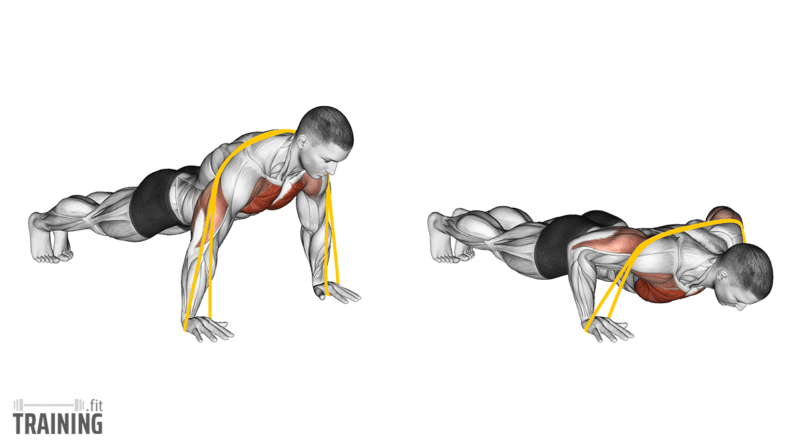
Main muscles
- Chest: Large pectoral muscle
(Musculus pectoralis major) - Shoulder: Anterior deltoid muscle
(Musculus deltoideus, Pars clavicularis) - Triceps: Three-headed arm muscle
(Musculus triceps brachii)
Training plans
Here you can find example plans for resistance band push-up training:
Resistance Band Push-Up: Basics and alternatives
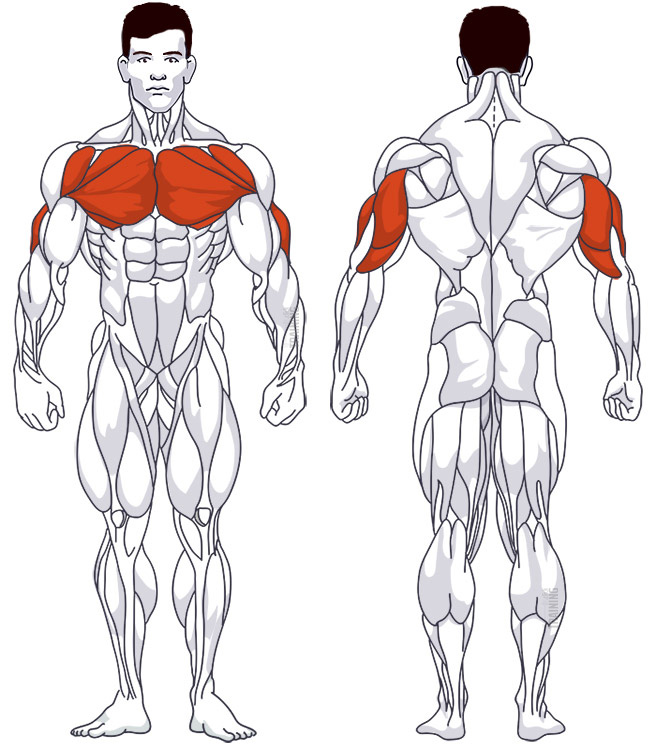
Involved main muscle groups:
Resistance Band Push-Up
Add a band to classic push-ups for extra resistance. Lay it across your upper back and secure its ends beneath your hands. As you press away from the floor, it stretches, adding resistance for your chest, shoulders and triceps.
Band chest presses use the band for a pressing movement with a different body position. In this version, you keep the familiar floor push-up and add only the band. Choose it once you can already do controlled push-ups with your own body weight.
Correct execution
Spread the band flat across your upper back, around your shoulder blades and clearly below your neck. Take the same length in each hand and hold the ends firmly against the floor under your palms. The band should stay put across your shoulder blades as you bend and straighten your arms.
Start with a light band and test a full rep. The top can feel harder, since the band is stretched most there. You should still be able to press up to straight arms, with your hips rising along with your chest, and control the full return. Stop and reposition the band if it starts to slip.
Before you step your feet back, check that the band lies flat under your palms, since a thick fold can tilt your hand. Keep enough band under each hand that it won’t pull free when your arms straighten, but don’t wrap it tightly around your wrists.
Keep your head in line with your back as you lower, looking at the floor just ahead of your hands, so your chin doesn’t reach the floor well before your chest. Let your elbows travel back at a comfortable angle rather than straight out to the sides, and keep your chest parallel to the floor instead of turning toward your stronger side. Breathe in on the way down and out as you press up. Your shoulder blades can move with each rep, so there’s no need to squeeze them rigidly together against the band.
Video tutorial
Step-by-step instructions
Place the band across your upper back at shoulder-blade height.
Hold one end in each hand.
Kneel down, plant your hands around shoulder-width apart and secure the band ends beneath your palms.
Step your feet back into a straight-body push-up position.
Bend your elbows and lower your chest while keeping the band flat across your upper back.
Press the floor away, lifting your torso and hips together against the band resistance.
After the set, lower your knees and release the band with control before standing up.
Common mistakes
A band that’s too short or stiff can prevent a complete press. If you have to raise your hips first to finish pressing up, use a lighter band.
Don’t let the band bunch around your neck or slip from under a hand. Keep your palms securely planted and check that the floor provides enough grip. Keep your head, trunk and legs aligned as you would in an ordinary push-up.
What the science says
The same research group conducted 2 studies on push-ups with added elastic-band resistance, and both compared them with the bench press.
In the first, 30 university students with advanced strength training experience did bench presses and band push-ups with a load they could manage 6 times. Muscle activity didn’t differ significantly between them. The students were then randomly split into groups that trained for 5 weeks with the bench press, band push-ups or not at all. Both training groups improved their 1-rep and 6-rep max by similar amounts, while the group that didn’t train stayed the same.[1]
In the second study, 29 fit young male university students did 3 reps each of several pushing exercises. Push-ups with added elastic resistance produced about the same activity in the chest, front shoulders and triceps as the bench press with heavy loads, while producing greater abdominal muscle activity.[2]
In both studies, demanding band push-ups performed comparably to the bench press. Neither study measured muscle size, and the training comparison covered only 5 weeks.
Sources
- Bench Press and Push-up at Comparable Levels of Muscle Activity Results in Similar Strength Gains. Calatayud J, Borreani S, Colado JC, Martin F, Tella V, Andersen LL. Journal of Strength and Conditioning Research. 2015;29(1):246–253. doi: 10.1519/jsc.0000000000000589.
- Muscle Activity Levels in Upper-Body Push Exercises With Different Loads and Stability Conditions. Calatayud J, Borreani S, Colado JC, Martin F, Rogers ME. The Physician and Sportsmedicine. 2014;42(4):106–119. doi: 10.3810/psm.2014.11.2097.