Dumbbell Bridge Bench Press
Compound exercise, Free weightsThis article is verified by 3 studies/publications.
Overview
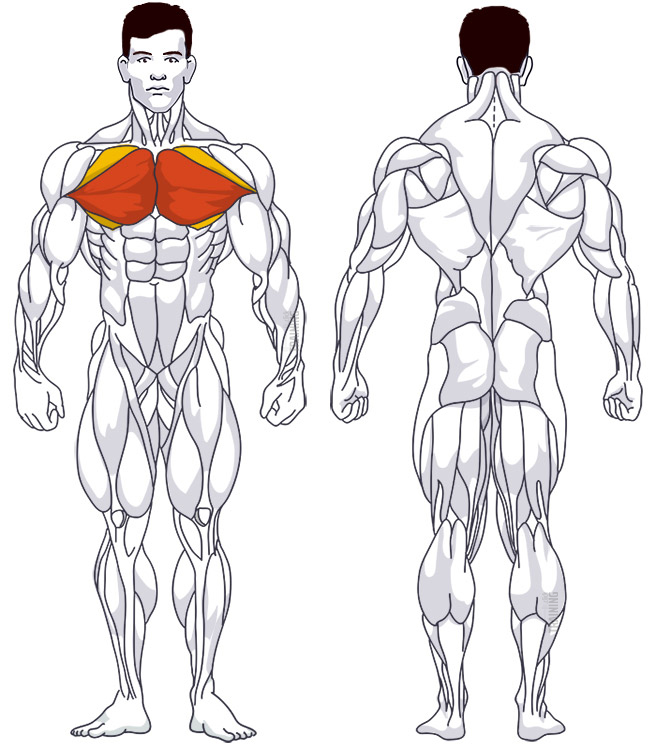
Main muscles
- Chest: Large pectoral muscle
(Musculus pectoralis major) - Chest: Small pectoral muscle
(Musculus pectoralis minor)
Training plans
Here you can find example plans for dumbbell bridge bench press training:
Dumbbell Bridge Bench Press: Basics and alternatives
Involved main muscle groups:
Dumbbell Bridge Bench Press
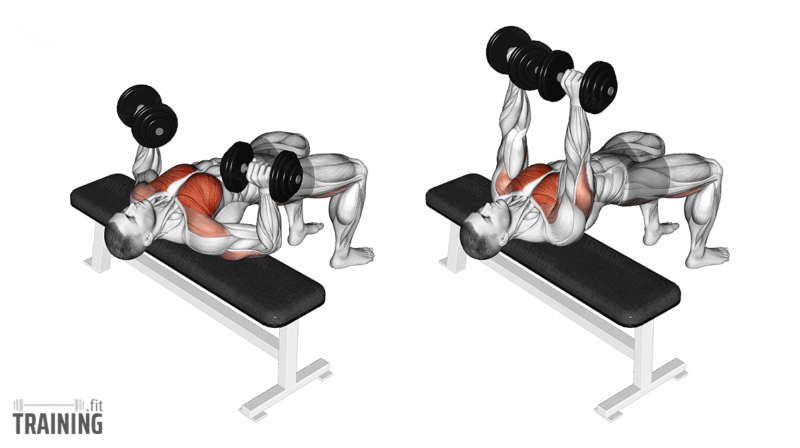
The dumbbell bridge bench press combines the classic chest press with a hip bridge. Rest your upper back across a bench and keep your feet planted and hips lifted. Your chest, shoulders and triceps press the weights while your butt and hamstrings hold the bridge.
Dumbbell bench presses support more of your body on the bench. In the bridge variation, you keep your hips at a steady height while you press with your arms.
Correct execution
Your hips stay up in the bridge the whole time you press. Practicing the hip position without weights first helps you see whether you can keep that support steady during the set.
Use a stable bench that won’t slide as you lean against it. Rest your upper back on the pad, not your neck, and place your feet so you can hold your hips at about shoulder height without overarching your back.
Use light weights while learning to combine the positions. Hold the dumbbells over your chest and lower them with your wrists over your elbows. Your hips shouldn’t rise and fall with each press. If you can no longer hold the bridge, end the set and lower the weights before changing your body position.
Set your feet so they stay flat on the floor while your upper back rests on the pad, and keep your knees in line with your feet as you start pressing. Once your feet are set, leave them in place for the whole repetition.
Keep the dumbbells over your elbows on the way down, so neither drifts toward your face or behind the bench. There’s no need to knock them together at the top. Breathe out as you press and keep your hips steady. If you need to move your feet or upper back, lower the dumbbells beside your chest first; don’t shuffle along the bench with the dumbbells held above your chest.
Video tutorial
Step-by-step instructions
Sit on the floor in front of a stable bench with light dumbbells resting securely on your thighs.
Lean your upper back across the pad and plant both feet on the floor.
Lift your hips into a controlled bridge and guide the dumbbells into a pressing position over your chest.
Lower the dumbbells beside your chest while keeping your hips at the same height.
Press both weights upward, extending your elbows without letting your upper body twist.
After the final repetition, bring the dumbbells down with control, then lower your hips and set the weights aside.
Common mistakes
Letting your hips sag changes how you’re supported during the press. If you can’t keep the bridge steady, end the set sooner or use lighter weights. And make sure it’s your hips holding the bridge, not an exaggerated arch in your lower back.
Don’t rest your neck on the bench edge or let the bench slide away. Check that your upper back rests securely on a fixed bench before taking the weights. At the end of the set, lower the dumbbells beside your chest before lowering your hips.
What the science says
There doesn’t seem to be a study on this exact exercise. The closest research compares chest presses on a flat bench with presses that use an exercise ball (Swiss ball) as the support. A ball introduces instability that a fixed bench doesn’t, so the results apply only partly to the bridge press.
In a study, 16 healthy men in their mid-20s did a dumbbell chest press at 80% of their 1-rep max on a bench and on a Swiss ball. On the bench, that’s the regular dumbbell bench press. They repeated the comparison with a dumbbell shoulder press. In either exercise, activity in the front shoulders, chest and six-pack muscle didn’t differ significantly between the 2 surfaces.[1]
A second study compared the barbell chest press 1-rep max of 13 people on a flat bench and on an exercise ball. They lifted about the same maximum weight on both, and there was no difference in the activity of 5 upper-body muscles and 1 trunk muscle, or in how far their elbows bent.[2]
Other researchers found a different pattern. When 14 resistance-trained people did separate lowering and lifting reps at 60% of their maximum force, their shoulder (deltoid) and abdominal muscles were more active on the Swiss ball than on the bench. The authors link the extra shoulder activity to the greater instability.[3]
The studies therefore disagree about whether a ball changes muscle activity during the press. All of them measured single sessions, not strength or muscle gains over time.
Sources
- Muscle Activation When Performing the Chest Press and Shoulder Press on a Stable Bench vs. a Swiss Ball. Uribe BP, Coburn JW, Brown LE, Judelson DA, Khamoui AV, Nguyen D. Journal of Strength and Conditioning Research. 2010;24(4):1028–1033. doi: 10.1519/jsc.0b013e3181ca4fb8.
- No Difference in 1RM Strength and Muscle Activation During the Barbell Chest Press on a Stable and Unstable Surface. Goodman CA, Pearce AJ, Nicholes CJ, Gatt BM, Fairweather IH. Journal of Strength and Conditioning Research. 2008;22(1):88–94. doi: 10.1519/jsc.0b013e31815ef6b3.
- Increased Deltoid and Abdominal Muscle Activity During Swiss Ball Bench Press. Marshall PW, Murphy BA. Journal of Strength and Conditioning Research. 2006;20(4):745–750. doi: 10.1519/r-18085.1.